

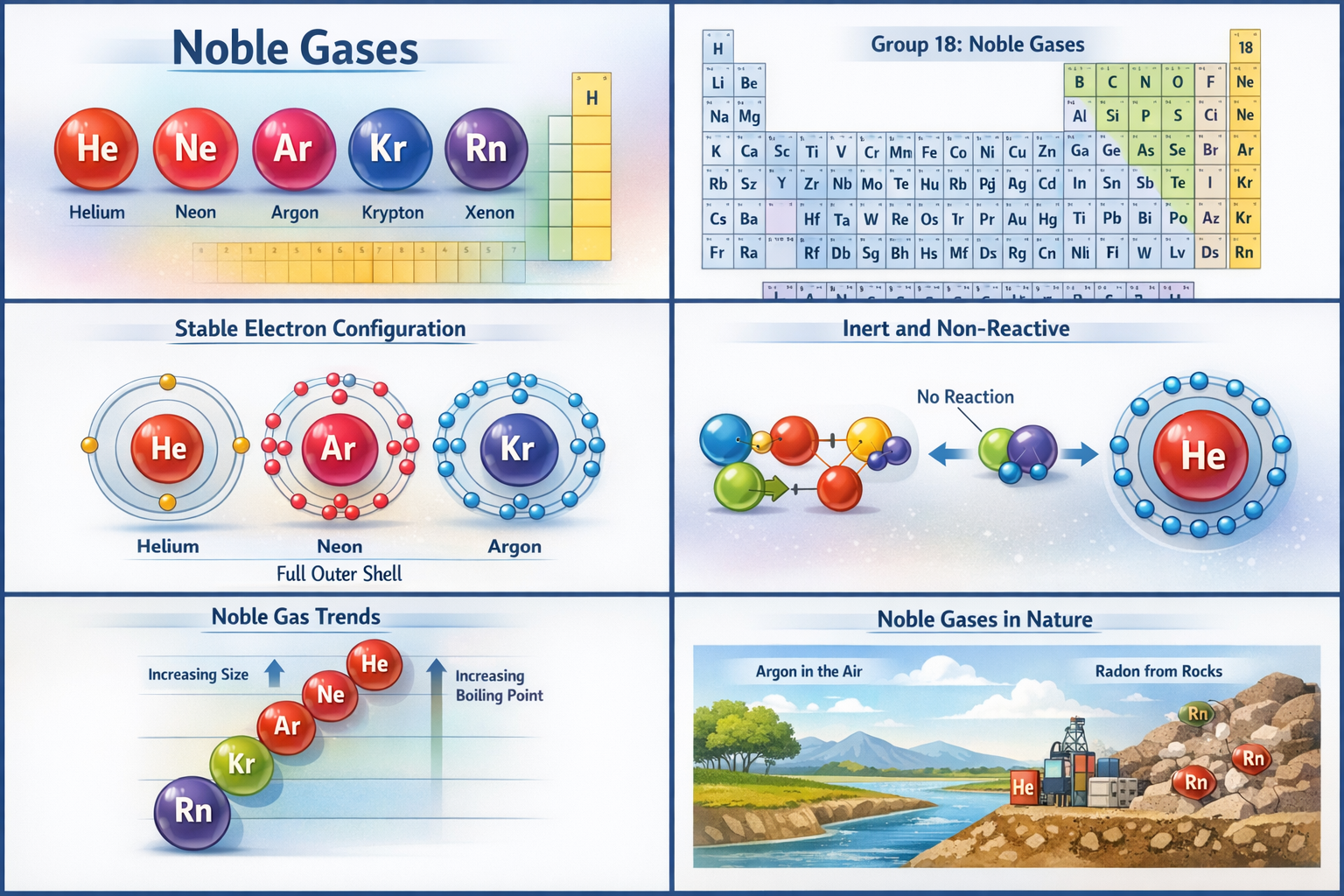
The air we breathe is made up of many different gases. Some of these gases are very active. Others are calm and do not react.
Noble gases are calm and do not react with other chemicals. Because of their peaceful nature, they are very helpful in scientific research and everyday life.
Noble gases are in group 18 of the periodic table. Noble gases are:
Noble gases are only found in small amounts in the air and inside the Earth. When we say 'noble' we are referring to their chemistry. Noble gases do not form compounds with other gases.
Noble gases are located in the last column (group 18). The periodic table is organized in order of increasing atomic number down the table (periods). Each group (column) contains elements with similar characteristics.
Noble gases have important features for being placed at the end of a period. They have:
Noble gases have unique characteristics. This is important to teachers and chemists because they can expect elements to behave in a certain way. Knowing the position of the noble gases helps students understand why they are stable compared to other elements like sodium or chlorine that are very reactive.
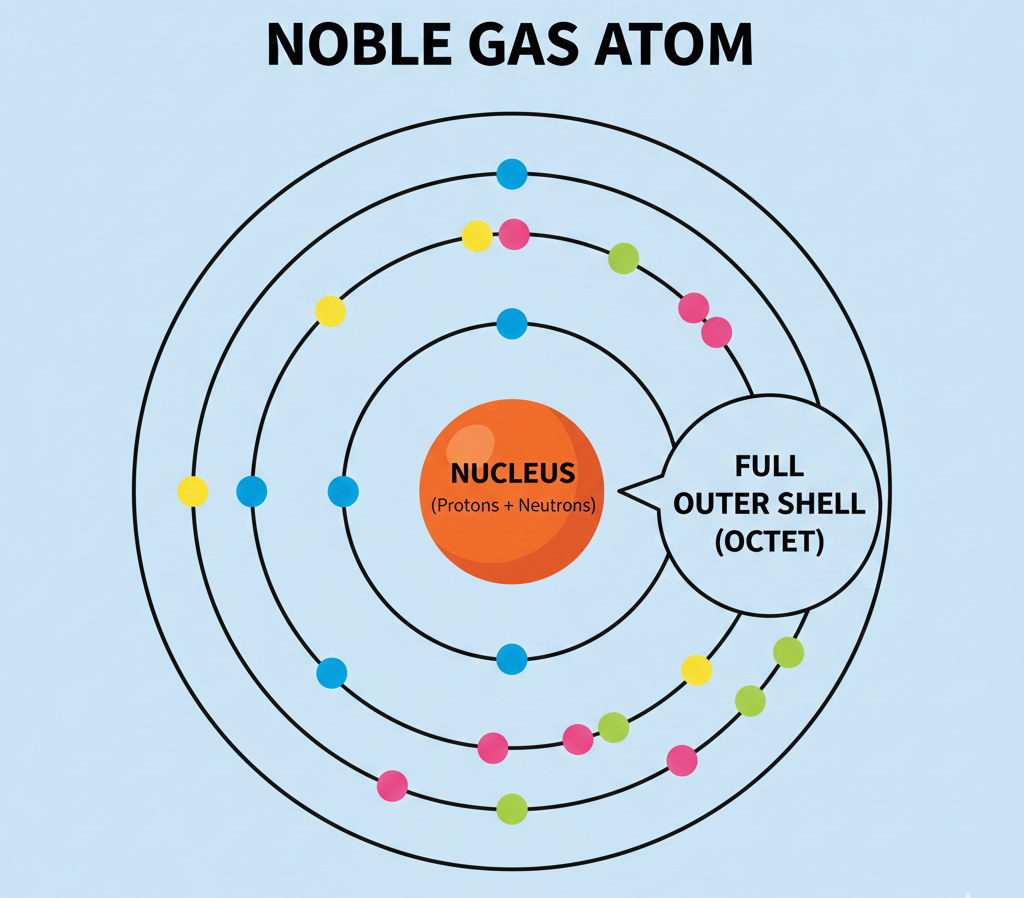
To understand the unreactivity of the noble gases we must understand their electron configuration. Surrounding the nucleus of the atom are shells of electrons. The outer shell is the valence shell. This shell is the most important for determining chemical reactivity.
Noble gases have:
Atoms usually gain, lose or share electrons to achieve a stable configuration of a full outer shell. This is known as the octet rule. Noble gases don't need to do this as they already have a complete shell and thus don't form any bonds. This is why they are known as inert or unreactive.
Noble gases have a number of physical characteristics that are identical to one another. These characteristics are the same as the types of characteristics that scientists use to help identify the element and use it in a particular way.
Here is a list of a few of the more key physical characteristics of a noble gas:
Noble gases are monoatomic and as a result the molecules have a very weak intermolecular force. As a result, the noble gases can easily be compressed. Because the boiling point is low, noble gases are present in the form of a gas at low temperatures.
Another key feature is low density, especially for helium and neon. That is why helium is used in balloons and airships — because it is lighter than air and is capable of lifting things.
Noble gases were previously thought to be completely nonreactive. That is why they were called inert gases. Now, however, it is known that some of the heavier noble gases can be made to form compounds, though this happens under very specific conditions.
Some important things to note about their reactivity include the following:
Noble gases can still be viewed as the most nonreactive elements in the periodic table despite a handful of their compounds that have been discovered. Their limited reactivity enables scientists to study the stability and bonding, or lack of, in atoms.
What we see as we move down Group 18 of the periodic table is that some properties change in a fairly predictable pattern. These changes are referred to as trends.
The important trends include:
The reason for these trends is the following:
These trends help students understand the atomic structure and how they affect the physical and chemical behaviors.
Noble gases are found in nature, but in small quantities. They are found in the atmosphere and in rocks sometimes.
Argon is the most abundant noble gas in the atmosphere, making up almost 1% of the air. Radon is also radioactive and poses a danger to health when it accumulates indoors. Therefore, in some areas, it is important to ventilate the affected zone.

Noble gases are not easy to react. But that makes them useful, and safe to use in many situations.
| Noble Gas | Common Uses |
|---|---|
| Helium (He) | Filling balloons and airships; deep-sea diving mixtures; cooling systems for scientific instruments |
| Neon (Ne) | Advertising signs and decorative lights — produces a bright red-orange glow when electricity is passed through |
| Argon (Ar) | Light bulbs to protect the filament; welding; double-glazed windows for insulation |
| Krypton & Xenon | High-intensity lamps, flash photography, some lasers, and medical imaging |
| Radon (Rn) | Studied in geology and medicine (monitored in homes due to health risks) |
Many technologies combine the chemical properties of noble gases in useful ways.
Safety comes first. Even if most noble gases are safe, some still pose a risk.
Safety points to remember:
Because accidents may happen and safety is the first priority, noble gases are used with safety precautions in laboratories and industries.
Noble gases are essential in studying chemistry. Noble gases help comprehend atomic structure and chemical bonding. Noble gases have a fully filled outermost shell of electrons, thus providing an explanation of electron configuration and atom reactions.
Their significance includes:
Noble gases depict that not every element reacts the same. Chemistry greatly relies on this notion and assists in defining the behavior of matter around the world.
Noble gases might seem quiet and lifeless, but they are very important and useful in science and technology. Their calm disposition is useful for protecting materials and illuminating cities. They also help explain one of the most important concepts in chemistry — the relationship between the electron framework and the chemical behavior.