

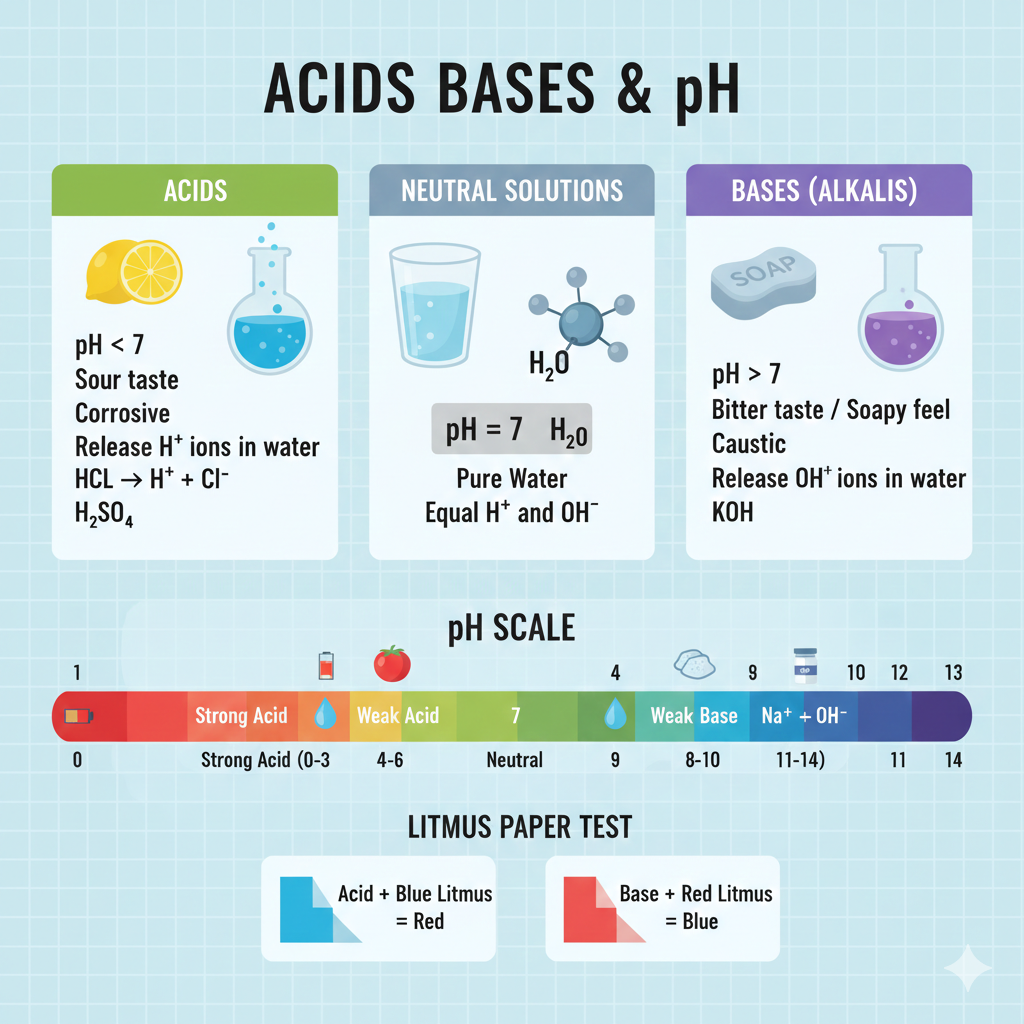
Have you ever thought about why water feels neutral? It doesn't feel sour or bitter; it feels neutral, and so does water in a swimming pool. The reason is that water and swimming pool water are neutral solutions. Neutral solutions are solutions that do not feel or taste acidic or basic.
Neutral solutions are things we encounter every day, from our chemistry labs, our bodies, to the everyday water that we drink. It is understanding neutral solutions that keeps our reactions safe, our bodies healthy, and the liquids we drink every day just right.
Neutral solutions are a central idea in chemistry, and the specific concept that ensures and maintains equilibrium and balance in liquids.
Many everyday activities, biological processes, and chemical reactions rely on neutral solutions. That is why understanding neutral solutions is important.
Neutral solutions are solutions that are not acidic or basic, meaning that there is an equal concentration of both hydrogen ions, H⁺, and hydroxide ions, OH⁻.
(H⁺) Ions are what make a solution acidic.
While (OH−) ions are responsible for making a solution basic.
An equation that represents a neutral solution:
[Hᶧ] = [OH−]
At 25°C, a neutral solution has a pH of:
pH = 7.
Pure water = neutral because:
[Hᶧ] = 1 × 10⁻⁷mol/L and [OH−] = 1 × 10⁻⁷mol/L.
Other neutral solutions include slightly diluted salt solutions, like water mixed with NaCl.
It is important because neutral solutions can be used anywhere, including human, animal, and plant consumption.
Drinking water should be neutral to avoid harming the body.
Many chemical experiments require neutral solutions to prevent unwanted reactions.
To fully understand neutral solutions, we need to understand acids and bases first.
A way to define the strength of an acid or a base is to use the pH scale, which goes from 0 to 14.
A solution with a pH level of below 7 is acidic, and one with a pH level of above 7 is basic.
The pH scale is a simple method for gauging the acidity or basicity of a solution. It operates on a scale of 0 to 14, with values less than 7 indicating acidic solutions, values greater than 7 indicating basic solutions, and a value of exactly 7 indicating a neutral solution.
We can define pH in relation to hydrogen ions: pH = - log[H+].
[H+] represents the concentration of Hydrogen ions in mols per liter (mol/L).
The minus sign helps the expression indicate that as the concentration of H+ increases (more Acidic solution), pH becomes lower. Conversely, as the concentration of H+ decreases (basic solution).
[H+]=1×10⁻⁷ mol/L
Then pH = −log(1×10⁻⁷) =7
At room temperature (25 degrees Celsius), a neutral solution will always have a pH of 7.
If the pH goes up or down, it indicates the solution is not neutral anymore.
Indicators help us determine if a solution is Acidic, Basic, or Neutral.
Some indicators include:
Indicators undergo chemical reactions with H+ or OH- to change colour.
Phenolphthalein and other chemical indicators are used in swimming pools to neutralize the water and keep it safe.
Neutral solutions can form by two main pathways.
Some salts, like NaCl, do not affect the H+ or OH- concentrations. Because of this, the solutions stay neutral.
This is the case when an acid reacts with a base to form a salt and water.
HCl (acid) + NaOH (base) → NaCl + H₂O
The resulting solution is neutral if there is an equal concentration of the acid and base.
Key concept: Neutral solutions result from a reaction where the H+ from the acids is equal to the OH- from the bases.
Neutral solutions depend on the balance of ions in water. Water can self-ionize, losing and gaining H+ and OH- ions.
H2O ⇌ H+ + OH-
At 25, the concentration of each is 1×10⁻⁷ mol/L. When H+ or OH- increases, the solution is not neutral.
Neutral solutions prevent damaging, unwanted cellular chemical reactions. Body fluids like blood are neutral and depend on the balance of ions.
When temperature increases, there will be a slight affect to the pH balance of a liquid, because the H+ and OH- ions will increase.
salts can be dissolved in water and can react with the water to create either an acidic, neutral, or even a basic solution.
When there is a high concentration of an acid or base, the pH balance will shift from 7.
When water is mixed with dissolved CO₂, it can create a small acidic solution.
CO₂ + H₂O ⇌ H₂CO₃ (carbonic acid) → H⁺ + HCO₃⁻
Neutral solutions play a major role in all of the following examples.
neutral solutions help in water, cooking, and cleaning (some neutral soaps).
neutral solutions help in pharmaceuticals, chemical manufacturing, and food processing.
Body fluids like blood, cytoplasm, and lymph need to stay neutral.
Neutral soil helps plants survive because the roots can not stand extreme pH.