

On this page:
Introduction What Are Metals? What Are Non-Metals? Physical Properties of Metals Physical Properties of Non-Metals Chemical Properties of Metals Chemical Properties of Non-Metals Reactivity Series Corrosion and Rusting Alloys Metals, Non-Metals & Bonding Uses in Daily Life Why Study This in MYP?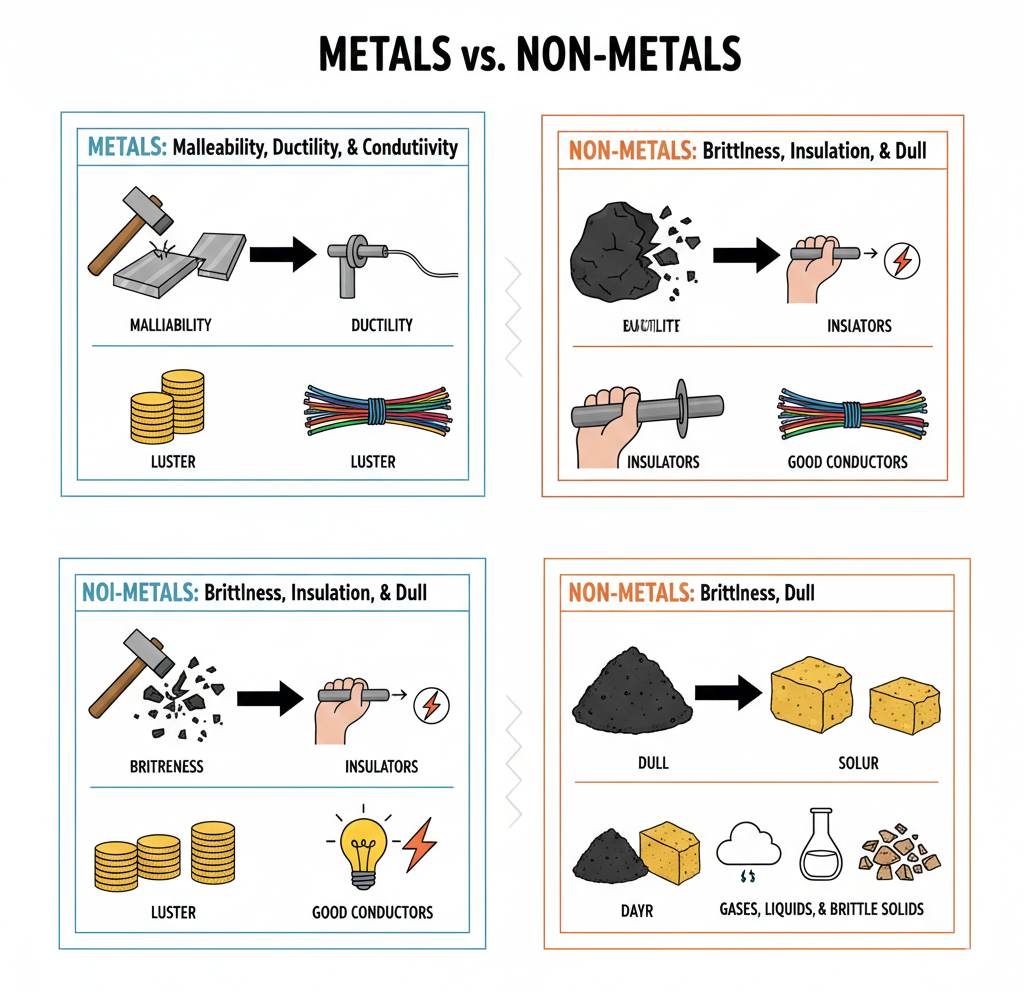
Stop and think for a moment. The chair you are sitting on, the wires in your room, the water you drink, and the air you breathe. All of them have to do with elements.
In Chemistry, elements are divided into metals and non-metals. This assists in understanding how and why certain materials are used for specific functions, why certain materials can conduct electricity while others cannot.
This basic classification is the building block of MYP Chemistry and the understanding of material science and chemical space.
Metals are elements that do not have a complete set of electrons in their outer shell. This means that metals will always lose electrons when they react with other substances. The loss of an electron will lead to the formation of a positive charge. This explains a number of their chemical and physical properties.
Because of the above characteristics, metals are commonly used in our daily lives. For instance, electrical wires use copper because it is conductive, construction uses iron because it is strong, and aluminium is used in aircraft construction because it is strong and light.
Elements that are incapable of losing electrons when they react chemically are located at the right end of the periodic table and are called non-metals. They can be of many different physical states.
Life would not be possible without non-metals. Respiration would not be possible without oxygen, all organic compounds would not be possible without carbon, and proteins would not be possible without nitrogen. Phosphorus is also needed in the cells of all living things.
In industrial and domestic uses, several physical properties of metals are applicable. The ability of metals to transfer heat and electricity is due to their free-moving electrons.
These properties justify their use in cooking utensils, electrical appliances, machinery, and buildings.
In comparison to metals, non-metals possess a different and generally opposite set of properties. The absence of free-moving electrons in their structure is why non-metals are poor electrical conductors.
These properties are the reasons why non-metal compounds are used in insulation. Non-metal based materials, such as plastics and rubber, are used to prevent electric shocks.
In chemistry, metals are highly reactive due to the fact that they lose electrons with relative ease. Basic metal oxides are formed as a result of reaction with oxygen. Many metals react with water and acids, which leads to the production of hydrogen gas and metal salts.
These reactions are significant in industries, electrochemical cells, and corrosion processes.
In reactions, non-metals tend to gain or share electrons. In reactions with oxygen, they typically produce oxides of non-metals that are acidic. With other non-metals, they frequently produce covalent compounds.
The chemical properties of non-metals account for the formation of a variety of important compounds including water, carbon dioxide, and ammonia.
Metals do not all react in the same way. Some react quickly, while others are stable and react slowly or not at all. The reactivity series lists metals in order of how active they are.
Reactivity is one of the factors that determines the method of extraction of metals from their ores. This principle is applied in the extraction of metals, prevention of corrosion, and forecasting of chemical reactions.
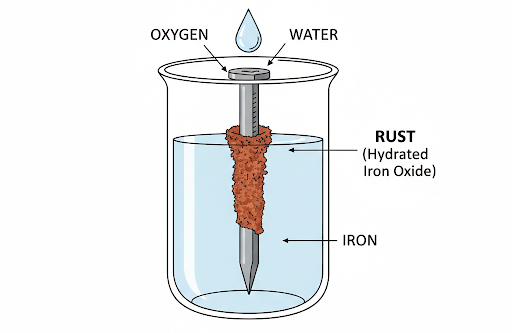
Rusting is a type of corrosion, specific to metals like iron, which reacts with moisture to form iron oxide. Corrosion is the slow chemical destruction of metals due to reactions with environmental elements.
The study of corrosion is essential in the building of bridges, vehicles, and machinery.
Metals are found in natural compounds called ores, which need to be processed to acquire pure metals. The most suitable processing method is selected based on the reactivity of the metals.
Metal removal and separation are essential for industries, technologies, and infrastructures, but they also have negative impacts on the environment. To remove and separate metals in a sustainable way, the recycling of metals is essential to conserving the world's natural resources.
The majority of pure metals are unsuitable for use, as they are either incredibly soft and malleable or are reactive. Alloys, however, are combinations of many metals and non-metals that enhance strength, and improve hardness, as well as resistance to corrosion.
| Alloy | Components | Common Uses |
|---|---|---|
| Steel | Iron + Carbon | Construction, tools, vehicles |
| Brass | Copper + Zinc | Musical instruments, plumbing |
| Bronze | Copper + Tin | Sculptures, bearings, coins |
The use of alloys is widespread, as they are essential in construction, transportation, tools, and machinery.
The differing properties of metals and non-metals lead to a variety of chemical bonds. When metals are used in a chemical bond, they always lose electrons to form positive ions, while the non-metals will gain electrons, leading to the formation of negative ions. The result of this is known as ionic bonding, while the non-metals operate differently and will share electrons to form covalent bonds.
Understanding the concepts involved in bonding will help explain why, for instance, many salts will dissolve in water, while many non-metallic compounds exist in the form of a gas or liquid.
Metals and non-metals play a vital role in everyday life and modern technology. However, it is the specific properties of each material that determines their application.
The first step in understanding the periodic table is learning about metals and non-metals. Understanding this classification allows students to predict how different elements will react together.
This topic is the groundwork for understanding how to study various types of chemical reactions, including acids and bases, electrochemistry, materials science, and environmental chemistry.
Knowledge of the metals and non-metals classification helps students to relate chemistry with real life, innovative engineering, and green chemistry.