

On this page:
Introduction What is an Ion? Why are ions created? Classification of Ions Valence Electrons and Ion Formation Electron Transfer and ionic bonding Formation of Ionic Compounds Constructing the Chemical Formulas of Ionic Compounds Polyatomic Ions Properties of Ionic Compounds Ions in Solutions and Electrolytes Naming ionic compounds Ions and Their Function in Chemical Reactions Everyday Examples of Ions Why It is Important to Learn About Ions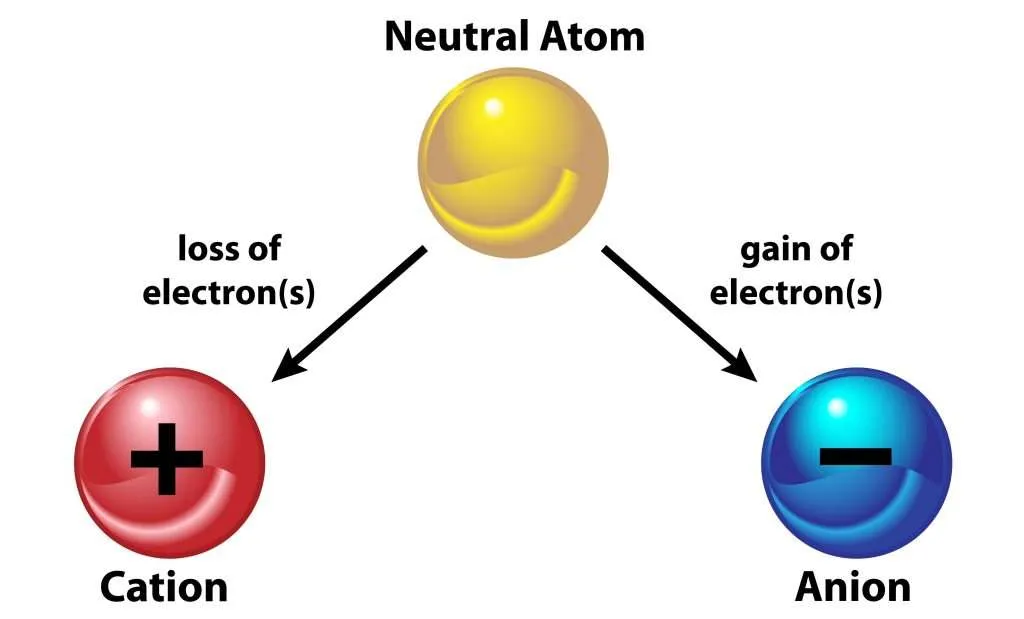
What do tasting a pinch of salt, touching a metal spoon, and turning on the light have in common? They all involve ions. Ions are tiny charged particles that help make all of these possible. Chemically, they explain why some compounds conduct electricity and why some substances dissolve in water. Knowing about ions is like knowing the secret code of the universe.
An ion is a charged atom or a collection of atoms. The charge imbalance is a result of the number of electrons being unequal to the number of protons.
Key idea in simple words:
To become chemically stable. Stability occurs when there is a complete outer shell. With a partial outer shell some atoms become reactive, while completely filled outer shell atoms become unreactive.
Atoms are trying to mimic the outer electron shell arrangement of noble gas atoms.
What makes noble gas atoms so unique is that they have a complete outer shell, and so they don't chemically react with others.
To become stable, atoms must either gain or lose electrons.
To create ions, atoms must use energy.
Ions can be classified into two categories based on charge.
Metals typically form cations. Because of the loss of electrons, there are more protons present which create a positive charge.
Everyday examples of this include:
Electrons that are gained create a state of abundance, which results in a lesser number of protons present. This is what gives a negative charge.
Everyday examples include:
Valence electrons are all electrons in the last shell of the atom. These electrons determine how the atom will respond.
Pattern:
When ions are created, electrons are transferred from one atom to another. This creates ionic bonding.
This attraction is known as the electrostatic force. This is what keeps ionic compounds together as solid crystals.
An ionic compound is created when positive ions and negative ions combine in a fixed ratio so the all the overall charge becomes zero.
Important points:
Take, for example, one Na⁺ and one Cl⁻. These two ions combine to form a neutral compound.
Another example is two Na⁺ ions combining with one O²⁻ ion.
This is the basic charge balancing rule for constructing chemical formulas.
Chemical formulas are a representation of the ratio of the different ions in an ionic compound. The objective is to have the total positive charge equal the total negative charge.
The total charge is neutral.
Basic principles:
Things to remember:
Ions that are formed from more than one atom that are bonded together are known as polyatomic ions.
Important aspects:
Examples of polyatomic ions:
During chemical reactions, polyatomic ions behave as though they are single charged ions.
A number of unique chemical and physical properties are found in ionic compounds due to the presence of strong forces of attraction that hold the individual ions together.
Typical Properties include:
These properties help identify ionic substances in the lab and in daily life.
When an ionic compound dissolves in water, it breaks into free ions. This process is called dissociation.
The solution now contains moving charged particles.
Such a solution is called an electrolyte.
Electrolytes can conduct electricity.
Everyday examples can include:
When naming ionic compounds there is a pattern. This pattern is universal to scientists anywhere around the globe.
Here are the basic ideas:
For example,
For polyatomic ions:
Ions are important in many chemical reactions, particularly in solutions.
Here are some of the important things to think about:
Because of these reasons, you can think of ions like the active agents that trigger reactions that occur in water.
Your everyday life is strongly influenced by ions.
In The Body
In industry
In technology
In water treatment
Ions are present in everyday life, strongly influencing technology, biology, and chemistry.
Ions are the basis of important advanced topics in chemistry and science. The understanding of ions explains how compounds are formed and links the atomic structure and chemical bonding.
Also, it helps to understand reactions, solutions, electricity, and connects real life and learning.
Understanding ions allows you to appreciate chemistry as more than abstract symbols. You begin to see it as a dynamic system composed of charged particles that construct the physical world around you.