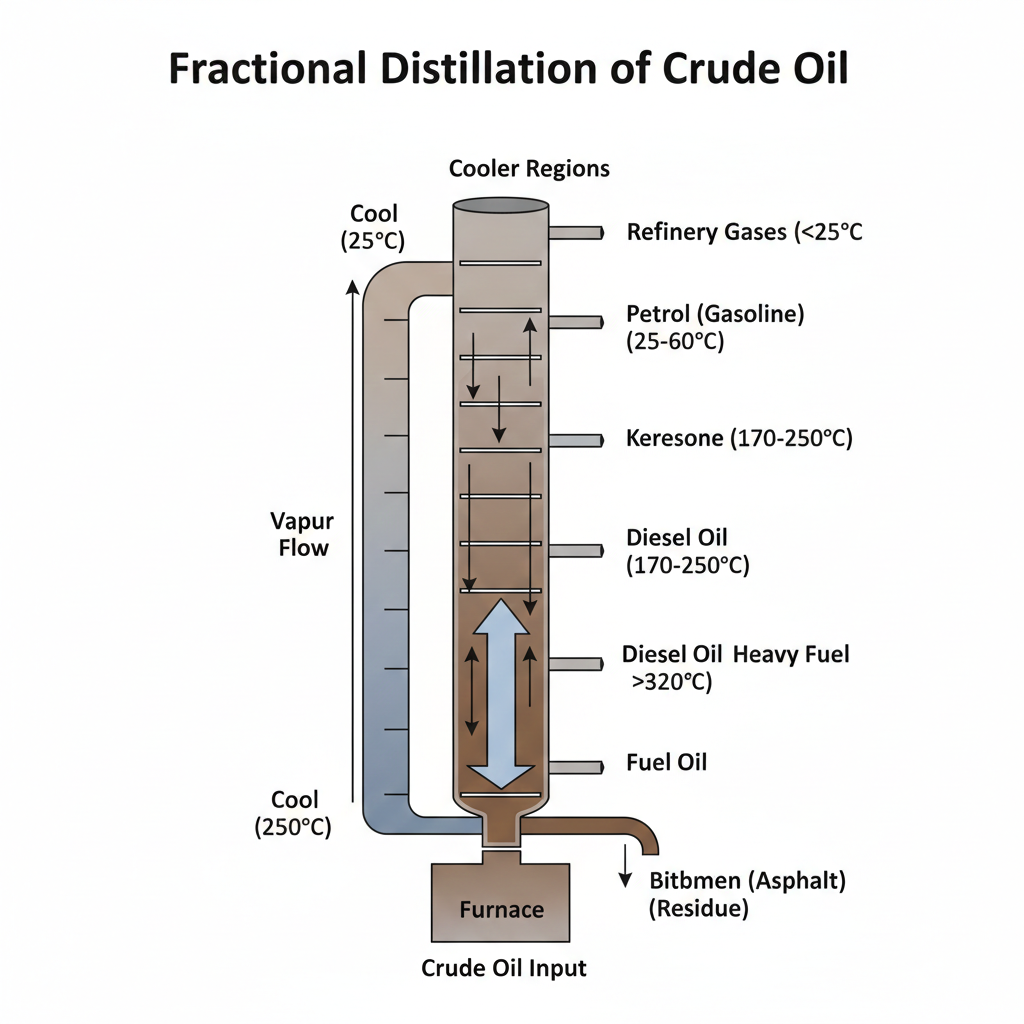
Fractional Distillation of Crude Oil
Have a look at your surroundings. The plastic bottles, the wax in the candles, and the roads that you walk on also contain the same crude oil as the fuel that powers buses. Crude oil is a thick, black liquid and a mixture of many different substances. However, we cannot use crude oil as it is. Crude oil needs to be separated into various components that can then be used in our daily activities.
In Chemistry, one of the most important parts of the process is the ability to separate a mixture. Fractional distillation is a very important process that is used to separate a mixture. It is also the most important industrial separation process. It is by this process that scientists and engineers are able to transform crude oil into various fuels, chemicals, and other substances that are essential for the different aspects of modern civilization.
What Is Crude Oil?
Crude oil is a type of fossil fuel that is made up of a mixture of hydrocarbons. It forms in the Earth over millions of years from the remains of small living organisms, which get buried under high heat and pressure. Crude oil is not a single pure substance. It is a type of mixture with many different hydrocarbons.
Hydrocarbons are chemical compounds that contain only two elements:
The hydrocarbons in crude oil are of different sizes and structures. Some hydrocarbons are small in size and have molecules that evaporate easily, while others are large in size and have thick and heavy molecules. So, crude oil must be separated into different groups based on similar hydrocarbons.
Why Do We Separate Crude Oil?
Different hydrocarbons have different properties and uses. For instance, if we burn crude oil in a car engine, the engine will get damaged. However, if we separate crude oil into different fractions, we get the fuels and materials that are useful for those specific tasks.
Separation is crucial because:
- Each fraction has a different boiling point.
- Each fraction has a different viscosity (thickness) and flammability.
- Each fraction serves a different purpose in everyday life and in industries.
The process of separation occurs in large industrial buildings known as oil refineries.
What Is Fractional Distillation?
Fractional distillation means separating a mixture of liquids into different parts (called fractions) depending on their boiling points.
This process involves:
- Heating the mixture.
- Gases with low boiling points will change to a gas faster than the other gases with higher boiling points.
- The gases are cooled and collected separately.
Because crude oil contains different types of hydrocarbons, the boiling points of different hydrocarbons are different, allowing them to be separated into fractions inside a tall structure called the fractionating column.
The Fractionating Column
The fractionating column is a tall structure found in oil refineries. The bottom is much hotter than the top, and therefore creates a temperature gradient.
- Hot gases rise from the bottom.
- As the gas rises, it encounters cooler air and will eventually cool to below the gas temperature (the boiling point). At this point, it will condense back into a liquid.
- Different fractions will condense at different heights, so.
This means the lighter fractions will be found collected at the top of the column, and the heavier fractions will be collected lower down.
Steps in Fractional Distillation of Crude Oil
There are several steps in refining crude oil that need to be done in a definite order:
- A furnace is used to heat the crude oil until the majority of it has turned into vapor.
- The vapor that is generated is directed into the bottom of a fractionating column.
- The column has several trays or plates that allow the gases to cool and condense.
- As the vapor travels upward, the gases cool and condense at different stages.
- Each separated fraction is drawn out of the column and kept in separate storage.
This process is what allows a refinery to create many of the products needed every day.
Main Fractions of Crude Oil and Their Uses
Many of the fractions made out of crude oil are separated according to the structure of the hydrocarbons in the chains that are similar to one another.
Here are some general fractions that you should be familiar with:
Refinery Gases
Top of column
Description: Very small molecules that are collected at the top of the column.
Uses: Used as cooking gas and heating fuel.
Petrol (Gasoline)
Upper part
Description: Light fractions with a low boiling point.
Uses: Used as fuel for cars and motorcycles.
Naphtha
Upper-middle
Uses: Used as a raw material to make chemicals and plastics, and is important in the petrochemical industry.
Kerosene (Paraffin)
Middle
Uses: Used as fuel for jet aircraft. It is also used in lamps and heaters in some regions.
Diesel Oil
Lower-middle
Description: Heavier than petrol.
Uses: Used in buses, trucks, and generators.
Fuel Oil
Lower part
Description: Thick and heavy.
Uses: Used for ships and power stations.
Bitumen (Residue)
Bottom
Description: Very heavy fraction at the bottom.
Uses: Used for road surfacing and roofing.
Properties of Different Fractions
The properties of each fraction depend on the size of the hydrocarbon molecules. As the molecules get larger:
- Boiling point increases.
- Viscosity increases (liquid becomes thicker).
- Flammability decreases.
- The fraction becomes less volatile (less likely to evaporate).
This means that petrol evaporates and burns more easily compared to Bitumen, which is thick and does not flow easily.
Fractional Distillation as a Physical Change
A safe process for separating crude oil is Fractional Distillation. It is a physical process, and not a chemical one. This means that no changes were made to create new chemicals. The hydrocarbons before and after the separation process remain the same. The only changes that occur are that their locations vertically change within the column of crude oil, and their physical states change as well.
In a chemical process, separation of the substances cannot occur. Physical changes, as opposed to chemical changes, allow the original substances to remain and be separated.
The boiling points of each of the hydrocarbons are what allow scientists to separate the crude oil in the column.
Use of Physical Properties: This simple process demonstrates the complex combination of crude oil and how the process of distillation can separate a mixture, all by utilizing the physical properties of each substance that comprises the mixture.
Distillation is a process we still use today, but we are looking for cleaner energy alternatives.
Non-Fossil Fuel-Based Energy Resources
Another important point to consider is the use of fossil fuels. First of all, a fossil fuel is crude oil that has taken millions and millions of years to form. It is a non-renewable resource. This means that when we use fossil fuels, we are using a resource that cannot quickly be replaced. The heavy use of crude oil has environmentally damaging effects.
Key points to remember:
- When we burn fuels, we release carbon dioxide into the atmosphere.
- Carbon dioxide is a greenhouse gas.
- Greenhouse gases are the cause of climate change and global warming.
Because of these factors, scientists have begun to search for other sources of energy, in hopes of finding something less damaging to our planet, such as:
Environment and Safety Considerations in Oil Refineries
Because of the flammability of crude oil and the crude oil fractions, oil refineries must follow strict safety guidelines.
Here are some main environmental and safety concerns.
- Fuel storage provides the possibility of leaks and fires
- Air pollution control helps us prevent the toxic effects of burning gases
- The step treatment of wastes helps us protect the water and soil from pollution
Today's technologies help us reduce harmful emissions.
This demonstrates chemistry's close connection to responsible and sustainable development.
Why is fractional distillation important to MYP Chemistry?
Fractional distillation is important to MYP Chemistry because it touches upon the following themes.
- Pure substances and mixtures
- Techniques for physical separation
- Boiling point as a physical property
- The daily use of hydrocarbons
- The impact of human activities on the environment
Once you learn the steps involved in fractional distillation, you appreciate the application of chemistry to the big industries and the impact of scientific knowledge on the world today. You also realize the extent of the use of resources and the implications of the choices made on the sustainability of the planet.