

On this page:
Introduction What Is a Salt? Acids, Bases, and Alkalis – The Reactants Neutralization - The Heart of Salt Formation Different Methods for Salt Formation Naming Salts Physical and Chemical Properties Solubility of Salts Preparation of Soluble and Insoluble Salts Uses of salts Importance of Salt Formation in Chemistry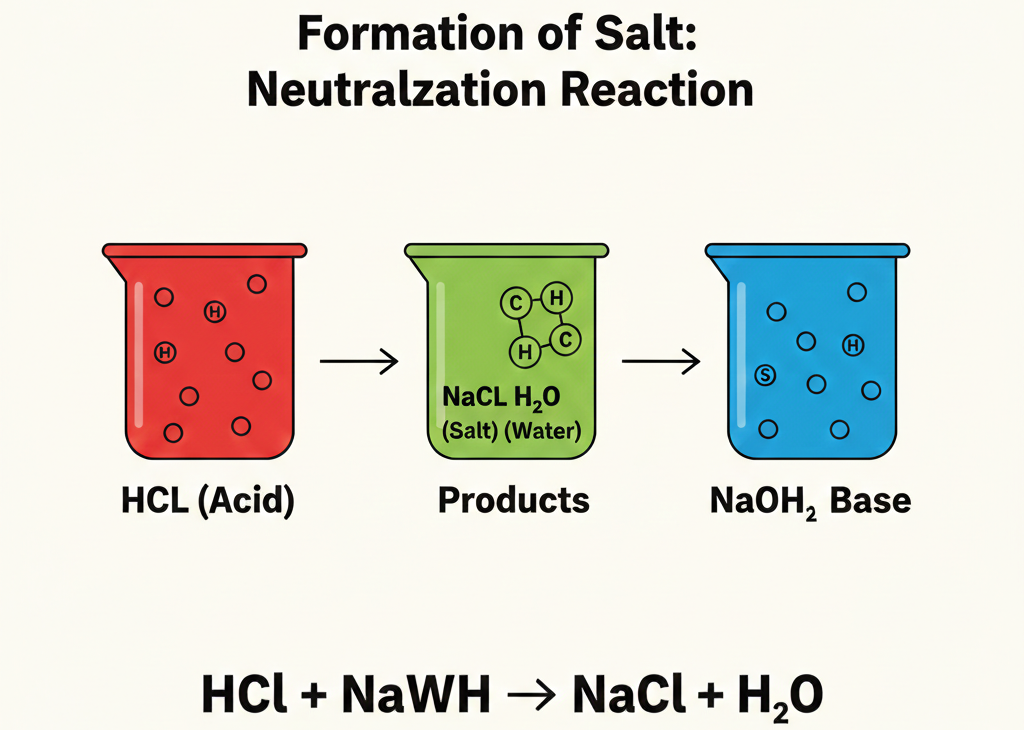
Have you ever been curious about how one simple white crystal moves from deep down in the ground, or maybe from the ocean, or even from a chemical factory, and makes its way to your home? The ordinary-looking grain of salt has a chemical history to tell.
Salts are not just things we add to our meals. Salts are a wide range of compounds in chemistry formed through chemical reactions. Knowing how salts are created helps us know about acids, bases, reactions, and the production of chemicals in labs and industries. This topic is about the real world, from fertilizers used in agriculture to the medicine and cleaning products used in our homes.
A salt in chemistry is a type of ionic compound that is formed when the hydrogen ions (H⁺) of an acid are substituted with metal ions or ammonium ions (NH₄⁺).
A salt is created when an acid reacts with a base or some other suitable material.
Salts are solid, crystalline materials formed from cations (positive ions) and anions (negative ions). Many salts can dissolve in water and generate solutions.
Example: Sodium chloride, or salt, comes from an acid (hydrochloric acid) and a base (sodium hydroxide).
To comprehend how salts are created, we need to know about the reactants.
To understand the formation of salts, we must first understand the substances that react to form them.
Acids are compounds that give off hydrogen ions (H+) when a compound is broken down in water.
Characteristics of acids include:
Examples include:
Bases are substances that can neutralize acids, and alkalis are bases that dissolve in water. Therefore, the main characteristics of bases/alkalis are the following:
Common Examples:
The most usual method of making salt is through a neutralization reaction.
Neutralization is a reaction of an acid and a base where:
Acid + Base → Salt + Water
The hydrogen ions (H⁺) from the acid react with the hydroxide ions (OH⁻) from the base to produce water (H₂O).
The other ions react with each other to form the salt.
Hydrochloric acid + Sodium hydroxide → Sodium chloride + Water
This reaction illustrates how chemically table salt can be formed even though industrial salt is usually sourced from seawater.
Salts can be formed through a variety of methods, depending on the reactants used, and each method has its own unique applications.
This is the simplest method.
Characteristics:
Sodium chloride and potassium nitrate are examples of salts.
Reaction example:
Nitric acid + Potassium hydroxide → Potassium nitrate + Water
When an acid and a metal react, they form a salt and hydrogen gas.
General word equation: Acid + Metal → Salt + Hydrogen gas
Key points:
Example: Hydrochloric acid + Zinc → Zinc chloride + Hydrogen
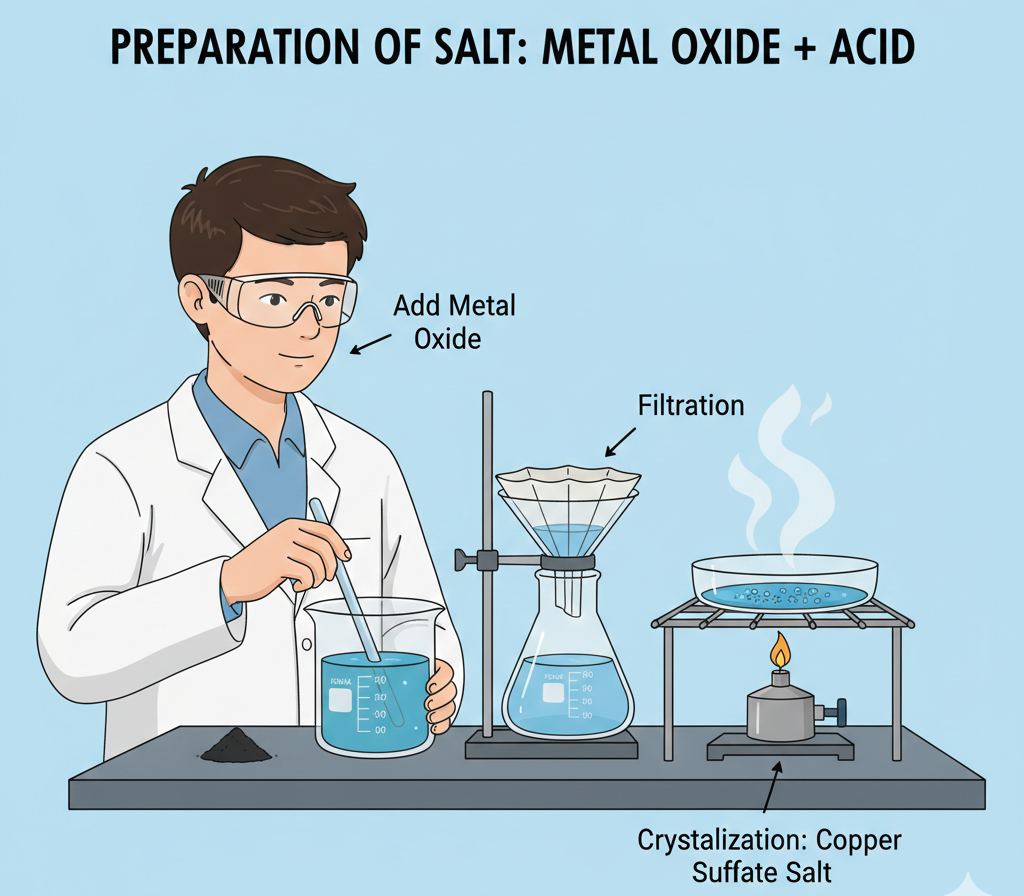
Metal hydroxides and oxides are bases and are included with the metals.
When in a reaction:
This reaction is performed when the metal is too dangerous to work with.
Example: Sulfuric acid + Copper oxide → Copper sulfate + Water
This reaction is used a lot in laboratories for preparing copper salts.
This reaction has three products:
General word equation: Acid + Carbonate → Salt + Water + Carbon dioxide
Key points:
Example:
Hydrochloric acid + Calcium carbonate → Calcium chloride + Water + Carbon dioxide
The parts of a salt name include:
Chemists have to understand acid-to-salt relationships and be familiar with this nomenclature.
Physical and chemical properties of a salt depend on the ions that make it up.
Water-insoluble salts are formed in certain conditions. Solubility is essential in the formation and uses of salts.
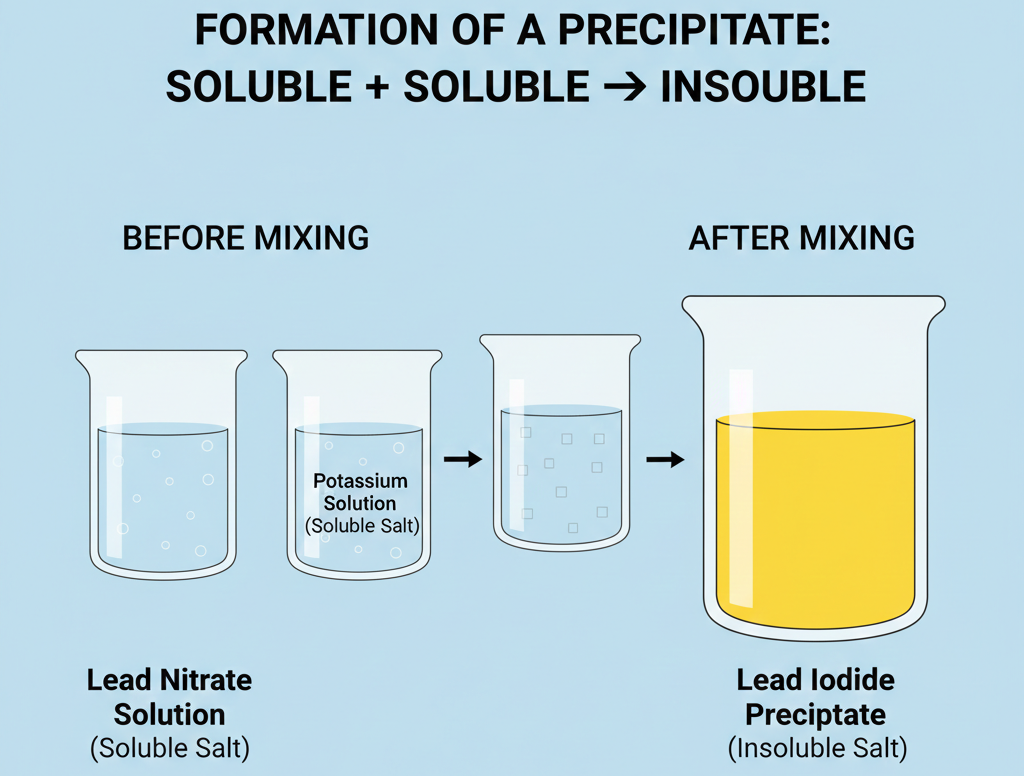
The technique used to prepare a salt depends on whether it is soluble or insoluble.
These are important techniques that are practiced in MYP Chemistry.
In our daily lives, salts are used in a wide range of applications beyond just food.
The practical application of chemistry in the real world is best understood from the formation of the above-mentioned salts.
One of the most fundamental principles in chemistry is the understanding of how salts are formed.
After understanding the process of salt formation, you can further build on your knowledge to learn about:
Salts may look ordinary; however, each salt crystal holds a fascinating story about the chemical processes of reactions, reorganization, and formation of new substances.