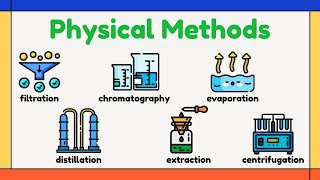
Filtration, Distillation & Chromatography Techniques
How do we get clean water from dirty water? How do we separate sugar from salt? How do we figure out the different colors in an ink pen? In chemistry, we often deal with mixtures, and in order to understand and study these substances effectively, we need to separate the different components in order to study them. Techniques such as filtration, distillation, and chromatography allow us to do so difference.
How do we separate mixtures, and why is this important?
To study pure substances, remove impurities, and prepare substances for chemical reactions.
Let's look at the main techniques.
Filtration
Separates solid from liquid
Suppose you want to separate sand from water. You cannot easily scoop out the sand. This technique is filtration, a technique that separates solid particles from a liquid by using a physical barrier, such as filter paper.
How filtration works:
- Pour the mixture into a funnel that has filter paper.
- The liquid, called the 'filtrate', will pass through the filter paper.
- The solid, called the 'residue', will remain on the paper.
Everyday Examples
- Brewing coffee - coffee grounds are filtered, but the coffee liquid passes through.
- Purification of water - coffee grounds are filtered, but the coffee liquid passes through.
Key Points
- For removal of insoluble solids in liquids
- Does not separate dissolved solids
Distillation
Separates liquids / purifies solutions
What if you want to separate two liquids or obtain pure water from a solution? For this, you would use distillation. Distillation works because of the difference in the boiling point of the liquids in the mixture.
How Distillation Works
- You heat the liquid mixture until one of the components boils.
- The vapor rises up and passes through a condenser, where it cools and returns to the liquid state.
- The liquid is collected in a different container
Types of Distillation
- Simple distillation: It is used to separate a liquid from a solid or to separate a liquid from another liquid, provided the boiling point of the two liquids is very different. For example, obtaining pure water from saltwater is done using this technique.
- Fractional distillation: It is used to separate two or more liquids that have boiling points that are very close to each other. For example, ethanol and water.
Key Points
- Useful for liquid-liquid separation
- Need difference in boiling points
- Can purify liquids
Chromatography
Identifies / separates dissolved substances
There are instances when the substances dissolved in a liquid or gas and we want to identify or separate them. In such cases, we use chromatography. It is a technique that separates substances, and it depends on the speed of the substances in relation to each other. It uses a stationary phase and a mobile phase.
Essentially, how all forms of chromatography work:
- A mixture is placed on a passive surface (stationary phase), such as paper, or a thin layer of silica.
- Some solvent, known as a mobile phase, is allowed to permeate the surface.
- Because some of the mixture components interact differently with the mobile phase and stationary phase, their movement will cause them to be separated into spots or bands.
Different Types of Chromatography
- Paper chromatography: A common technique in laboratories to separate the pigments in an ink or a plant extract.
- Thin-layer chromatography (TLC): A technique in operating faster and providing higher precision; there is, however, a thin layer of solid on the surface of the plate.
- Gas chromatography: A technique that is used to separate volatile (easily vaporized) substances. A gas is used as the mobile phase.
Key points in chromatography.
- Chromatography can separate the components of a solution.
- It can also be used to distinguish between various unknown substances.
- It involves a mobile phase and a stationary phase.
Comparison Chart Technique of Chromatography
| Technique |
Separates |
How It Works |
Example |
| Filtration |
Solid from liquid |
Solid is trapped in a filter; the liquid passes |
Sand from water |
| Distillation |
Liquid(s) / Liquid from a solution |
Based on different boiling points of the components |
Saltwater → Pure water |
| Chromatography |
Dissolved Substances |
Based on different movement through a stationary phase |
Ink pigments |
Final Notes
- Filtration can be used for insoluble substances.
- Distillation can be used to separate liquid from a solution.
- Chromatography can be used for identifying or separating small molecules in a mixture.
The Importance of Understanding Separation Techniques in Chemistry
Chemists use various separation techniques to study substances in their original / pure forms. It is important to understand which one to use to save time and increase accuracy.
For instance:
- Pharmaceutical companies use distillation and/or chromatography to purify their drugs
- Water treatment plants use filtration for removing impurities
- Scientists use chromatography to find out what certain chemicals are
Key Terms
- Mixtures: Combination of more than two substances that can be separated
- Pure substances: Substances that cannot be separated by physical means
- Solubility: Determines if it is suitable for another method rather than filtration
- Boiling point: Important for distillation
- Adsorption / mobility: Important for chromatography
Everyday Examples
- Filtration: Straining juice to remove pulp
- Distillation: Making drinking water or alcohol
- Chromatography: Food color detection or ink analysis
The techniques listed above are not only found in a chemistry laboratory but are also a part of everyday life. These techniques are a reminder of how science helps to keep and improve our quality of life.
Separation Techniques Safety
When separating substances, follow these safety protocols:
- Avoid direct contact with chemicals by wearing gloves and goggles.
- For distillation, carefully heated liquids can cause burns.
- Glassware should be handled with care to avoid breakage.
- If using a solvent, be sure to work in a place with enough air flow.
Key Vocabulary
- Filtrate: liquid that has passed through a filter.
- Residue: the solid that remains on a filter.
- Boiling Point: the temperature a liquid must reach in order to become a vapor.
- Stationary Phase: the solid phase that the substances encounter and do not move through easily.
- Mobile Phase: the liquid or gas that moves the substances through the stationary phase.
Conclusion
Separation techniques are essential in chemistry in order to identify and purify a particular substance from a mixture to make it usable and to make it pure. Mastering these techniques will help you to prepare for chemical analysis, reaction purity, and lab work. Once you understand the movement and separation of substances, you will be able to recognize the order in what seems to be a chaotic mixture.