

On this page:
Introduction What does the term 'ore' refer to? Why is metal extraction necessary? The reactivity series and extraction of metals Key Extraction Processes Extraction of Different Metals Environmental Damage from Extraction Recycling as a Solution Importance of Extraction in Chemistry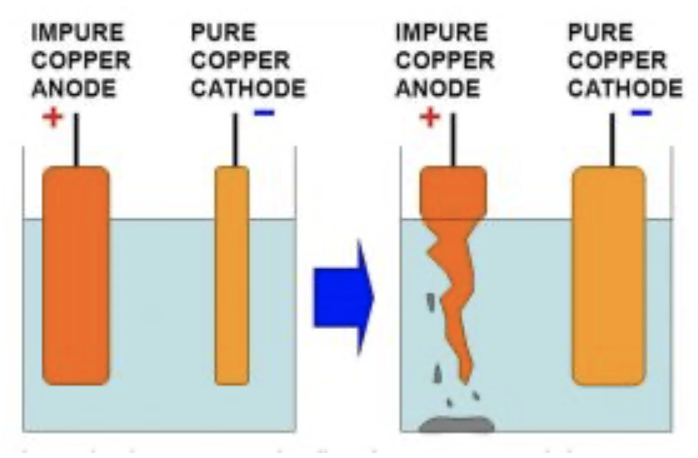
Think about everything around you. Your keys, wires, utensils, buildings, and even your phone all use some sort of metal. But did you know that metals do not exist as finished products? Metals are found in ores (rocks containing metals). In order to turn those rocks into useful metals, chemists use a procedure called extraction. This explains the careful ways that people obtain the metals from the earth.
Extraction is important because metals are needed for:
Without extraction, modern life would not exist.
An 'ore' refers to naturally occurring solid substances that contain enough valuable metal to make extraction economically worthwhile. Not every metal-containing solid is classified as an 'ore.' For solid substances to merit classification as ores, they must be:
Bauxite is an ore that contains Al, and hematite is an ore that contains Fe. Most ores contain metals in the forms of oxides, sulfides, or carbonates.
Most metals are reactive, and as a result, their occurrence in the earth's crust is in the form of stable chemical compounds with reactive metals, sulfides, or carbonates. The extraction process breaks down those stable compounds to obtain individual pure metals. The extraction process is determined mainly by:
The reactivity series of metals is a way of organizing metals in the order of decreasing reactivity. This is useful to chemists in determining the best extraction method. Very reactive metals (like potassium, sodium, and aluminium) are particularly difficult to extract from the other compounds.
Getting metals out of the ground is harder for some metals than others, and it is easier for metals like copper and silver because they don't react with other elements as easily, and they can sometimes be found already as native metals.
So, with all metals,
Extraction processes vary by metal and by ore, but in general, there are three main stages.
Before metal extraction can be done, some of the ore is concentrated so that unwanted materials like sand and rocks are removed. This allows the extraction to be done more quickly. Techniques like washing, crushing, and separating denser materials are all used.
The benefits of this step are: Less waste, Lower energy and chemical costs, Higher quality of the extracted metal.
In the second stage of metal extraction, some concentrated ores are heated with air.
For the roasting process, ores that contain sulfides are heated with air to convert the sulfides to oxides and release sulfur dioxide gas.
For the calcination process, ores that contain carbonates are heated to break the carbonates into oxides and release carbon dioxide gas.
In these processes, the compounds in the ore are prepared for the next step by converting them to metal oxides that can be more easily reduced.
When reducing a metal oxide, we are trying to recover the pure metal by removing the oxygen component from the oxide.
This can be done in two main ways:
Reduction can be done by the use of carbon. Some metals can be extracted by heating the carbon oxides in a furnace. This can be done with iron, zinc, and lead. This is because these metals are less reactive than carbon. In the furnace, carbon will grab the oxygen from the metal oxide. As a result, the metal will be left behind in either a solid or molten state.
On the other hand, the more reactive metals like sodium and aluminum cannot be extracted by carbon. Such metals require electrolysis to be extracted. During electrolysis, a direct current (dc) is used to break down a molten compound. The reactive metal in question will end up at the negative terminal (cathode) of the apparatus. Meanwhile, some non-metals, such as oxygen, will end up at the positive terminal (anode) of the apparatus. Due to the high costs of energy used during electrolysis, this method is deemed expensive.
Due to differing chemical reactivity, different metals require different extraction processes.
Here are some real-world examples of how chemistry is used.
Although the benefits of metal extraction are numerous, the process negatively affects the environment through:
As a result, industries are focusing on:
Recycling metals helps reduce the need for mining and extraction, and it helps to:
For example, the energy used to recycle aluminum is significantly less than the energy used to extract it from bauxite.
Also, less mining is required when recycling iron and copper.
This makes recycling a more sustainable option and helps keep the environment healthy.
Metal extraction connects chemistry with everyday life and industry and illustrates the practical application of scientific concepts.
In this topic, you will learn about:
The concept of extraction helps to understand the:
Chemistry helps us understand how metals, which are vital to civilization, can be safely sourced from the environment and converted to tools.