Energy Changes in Reactions
Think about a hand warmer. You must've seen them get warm, and ice packs get cold. Everyday chemical reactions either take in energy, or give off energy. Chemists studying energy changes will help them figure out if a reaction will happen by itself or if it will happen quickly or if there's a lot of energy involved in the reaction.
What Are Energy Changes?
The processes of a chemical reaction, which involve breaking or making chemical bonds, changes energy in the system.
- Energy is absorbed which occurs when bonds are broken in the molecules.
- Energy is released which occurs when bonds are formed in the products.
Energy transfers occur in all reactions. If a reaction absorbs more energy than it gives off, then that reaction is endothermic, meaning heat is absorbed. If a reaction gives off more energy than it absorbs, that reaction is exothermic, meaning heat is produced.
Exothermic Reactions
ΔH < 0 (negative)
Exothermic reactions deal with the transfer of energy from the chemical system to the surrounding system.
Exothermic reactions can be identified by a release of heat, light, or sound.
The heat is released in to the surrounding system, causing a temperature increase.
Examples
- Burning wood or petrol.
- Burning hydrogen and oxygen to form water.
- The breakdown of glucose in humans is also an example.
Important Points
- The energy contained in the products is less than the energy contained in the reactants.
- ΔH (the change in enthalpy) is negative.
- Exothermic reactions tend to happen without any outside intervention.
Exothermic reactions can be thought of as "giving away energy." In this case, energy refers to the heat released.
Endothermic Reactions
ΔH > 0 (positive)
Endothermic reactions deal with the absorption of energy from the surrounding system.
The surrounding system, in this case, becomes less hot or cooler.
The chemical energy is stored in the bonds of the products.
Examples
- An example of an endothermic reaction is photosynthesis. In this process, plants absorb sunlight to manufacture glucose.
- When potassium nitrate (KNO₃) or potassium chloride (KCl) salts are dissolved in water, they undergo a thermal decomposition reaction, which occurs when calcium carbonate is heated to form calcium oxide and carbon dioxide.
Key Points
- Energy of products is greater than that of reactants.
- ΔH (change in enthalpy) > 0
- Reaction continues on its own and requires input of energy.
An endothermic reaction is one that "takes energy in" to create new bonds.
Reaction Energy and Bond Energy
Every chemical reaction involves breaking old bonds and forming new ones. Different amounts of energy are required for these processes depending on how strong the bonds are.
Bond energy is the amount of energy needed to break one mole of a particular bond, and how strong a bond is directly correlates to how much energy is required to break it.
When new bonds are formed, the energy that is released is usually greater or smaller than the energy that was required to break the old bonds.
To find out how these energies change, we can use the following equation:
ΔH = Energy absorbed to break bonds – Energy released to form new bonds
- ΔH < 0 → Exothermic
- ΔH > 0 → Endothermic
This is why burning fuels is such a large source of energy output, the bonds that are broken in the fuel and oxygen are much weaker than the bonds that are formed in the carbon dioxide and water.
Initial Energy Input and Activation Energy
Every reaction, even ones that are exothermic (release energy), need some amount of energy input.
Activation energy is the amount of energy input that is needed for a reaction to occur.
Think of this as the need for a push to go down a slide.
A catalyst can increase the rate of a reaction without being consumed by lowering the activation energy.
Enzymes — Little molecules in our bodies called enzymes lower the activation energy for digestion.
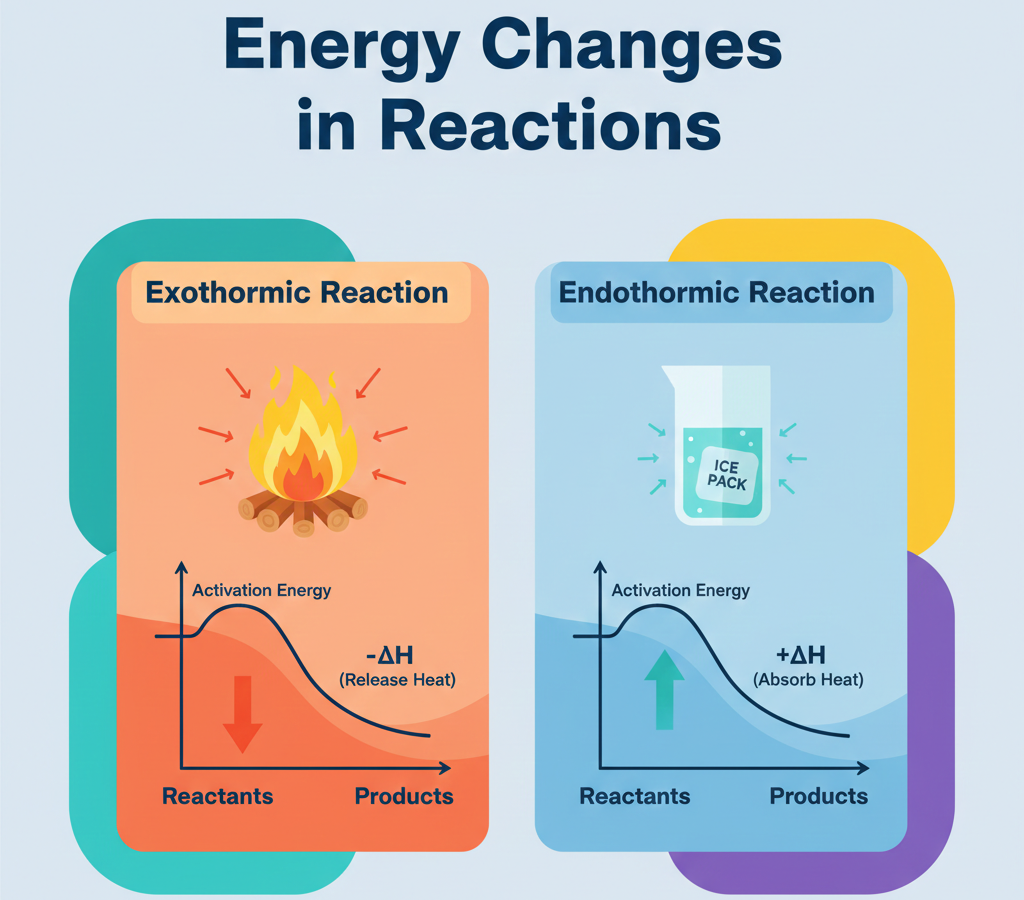
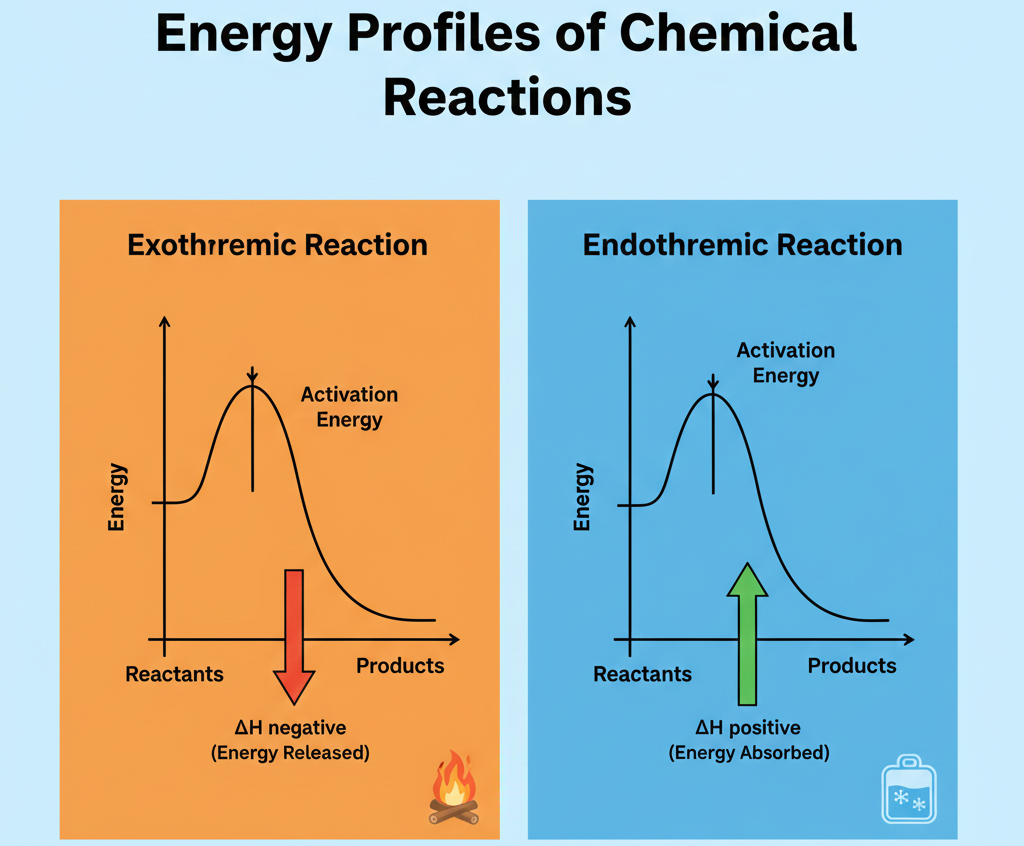
Energy Changes Graph
We can measure energy changes with a scatter graph.
- The starting energy of reactions is a certain level.
- The energy needed to rise (this energy needs to be input by the reaction for it to occur), and then it rises and falls to the level of energy for the products.
- The difference in the heights of the products and reactants is the ΔH (this is the change in heat, or energy, or the reactants/products).
Interpreting the graph:
- The peak of the energy change is the activation energy.
- If the ΔH is positive, it is an endothermic reaction.
- If the ΔH is negative, it is an exothermic reaction.
Energy changes and reactions are influenced by:
- Nature of reactants: More energy is needed to break strong reactant bonds.
- Concentration: More particles cause more collisions which leads to faster reactions.
- Temperature: Collisions happen faster when heat is added because particles have more energy.
- Catalysts: Faster reactions happen when less activation energy is required.
Controlling energy release or absorption through reactions is vital in both labs and industry.
Energy changes in our daily life
Energy changes are not just theoretical, they can be seen in our daily lives.
Hand Warmers
An exothermic reaction heat is released inside hand warmers.
Ice Packs
An ice pack becomes cold because an endothermic reaction absorbs heat.
Cooking
Energy is released as heat due to the breaking and forming of bonds in the molecules of the food during the cooking process.
Batteries
A reaction occurs in a battery that converts released chemical energy to electrical energy.
Knowing how to control energy changes leads to more chemical processes being broken down safely and more efficiently.
Chemistry and the Importance of Energy Changes
The reason energy changes are important is:
- Safety - Is it possible that too much heat will be generated?
- Efficiency - Are there certain methods that work better to optimize or regulate the reactions?
- Spontaneity - Will a reaction happen on its own?
- Biological systems - The way living systems produce and use energy.
Exothermic reactions and endothermic reactions are types of chemical reactions that involve a change of energy, and that is the energy of the system itself.
Main Points
- When some chemical bonds are formed energy is released, and when some chemical bonds are broken energy is absorbed.
- Exothermic reactions are reactions that give off heat, and therefore, they are said to have a negative ΔH.
- Endothermic reactions are reactions that take up heat from the surroundings, and therefore, they are said to have a positive ΔH.
- The energy change of a reaction can be determined by the bond energy.
- For a chemical reaction to occur, there must be some activation energy, which is the minimum amount of energy required to start the reaction.
- The energy associated with a particular reaction and the duration of that reaction can be affected and, therefore, controlled by the concentration of ions, the heat of the system, and the chemical bonds.
Chemistry, life, and industry rely on the concept of energy changes.
When an ice pack is touched or a candle is lit, the process demonstrates the change of energy as well as the chemical reactions.