

On this page:
Introduction What Are Electrons? Energy Levels and Sublevels Electron Configurations Valence Electrons Determining Valency Electron Configuration and the Periodic Table Rules to Remember Orbital Diagrams Connection Between Electron Configuration and Chemical Behavior Transition Elements and Valency Why Electron Configuration is Important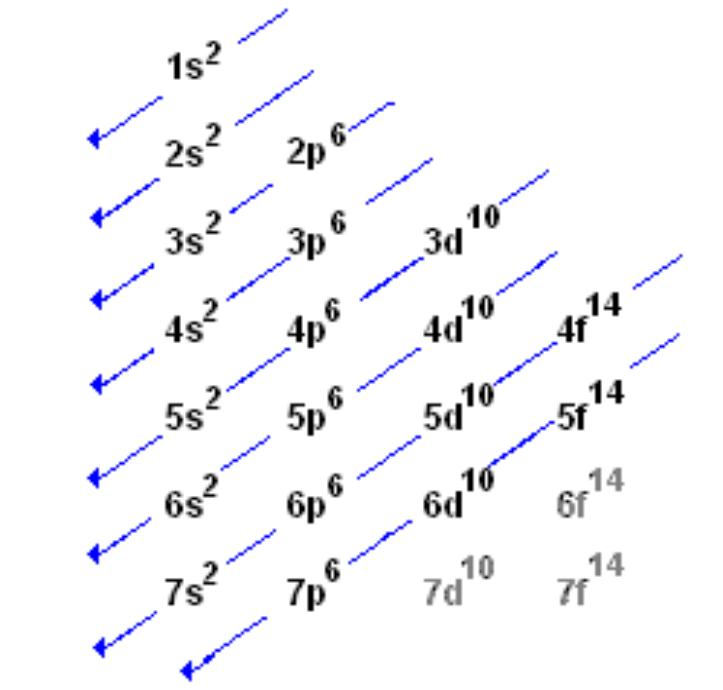
Have you ever wondered why some elements react extremely aggressively, and others don't seem to react at all? Or why some elements can form different compounds and others can only form one?
It all has to do with what is going on in the center of their atoms, with their electrons.
Electrons are far more than just tiny particles that orbit the atoms. They are the drivers of chemical behaviour and chemical bonding. Electron configuration and valency are concepts that offer insight into how different elements will chemically react, and are the bedrock of Chemistry.
Electrons are negatively charged particles that orbit around the nucleus of an atom. They are much less massive than neutrons and protons.
An atom's electrons determine most of the atom's properties.
You can relate electrons to a series of tenants that live in an apartment building (the atom).
Every level of the building is an energy level (or shell), and within each level, there are several suites (or orbitals) where the electrons are located.
Electrons occupy regions around the nucleus called energy levels (or shells), labeled K, L, M, N… or numerically 1, 2, 3, 4….
Each energy level contains sublevels (types of orbitals) labeled s, p, d, f:
| Sublevel | Number of Orbitals | Max Electrons |
|---|---|---|
| s | 1 | 2 |
| p | 3 | 6 |
| d | 5 | 10 |
| f | 7 | 14 |
Electron configuration is the listing of electrons in their orbitals.
Energy levels to fill: 1, 2
Electron filling: 1s² 2s² 2p⁴
Explanation:
So, the configuration is 1s² 2s² 2p⁴.
Electron configuration: 1s² 2s² 2p⁶ 3s¹
Notice how the outermost electron (3s¹) is responsible for chemical reactions.
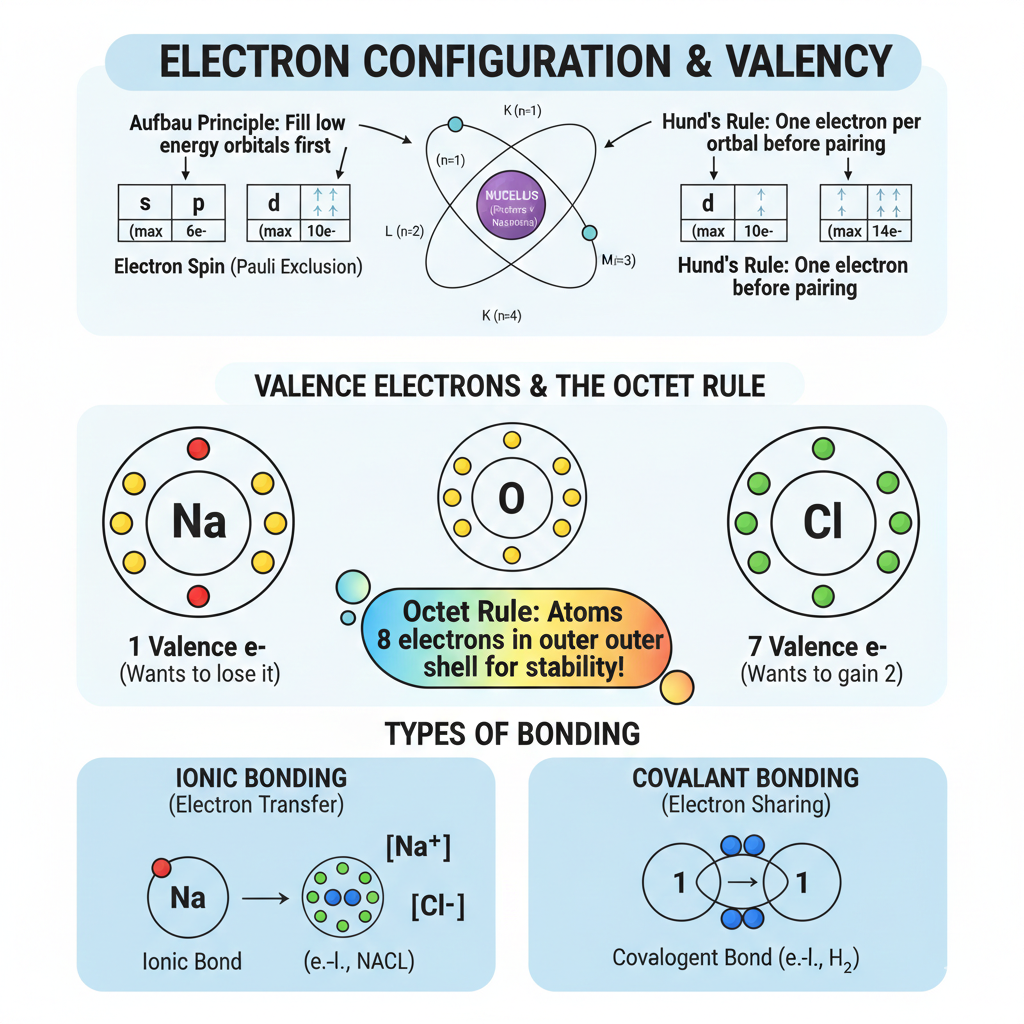
Valence electrons are the electrons located at the outer shell of an atom.
They are important because they take part in the formation of chemical bonds.
When an atom has closer to 8 valence electrons, it becomes more stable. This is known as the Octet Rule.
Valency refers to the combining capacity of an element. It determines how many electrons an atom can lose, gain, or share to achieve a stable configuration.
Elements in a group of the Periodic Table have the same number of valence electrons. Elements in the same period have the same number of electron shells.
This is why elements in the same group tend to have similar chemical properties.
Electrons can also be shown using boxes or arrows to represent orbitals.
Each box represents an orbital. Each arrow represents an electron.
If they are up and down arrows, they have opposite spins.
1s: ↑↓
2s: ↑↓
2p: ↑↓ ↑ ↑
This visual representation helps determine which electrons are paired or unpaired. This is important and is used for bonding.
The number of valence electrons determines how an atom bonds (ionic or covalent), its reactivity, and the types of compounds it can form.
This is created when electrons are transferred.
Example: Sodium (1 valence electron) + Chlorine (7 valence electrons) → NaCl
This is created when electrons are shared.
Example: Oxygen (6 valence electrons) shares electrons with hydrogen to form H₂O
Transition metals (Fe, Cu, Zn) can have more than one valency. This is because its d orbitals can participate in bonding.
Example: Iron → Fe²⁺ or Fe³⁺
This is the reason why transition metals can form multiple compounds with different properties.
Knowledge of electron configuration combined with the knowledge of valency is like having the chemistry GPS. It allows you to predict how elements will behave, why compounds will form, and how reactions will take place. It's the answer to all chemistry problems.