

On this page:
Introduction What Is an Electrochemical Cell? Components of an Electrochemical Cell The Functions of an Electrochemical Cell Types of Electrochemical Cells Standard Electrode Potential Redox Reactions in Electrochemical Cells Cells' Voltage and Energy Real-Life Applications of Electrochemical Cells Factors Influencing the Efficiency of an Electrochemical Cell Safety and Environmental Concerns Summary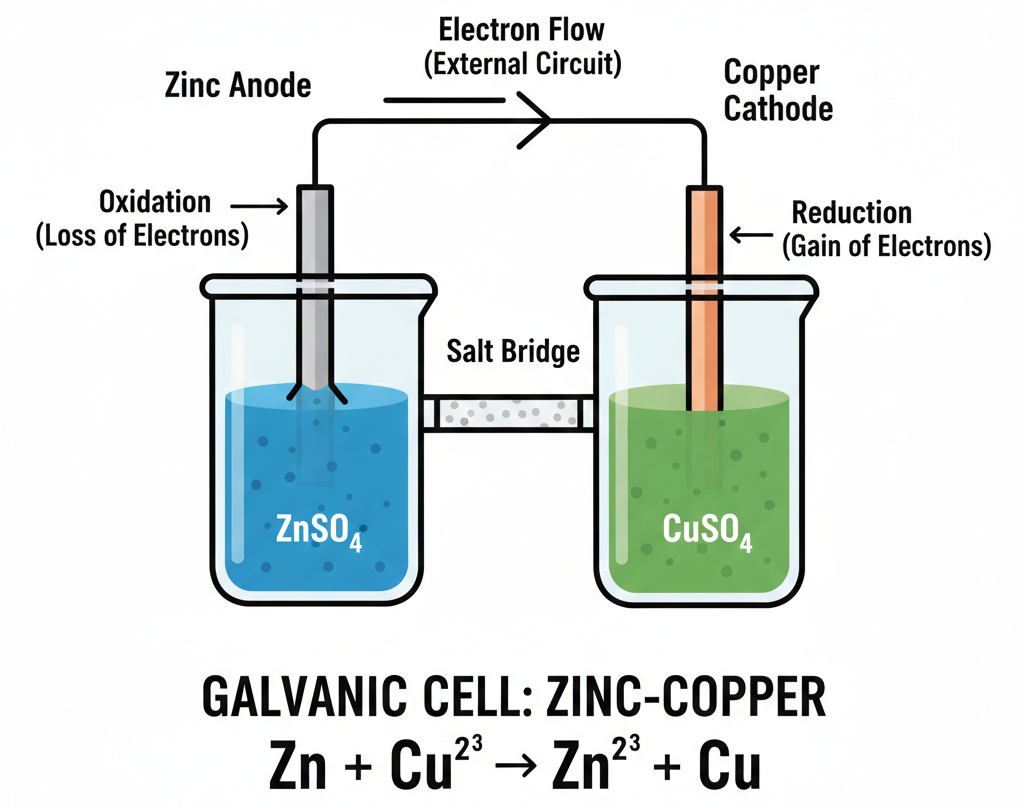
Think about a world without batteries. How would we use phones, cars, flashlights, and even life-saving devices? Thankfully, we have electrochemical cells to make modern conveniences work.
Have you ever thought about the process used to charge your smartphone? How about the way a battery in a remote control works for several days without plugging it in?
It would take a lot of time to explain, but the electrochemical cell is definitely a reason to be thankful. These cells work through a series of chemical reactions to convert stored chemical energy into electrical energy.
Electrochemical cells are extremely important in chemistry because they demonstrate the ability of chemical reactions to perform work other than producing heat or light. In this lesson, we will examine the theory, parts, varieties, and real-world relevance of electrochemical cells in the most clear and simple way.
An electrochemical cell is a device for the transformation of chemical energy into electrical energy through the process of a redox (reduction-oxidation) reaction.
In other words,
Reduction occurs when electrons flow through an external wire connecting the site of oxidation (loss of electrons) and the site of reduction (gain of electrons). This flow of electrons is what produces an electric current.
Imagine a mini-electron superhighway that connects two metals through a liquid; that flow of electrons is what drives all our novelty products.
Each electrochemical cell contains the same components
Conductors (usually metals) where the reactions occur
A liquid that allows ions to flow to complete the electric circuit
A U-shaped channel containing a non-reactive electrolyte that serves to maintain the charge balance by allowing ions to move between the two half-cells
A wire that connects the anode and Cathode electrodes to enable the flow of electrons
In the example of a zinc-copper cell, zinc produces oxidation (loss of electrons) at the anode, copper produces reduction (gain of electrons) at the cathode, and a flow of electrons occurs through the wire, resulting in the production of an electric current.
The functions of an electrochemical cell can be boiled down to four basic steps.
The combination of these steps guarantees a constant flow of electrons, maintaining current as long as the reactants last.
Electrochemical cells are classified into two main categories:
Characteristics:
Features:
Understanding these differences helps identify energy-giving reactions from energy-consuming reactions.
One important concept in electrochemistry is standard electrode potential (E°). This is the standard electrode potential (E°), which is the measure of the tendency of a substance to gain or lose (give away) electrons at standard conditions.
The cell potential (Ecell) can be calculated using:
A positive cell means that the reaction is spontaneous and can produce electricity.
Redox reactions are the core of electrochemical cells. Let's break it down:
An Oxidation Default Anode: Zn → Zn²⁺ + 2e⁻
Reduction Default Cathode: Cu²⁺ + 2e⁻ → Cu
Electrons flow through the wire from zinc to copper, while ions move through the salt bridge to balance the charge.
Electron movement is what generates the electric current.
The voltage and energy produced by a cell depend on the cell potential and the amount of substance reacting.
shows us how strongly the electrons are pushed through the circuit.
When a more reactive metal (like zinc) is paired with a less reactive metal (like copper), it gives a higher voltage.
The energy produced is proportional to the number of moles of electrons transferred.
For instance, a simple zinc-copper cell generates about 1.1 volts.
When cells are stacked, the voltage increases. Cells are stacked inside a battery to power a circuit.
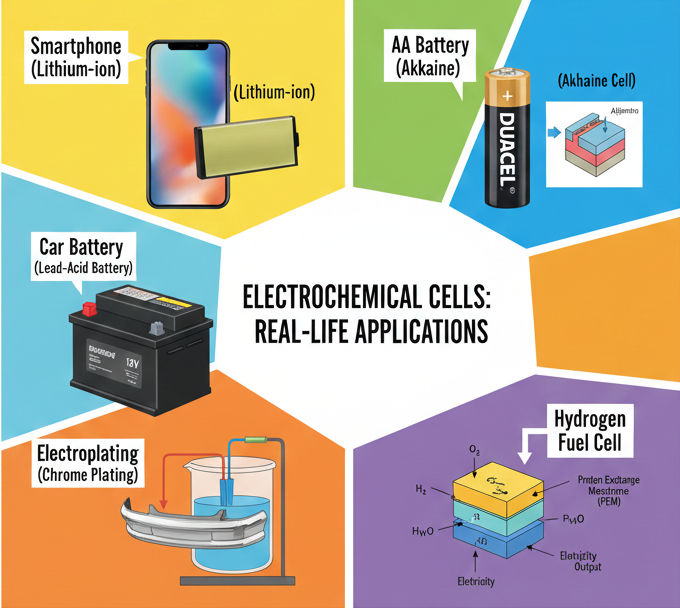
Everywhere we go, we carry electrochemical cells.
Some examples include:
The cells are often overlooked because they have no moving parts, unlike most machines. All the action is at the microscopic level, and it's all chemistry.
There are a number of variables that determine the efficiency and the voltage of a cell.
The design, materials, and construction of cells in devices can be improved in real life by manipulating the above properties.
The use of electrochemical cells brings a number of concerns that must be addressed.
Electrochemical cells combine certain chemicals in a controlled manner in order to release energy; essentially, they perform chemical work.
Understanding electrochemical cells gives insight into how chemistry can be utilized on a massive scale, from small batteries to large-scale energy systems.