

On this page:
Introduction What Is Diffusion? Diffusion in relation to Particle Theory What This Reveals About Diffusion Factors Affecting Diffusion Diffusion (Gases) Diffusion (Liquids) Diffusion in Solids Osmosis vs. Diffusion Practical Examples of Diffusion Summary of Key Concepts Why Understanding Diffusion Is Important in Chemistry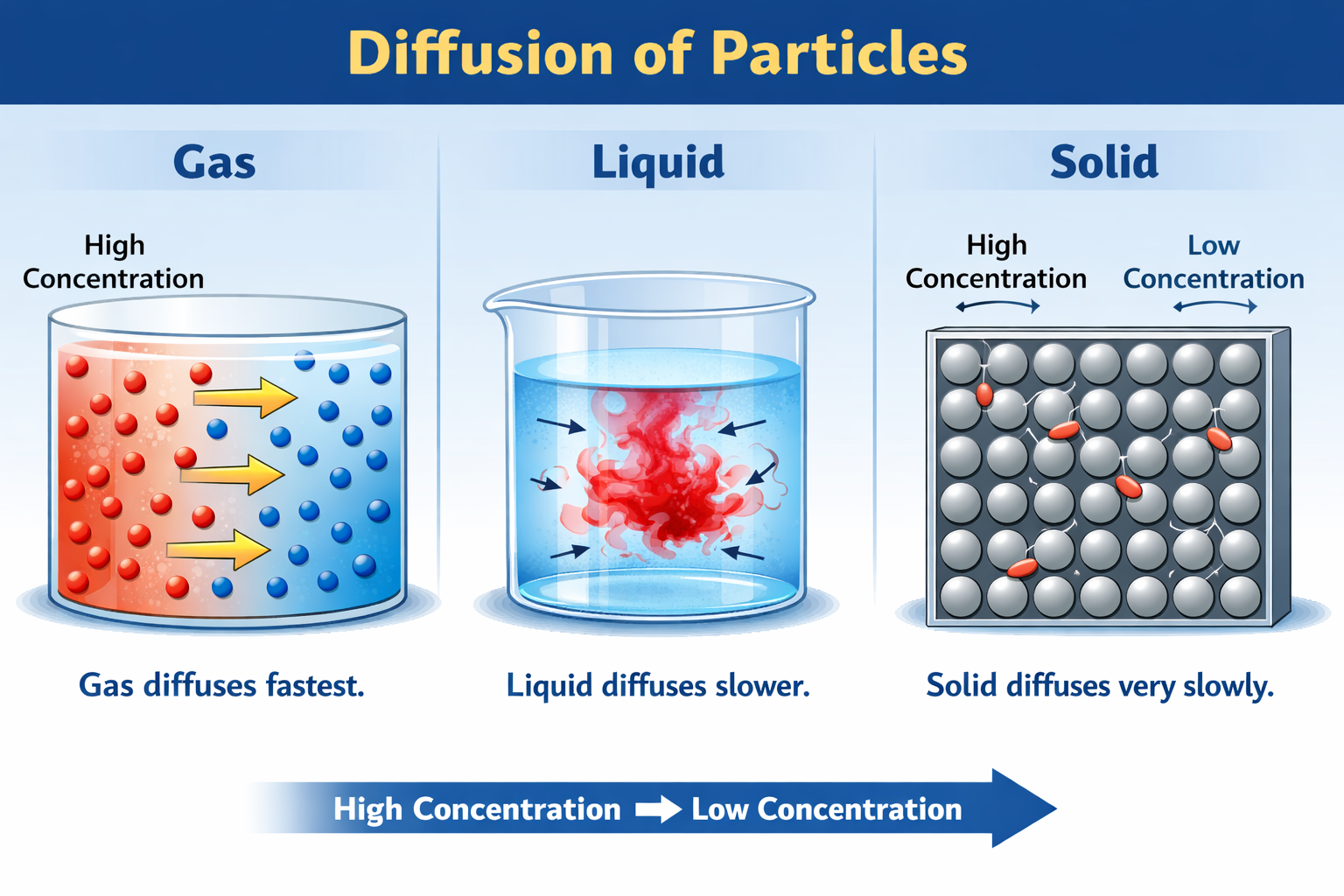
What comes to your mind when you think of a bottle of orange juice being opened in a classroom? Does a case of perfume or even sugar spooned into a cup of tea, and then watching the sugar disappear into the water? All of the examples in one way or another are diffusion.
In simple terms, diffusion is a process that allows the spreading of particles within a given space.
Diffusion is a process that occurs in almost every aspect of life. Smelling a fragrance in the air or even the way oxygen is supplied to our cells are simple examples of diffusion.
Diffusion is the process that causes the unequal distribution of matter.
For example, the smell of perfume does not remain confined to a particular place. Its smell is uniformly distributed all over the place. This occurs due to the movement of perfume particles.
This means that matter is made of particles.
To move, the particles of gas, liquid, or solid substances do not require stirring or other manual interference. In all three states of matter, diffusion takes place at a varied rate.
In solids, it occurs at a slower rate. In liquids, it is faster, whereas it occurs at the fastest rate in the gaseous state.
An illustration of the example of diffusion in a solid state is the smell of freshly brewed coffee.
Diffusion in the liquid state can be illustrated with the example of the color of tea diffusing uniformly in hot water.
A reminder about the particle theory of matter is needed in relation to diffusion:
Visual Example: Consider a few drops of food coloring in the water. The coloring particles will spread randomly until the water is uniformly colored. This is a demonstration of diffusion.
The factors that determine the pace of diffusion include the following.
Gas particles are far apart and can move freely, and thus can spread out. They can spread both up, down, left, right, and even diagonally!
When there is a high concentration of gases, the gas particles naturally move to areas of lower concentration.
No energy is needed from the outside because the gas molecules will move out of the high concentration area on their own.
To see diffusion in gases, do this:
Get a small tube and place a small amount of ammonia (NH3) on one end of the tube.
On the other end of the tube, place some hydrogen chloride (HCl).
White smoke will be formed.
Observation: Due to diffusion, the white ring will be closer to the end with HCl, because it has the lower concentration.
Key Learning: Based on molecular mass, gases diffuse at differing rates.
The lighter the gas, the more quickly it will diffuse.
Diffusion is slower in liquids than in gases because in liquids, the molecules are closer together.
Example: tea or coffee that is mixed in hot water will diffuse more quickly because the water is heated.
To see diffusion in liquids:
Get a drop of potassium permanganate and place it into a beaker of water.
Once the drop is in the water, observe it to see that the color will diffuse into the water.
The color of the water will spread gradually (without stirring) to all parts of the water.
Example of diffusion in everyday life: The color that spreads out into the soup when you add food coloring to it.
Solid particles are stiff (or fixed) in positions and are more closely packed (than in liquids or gases), which is why the process of diffusion occurs much more slowly than it does in other states of matter.
Diffusion in solids can take place over the span of days and even years.
Example: The gradual spreading of sugar throughout solid chocolate.
Diffusion: Movement of particles from an area of higher concentration to an area of lower concentration.
Osmosis: A special kind of diffusion that occurs through a selectively permeable membrane. In osmosis, the solvent molecules move, but the solute molecules do not.
Example: Roots of plants absorb water from the soil through osmosis.
Water moves from a less concentrated solution (soil) to a more concentrated solution (root cells).
Diffusion explains the mixing of substances without the use of a stirrer. Understanding diffusion helps to explain chemical reactions as well, especially in relation to the mixing or meeting of the reactants.
Finally, diffusion demonstrates the effect of temperature and concentration on the rate of a chemical reaction.
In a laboratory, for example, the mixing of two solutions without diffusion would be impossible.
In biology, for example, the diffusion of oxygen to the cells is crucial and must take place.