Combustion of Fuels
Have you ever thought about why ice will melt or why flames burn and feel hot? Every reaction results in an energy change. Energy can either be lost or gained, and sometimes is lost or gained from the surroundings. These changes must be understood to be able to predict the reaction and how it can be applied in the real world.
Energy can be transferred from one place to another. It never disappears; it only changes. Heat will spread, and light will travel. Some reactions will actually warm up an environment, while others will cool it down. These ideas can be applied to create better batteries, safer fuels, and smarter technologies for everyday life.
The breaking and making of chemical bonds involves energy changes:
- Energy is required to break chemical bonds.
- Energy is released when chemical bonds are made.
The total energy change in a reaction is what determines the reaction to be endothermic or exothermic.
What Are Endothermic Reactions?
Endothermic reactions are defined as reactions that take in energy from the environment, usually in the form of heat. In this type of reaction, you will feel the reaction getting colder.
Key Points:
- Energy is taken in from the environment.
- The environment cools as the reaction occurs.
- The final products have more energy than the initial reactants.
- In an energy diagram, this type of reaction is shown with a higher energy level of products compared to the reactants.
Examples
- Melting of ice
- Evaporation of water
- Cooking an egg (heat is absorbed, so the molecular bonds can break)
- Photosynthesis is an example of the sort of thing we want to consider here.
What Are Exothermic Reactions?
You can feel the reaction get hotter; therefore, exothermic reactions are said to release energy, usually as heat, light, or sound.
Key Points:
- Heat is released to the environment.
- Heat surrounds the reaction.
- Products are at a lower energy state than reactants.
- The energy diagram shows reactants higher than products.
Examples
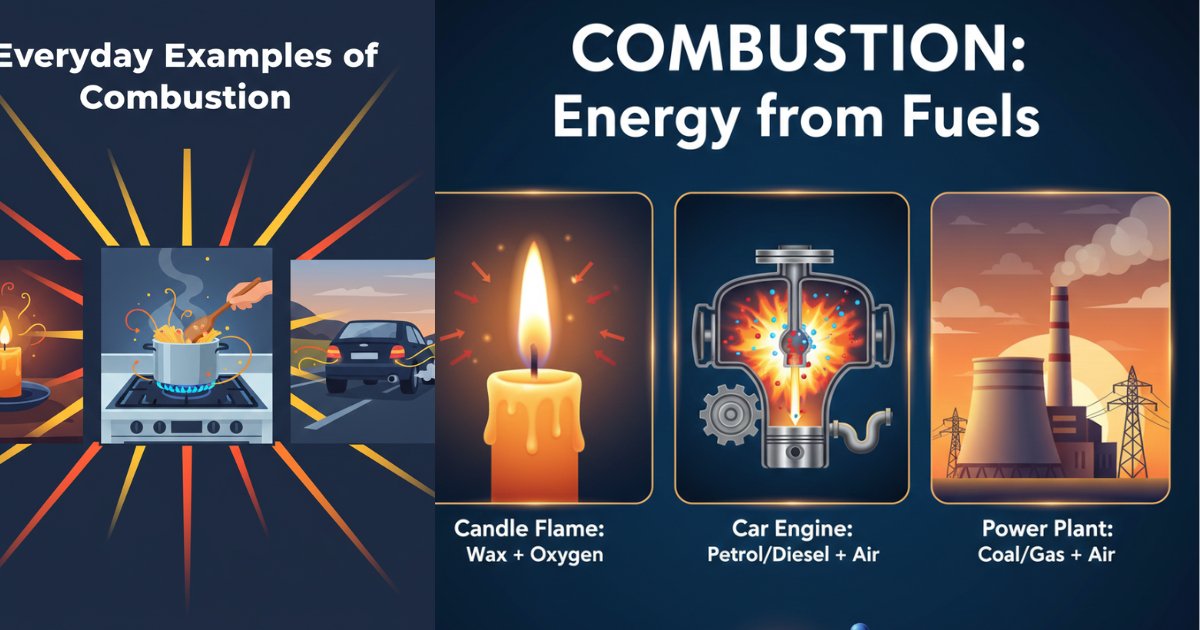
- The most everyday example of this is the different types of fuel combustion (gas, wood)
- Cellular respiration
- Water freezing (heat is absorbed)
- Firework explosions
Bonding and Energy Transfer
The breaking and forming of bonds involves two important processes.
- To break the bonds is an energy input, while to make the bonds is a release of energy.
This means that the net energy change depends on which of the two processes is dominant.
- If an endothermic reaction occurs, it means that energy input is greater than the energy released upon the formation of new bonds.
- In contrast, if an exothermic reaction occurs, it means that the energy released upon the formation of the new bonds is greater.
Bullet Points for Understanding:
- Climbing a hill represents the energy absorbed for breaking the bonds.
- Breaking the bonds requires energy (think of climbing a hill).
- The energy released for forming the bonds is represented by rolling down the hill.
- This is to represent the energy released for forming the bonds.
- Net energy change = energy absorbed - energy released
Energy Profiles of Reactions
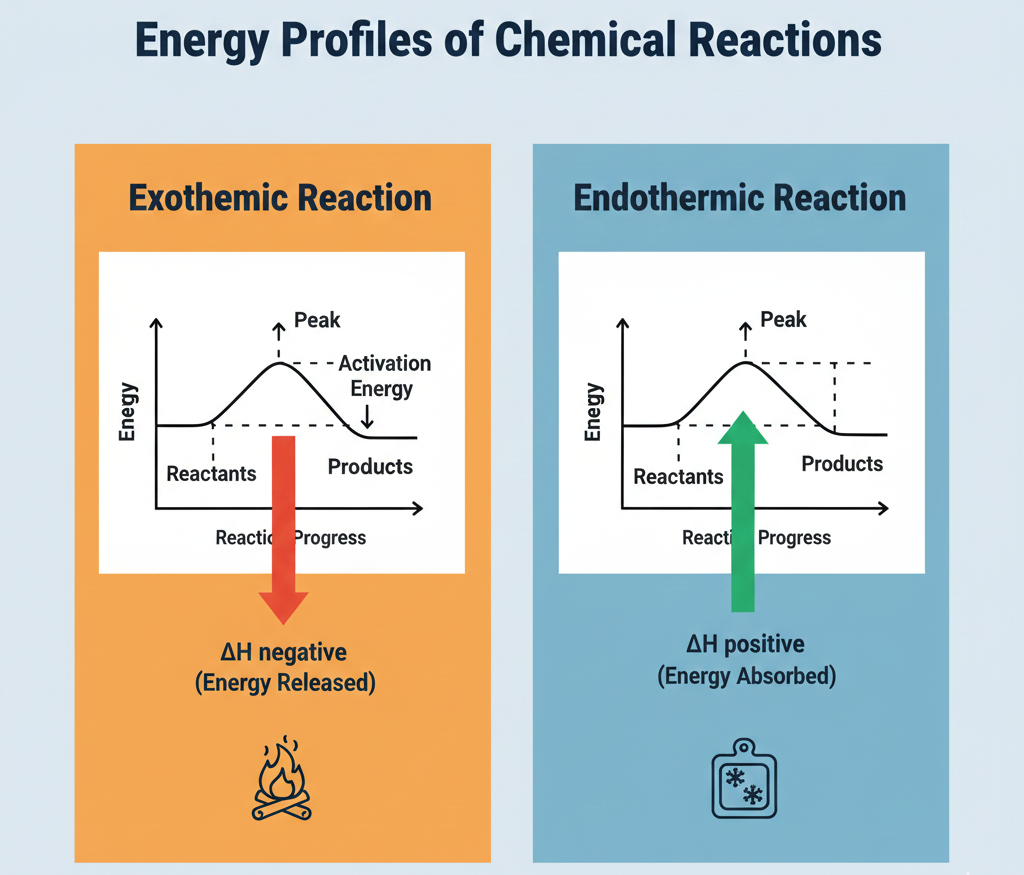
The progress of a reaction is represented by an energy profile graph over time.
Endothermic reactions
- reactants are at a lower energy
- products are at a higher energy
- Energy is absorbed from the surroundings (the graph goes up)
Exothermic reactions
- reactants are at a higher energy
- products are at a lower energy
- energy is released to the surroundings (the graph goes down)
Activation energy (Ea): each reaction needs a minimum energy to start, it's shown as a peak on the energy diagram.
Catalysts lower the activation energy, speed up reactions (without being used).
Conservation of energy: energy cannot be created nor destroyed, only transformed. In chemical reactions, this is seen as:
- Endothermic: energy absorbed → stored in chemical bonds of products
- Exothermic: energy released → transferred to surroundings
This is the reason chemical reactions can be used to heat homes/cook food, and generate electricity.
Everyday applications of endothermic and exothermic reactions
Endothermic reactions:
- Injured cold packs absorb heat from your skin
- Photosynthesis is the process used by plants to store energy and food
Exothermic reactions:
- Hand warmers release heat due to the oxidation of iron
- burning fuels release energy used for cooking, warming, and transporting
Bullet points to connect the theory to the practice:
- The combustion of fuel gives energy to machines
- Respiration releases energy in living organisms
- Ice packs absorb heat; this is an endothermic reaction used for first aid
- Cooking → energy absorbed to alter food chemistry
Factors influencing energy alteration
- Type of bonds: More energy is released when stronger bonds are created.
- Quantity of reactants: Additional molecules can increase the total energy released or absorbed.
- Temperature: More energy can be given to achieve the activation energy.
- Catalysts: Reduce activation energy, alter rate, but no change to net energy.
Conclusion
- Endothermic reactions absorb energy; the surroundings become cooler; products increase in energy.
- Exothermic reactions release energy; products become less energetic.
- Bond breaking requires energy, bond making releases energy.
- All reactions require activation energy.
- Energy changes account for most of the natural phenomena, processes in industries, or functionalities of everyday objects.
Important Points
- Energy changes are fundamental to every chemical reaction.
- Energy is neither created nor destroyed, merely transferred between the system and the environment.
- Real-world applications of energy storage, and of heating and cooling processes, can be explained by understanding exothermic and endothermic reactions.
- Chemical reactions are not just a series of formulas and equations. They are energy interactions that happen constantly in the environment. By knowing whether a reaction gives off or absorbs heat, we can predict its behavior and apply chemistry safely in our everyday lives.