

On this page:
Introduction What is a Chemical Reaction? Identifying a Chemical Reaction Classification of Chemical Reactions The Law of Conservation of Mass Balancing Chemical Equations Reasons Why Mass Appears to Change Energy in Chemical Reactions Chemical Reactions in Everyday Life Conclusion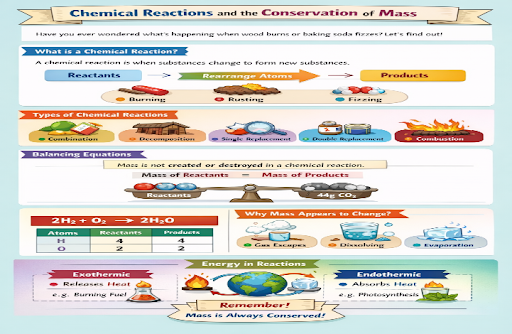
Why do you think a burnt piece of paper "disappears" and only leaves ash? Or, do you know why baking soda causes a cake to rise? These are examples of chemical reactions. Chemistry gives us the tools to quantify and explain these types of change.
Process with paper can't work to say it is disappeared. Solid paper changes to invisible gases such as carbon dioxide and water and freely disperse to the air. What remains as ash is the non-burning microscopic part of the material.
When baking soda is heated or mixed with acid in the batter of the cake, it produces carbon dioxide. These tiny bubbles get trapped in the batter causing it to expand. This gentle expansion is responsible for the soft and fluffy rise of the cake.
A chemical reaction is when a set of substances undergo a change to form entirely new substances that have different characteristics. These changes are a result of a reorganization of the atoms. No atoms are created or destroyed in the process, only rearranged.
Here are some additional examples that illustrate the process:
Important to know:
Remember, in all of these, the atoms are NOT lost. They are just rearranged.
Some clues of a chemical reaction may include:
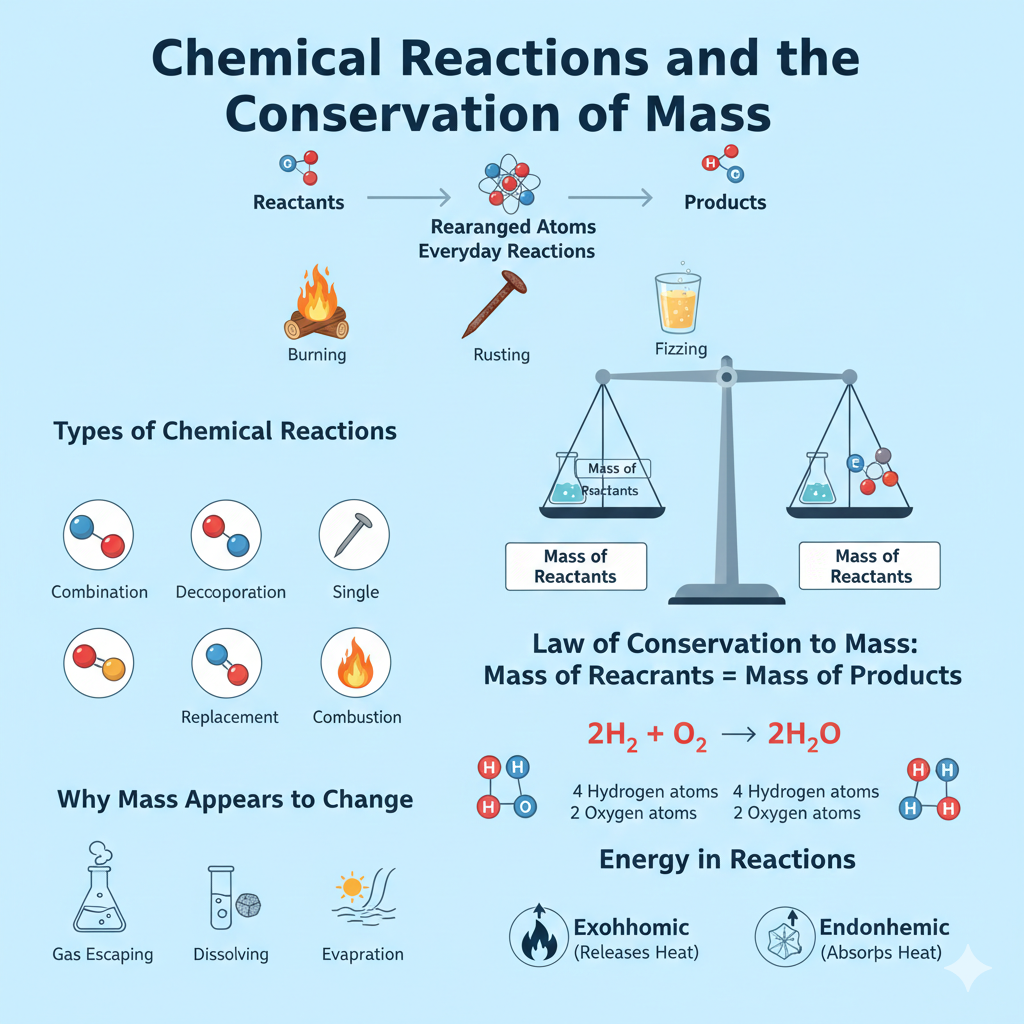
A chemical reaction can be classified into five broad categories:
When two or more reactants combine to form a single product.
2H₂ + O₂ → 2H₂O
A single compound breaks down into two or more simple substances.
2H₂O → 2H₂ + O₂
A reaction in which one element takes the place of another element in a compound.
Zn + 2HCl → ZnCl₂ + H₂
A reaction that involves the exchange of ions between two chemical compounds.
AgNO₃ + NaCl → AgCl + NaNO₃
A chemical reaction in which a substance combines with oxygen, releasing a large amount of energy in the form of heat and light.
CH₄ + 2O₂ → CO₂ + 2H₂O
"Mass cannot be created or destroyed in a chemical reaction; it only changes forms."
Example: Burning 12 g of carbon in 32 g of oxygen forms 44 g of carbon dioxide.
Mass before = Mass after → 12 + 32 = 44 g
This law explains why chemists balance chemical equations.
A chemical equation must obey the law of conservation of mass. It is a way of combining both symbols and formulae to show a reaction.
Steps to Balance an Equation:
Example:
Mass also looks like it disappears and seems to escape.
Example 1: CO₂ gas is released when baking soda is mixed with vinegar.
Example 2: Some mass disappears when the liquid level in a cup decreases due to a dissolved solid or the liquid level drops due to some evaporation.
If all the products of mass that seems to disappear, the mass will remain constant.
Chemical reactions attract energy which can be seen in:
Combustion of fossil fuels release energy in the form of heat and light.
Photosynthesis and other processes absorb energy.
Mass is conserved during the rearrangement of atoms.
Knowing the chemical reactions is of use when:
You can witness the principles of chemistry in everyday life by observing chemical reactions.
These basic concepts help you predict the result of the reactions, accurately perform measurements, and abide by the law of conservation of mass, which states that matter can be transformed, but never lost.