

On this page:
Introduction What is the speed of a chemical reaction? What is collision theory? Key Factors That Influence The Rate Of Reaction Energy Profile and Activation Energy Why do we care about reaction kinetics in real life? Important information to remember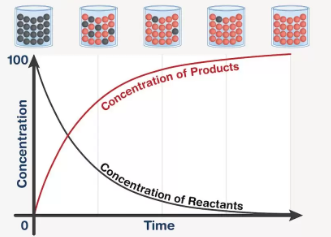
Consider a lit match. It flares up almost instantly. Now think of iron rusting. The process could take days, weeks, months, or even longer. These are both chemical reactions, yet the speed at which they occur is remarkably different. What determines the speed of a reaction?
Chemical reaction kinetics answers this question. Kinetics is the field of study focused on the speed of reactions and the factors that influence it. Reaction rates help chemists determine how to construct a medicine, manage an industrial process, and make a reaction that is safe and efficient.
The speed of a reaction determines how quickly the reactant is utilized or how quickly the products are created over a specific period of time.
In short, how much time has it taken for a particular change to occur?
Consider the "reaction rate" as the "change over time." For example:
Burning, exploding
Rusting, fermenting
The rate of a reaction can be observed with the following changes:
Collision theory helps explain why reactions occur at different rates.
This theory states that particles (atoms, ions, or molecules) need to collide for a reaction to occur.
However, a reaction may not occur as a result of collision for at least two main reasons:
Particles low energy will just bounce away, while the wrong aligned particles will prevent the breaking or formation of chemical bonds.
There are several reasons when the reaction rate increases:
Reaction rate can be measured using collision theory, which explains the reasons for the rapid formation or depletion of reactants.
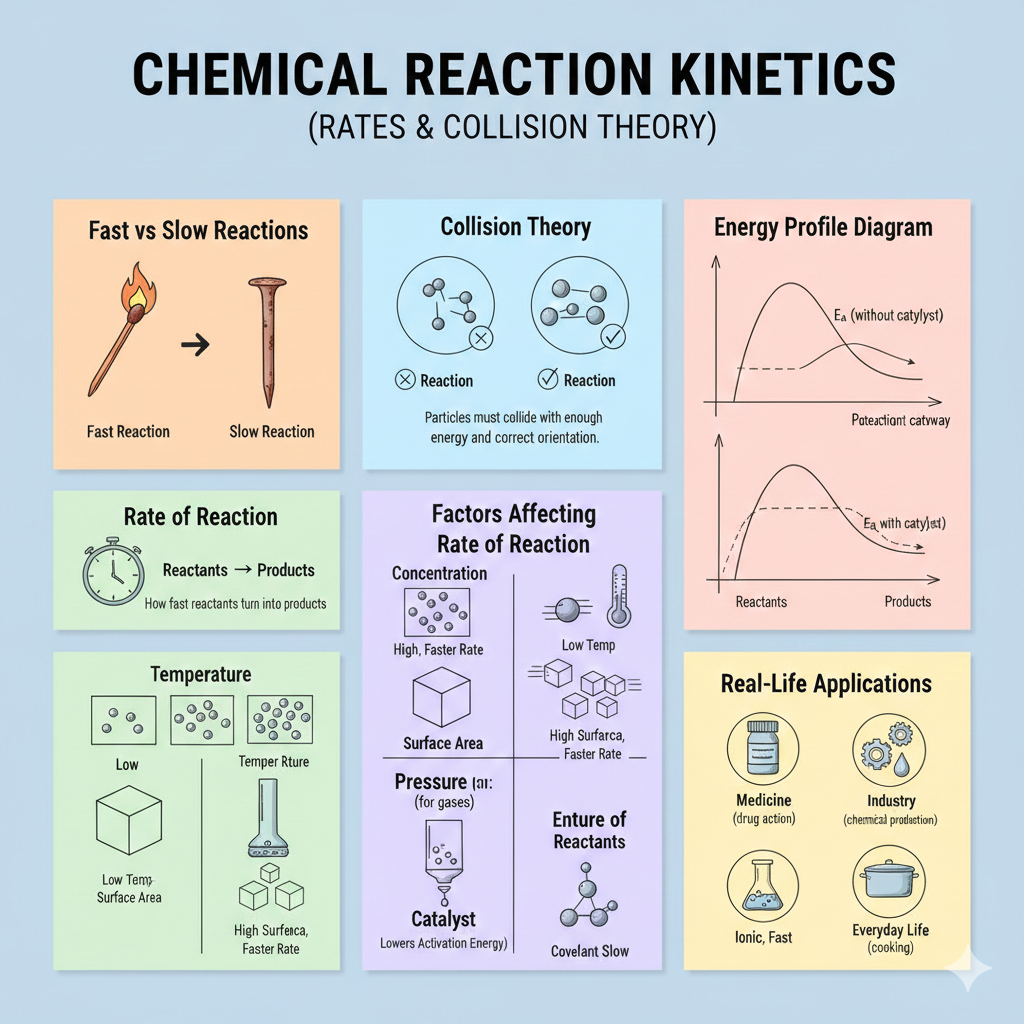
There are several reasons why the rate of collisions and reactions of particles change, and we are going to explore the most important.
Concentration defines the amount of substance per unit volume.
An increase in concentration leads to: More reaction particles in the same unit of volume, increase in rate of collisions, increase in effective collisions.
High concentration = high rate of reaction
Temperature is a measure of hotness and coldness of a substance and determines the amount of energy present in the particles.
When temperature rises: Particles move faster, bump more often, more particles gain enough energy to react.
Food spoils more slowly in a refrigerator.
When reactions involve solids, the reaction occurs only on the surface of the solid.
When a solid is reduced into smaller pieces: total surface area increases, more particles exposed, more collisions.
Powdered solids react quicker than lumps.
Gas reactions require a specific focus on pressure. When gas is compressed, particles are forced to collide more frequently.
When pressure goes up: Gas particles get pushed together, volume has more particles, number of collisions increases.
Catalysts are substances that cause reactions to occur faster, without being included in the reaction.
How catalysts function: Provide alternative pathway, reduce activation energy, assist in breaking and forming bonds.
They are not chemically changed and do not affect total yield.
Not all reactants will react at the same rate.
Depends on: How strong the bonds are, how simple/complex reactants are, whether reactants are ions or neutral molecules.
Ionic reactions are usually fast; strong covalent bonds are slower.
Each reaction needs a minimum amount of energy to be able to start the process. This is known as activation energy.
Key ideas:
When…
This explains:
The speed at which a drug reacts in the organism.
The speed at which products are manufactured.
The speed at which pollutants are broken down.
The speed at which food cooks or spoils.
Understanding kinetics helps scientists to:
Chemical reaction kinetics describes and explains the speed of reactions and the reasons for variations in the speed of reactions. The frequency and effectiveness of particle collisions determine the reaction rate.
These are the main factors that change reaction rate:
Controlling these factors enables chemists to slow down or speed up reactions to suit different needs.