

On this page:
Introduction What Are Chemical Formulas? Types of Chemical Formulas Definitions of Atoms and Ions in Formulas Rules for Writing Chemical Formulae Significance of Chemical Formulas in Daily Life Chemical formulas also assist in calculations Recap of Atoms, Molecules, and Compounds Why You Should Care About Chemical Formulas in MYP Chemistry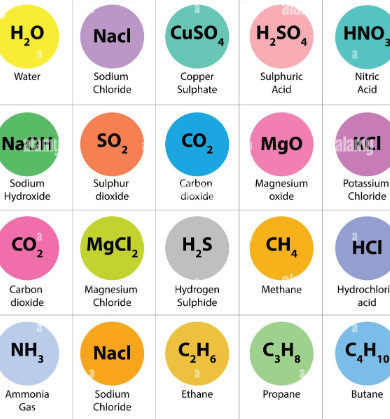
Why do you think water is always H₂O and never H₃O or H₂O₂? Why do you think table salt is NaCl and never Na₂Cl? This is all due to chemical formulas, which are the codes of chemistry showing the exact type and number of atoms in a substance.
In chemistry, knowing chemical formulas helps scientists to:
There is a lot to cover with chemical formulas.
A chemical formula is a shorthand way of showing what elements are contained in a compound and the total number of atoms of each element.
H₂O – Water has 2 hydrogen atoms and 1 oxygen atom.
CO₂ is made up of 1 carbon atom and 2 oxygen atoms.
NaCl is made up of 1 sodium atom and 1 chlorine atom.
Chemical formulas are important because they assist in:
Molecular formulas show the exact number of each atom in a molecule.
Example: C₆H₁₂O₆ (glucose)
The empirical formulas show the lowest whole-number ratio of the atoms in the compound.
Example: HO (hydrogen peroxide empirical)
The structural formula for a compound shows how the individual atoms are interconnected.
Example: CH₃CH₂OH (ethanol)
The ionic formula shows the charged ions in the compound.
Example: Na⁺Cl⁻ (sodium chloride)
Some compounds have water molecules connected to them, shown as a dot in the formula.
Example: CuSO₄·5H₂O (copper sulfate pentahydrate)
Cations are positive ions (Example: Na⁺, Ca²⁺)
Anions are negative ions (Example: Cl⁻, O²⁻)
The charges in an ionic formula must balance for the compound to be neutral.
Example: Magnesium oxide → Mg²⁺ and O²⁻ → Formula = MgO
Example: Aluminium chloride → Al³⁺ and Cl⁻ → Formula = AlCl₃
Knowing ions helps to explain solution conductivity, which are the compounds that have free ions, and can conduct electricity.
Example: Calcium nitrate → Ca²⁺ and NO₃⁻ → Formula = Ca(NO₃)₂
Molar Mass: the total mass is obtained by adding the atomic masses (based on the chemical formula).
Example: H₂O → (2×1) + 16 = 18 g/mol
Stoichiometry - to determine the total mass and balance the rate of a chemical reaction.
They also allow chemists to handle chemicals without the risk of an unwanted reaction, which is very important in a lab.
the smallest part of an element (e.g., H, O, Na)
more than one atom that has bonded (e.g., H₂O, O₂)
a different element or a different combination of bonded molecules (e.g., CO₂, NaCl)
Chemical formulas are a widely used tool in chemistry that is used to streamline communication among chemists.
When it comes to cake baking and chemistry labs, accuracy is key, and recipes and protocols serve the same purpose.
Chemical formulas give you the ability to predict the properties of any substance, give you the power to balance any chemical equation, and allow you to explore the exciting, yet tiny, worlds of atoms and molecules.
In chemistry, all experiments, all calculations, and all chemical reactions are based on:
Let's say you want to calculate how much NaCl (table salt) would dissolve in a certain amount of water. If you want to get your calculations right, you have to make sure that you write NaCl in your calculations. If you have a mistake in your chemical formula, you will get an error in your chemistry experiment.
Chemical formulas are a lot more than just symbols. They are the very foundation and the blueprints of chemistry. You've got to be good at them if you want chemistry to be all about patterns, precision, and exciting discoveries.
They also help explain everyday objects around us, and make chemistry interesting and important, such as cleaning products and fertilizers.