

On this page:
Introduction What is a gas? Particle model of gases Key physical properties of gases Diffusion in Gases Gas Pressure Temperature and Behavior of Gas Volume and Expansion of Gases Basic Gas Laws Every Day Instances of Utilizing Gases Gas Behavior Compared to Solids and Liquids Importance of Gas Studies in Chemistry Critical Factors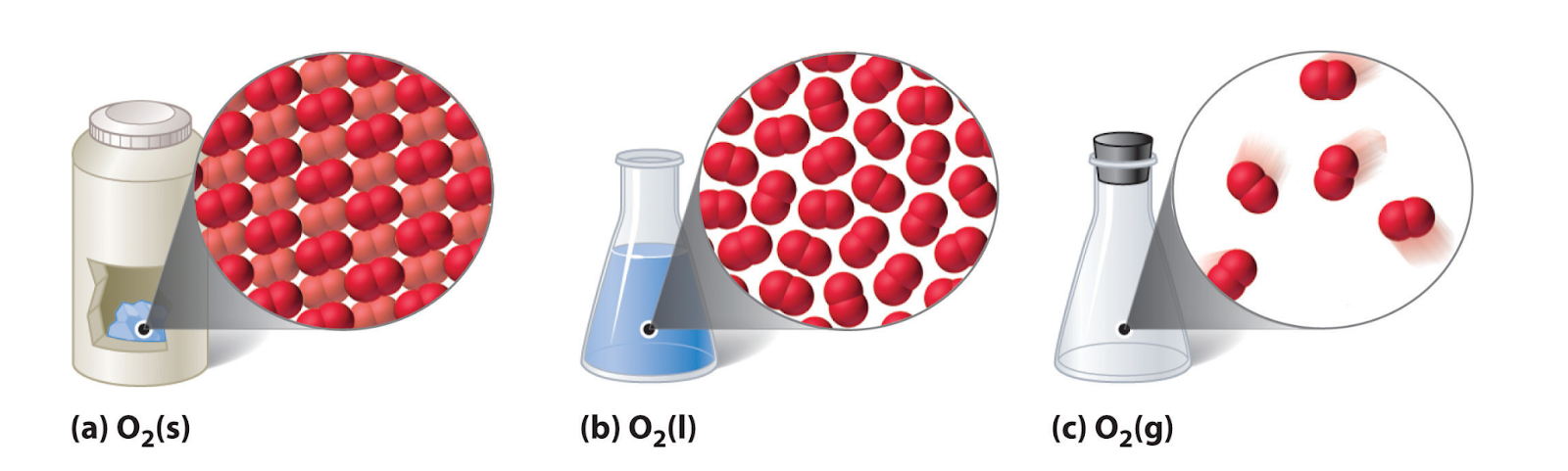
Try to look around the classroom and see if you can see something like oxygen or air. We know we cannot see oxygen or hold it. And, we know that we need to breathe in and out oxygen. Now, the question is, how can the invisible gas take up space, and can move other gases, and can even push other gases by exerting pressure on them?
Chemistry involves the study of gases, and it helps us to understand the behaviour of matter in the most energetic and free state. Gases are used to explain many everyday phenomena, like weather, breathing, the working of engines, balloons, etc.
To study gases, we adopt the particle model of matter. This model explains the behaviour of tiny particles and why gases behave the way they do.
A gas is a state of matter where:
In gases, particles are arranged in such a way that they do not have a definite shape or volume. They fit the shape of the container they are in, and expand to fill all the space available in the container.
The particle model of gases states:
The particle model explains why gases are easily compressed and why they flow and exert pressure.
The shape of the container determines the shape of the gas. For instance, in a bottle, gas takes the shape of the bottle. In a room, air takes the shape of the whole room. This happens because the gas particles can move freely and are not held in fixed positions.
Gases fill the available space, and as such, they do not have a fixed volume. Gas expands when there is more room available. Gas compresses when some of the room is taken away. That is the reason why a gas in a small syringe only takes up a small amount of room, but when released, it can fill a big container.
Gases can be compressed easily. Because of the big gaps between the particles, the particles can be pushed closer together. Gas volume can be reduced by applying pressure. This principle is used in gas cylinders and air pumps. Liquids and solids can't be compressed as easily because the particles in them are already close together.
Gases have much lower density than solids and liquids. This is because there are fewer particles in a given volume. This is how gases feel "light". Hot air balloons rise because warm air is less dense than cold air.
Diffusion is the spreading of particles from a region of high concentration to a region of low concentration.
These are examples of diffusion: the smell of perfume, the smell of food, and gas leaks.
Due to gas particles, diffusion happens more quickly. They mix easily and move randomly. Compared to diffusion in liquids, diffusion in gases is much quicker because the particles in gases are farther apart and move more freely.
Gas pressure is due to the collisions of gas particles with the walls of their container.
Consider the following gas pressure examples that you see in everyday life: Pressure of air in a football, Pressure inside car tires, Pressure that is present in the air around us.
The following factors affect gas pressure: Amount of gas particles present, Heat of gas particles (kinetic energy or temperature), Volume of container.
In a gas, the temperature is a measure of the average kinetic energy (energy of motion) of the gas particles.
When the temperature is increased, particles move with more energy (i.e., faster).
When a gas is heated:
This is the reason for: Balloons expanding in the heat, Increased gas pressure during summer, Hot air balloons rising, Cold air collapses.
When gas is heated, it expands, and it contracts when cooled.
Heating up a gas makes its particles move faster, causing them to move apart and take up more space. This principle is used in many places, including:
If there is a constant temperature, the more pressure there is, the less volume there is.
If there is constant pressure, the more temperature there is, the more volume there is.
If there is a constant volume, the higher the temperature there is, the more pressure there is.
Using these concepts, scientists have been able to foresee the actions of gases based on their surrounding conditions.
Here are some examples of practical uses of different gases:
In labs and industry, gases are stored in cylinders because of the following:
| Comparison | Description |
|---|---|
| Solids and gases | Solids have a definite shape and volume. Gases have no definite volume, and their particles move freely. |
| Liquids and gases | Liquids have a definite volume, but their shape is not fixed. Gases have no fixed shape or volume. |
These differences are a result of the spacing of the particles and the strength of the attractive forces.
Gas studies are important because they illustrate many chemical and physical interactions. The involvement of gases in chemistry comprises:
In an everyday context, it is gas behavior that comprises of:
When it comes to gas chemistry, scientists must exercise a great deal of control over:
Work in gas chemistry must be adjusted and closely monitored. With deliberate control of these variables, the causes and effects of gas behaviors and reactions can be manipulated.
Gas behaviors are summed up as:
The behavior of gases can be predicted and explained using the particle model and gas laws. This knowledge allows scientific concepts to be applied to real-world situations and everyday activities.