

On this page:
Introduction What Is a Chemical Equation? The Law of Conservation of Mass Why Do We Balance Chemical Equations? Parts of a Chemical Equation What does balanced mean? A Simple Method for Balancing Equations The Different Types of Chemical Reactions You Will Balance States of Matter in Equations Coefficients and Ratios Common Mistakes to Avoid Why Do We Balance Equations?It may look like matter is disappearing in a burning candle. But in reality, the atoms are simply being rearranged. To describe this rearrangement, chemists use chemical equations. If chemical equations are balanced, it means they are able to describe nature's accounting.
In chemistry, there is no guessing. If a reaction starts with a particular atom, there is a product that includes that atom. Equations must be balanced because they are the foundation that supports predictions. Without being able to balance equations, you cannot understand how to predict products of reactions and determine how much of each reactant is required.
A chemical equation is a symbolic representation of substances that react (the reactants) and the substances that are formed (the products).
When hydrogen combines with oxygen to create water, it can be written as follows:
Hydrogen + Oxygen → Water
Using chemical symbols, it is written as H₂ + O₂ → H₂O
However, as the equation stands, we do not know how many of each substance is involved. This is the reason why we balance equations.
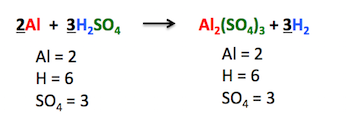
Chemical equations are based on a scientific principle, the Law of Conservation of Mass, which was first articulated by Antoine Lavoisier.
This law states that in a chemical reaction, mass is not created or destroyed. In other words, simply put:
The same number of each type of atom must be on each side of the equation. For example, if there are 4 oxygen atoms before the reaction, there will be 4 oxygen atoms after the reaction.
Balancing chemical equations is not a waste of time. It helps us:
Unbalanced equations don't help with any calculations.
You need to identify the following to balance equations accurately:
This shows the arrangement of the type and the number of atoms in a molecule. For instance in water, H₂O, there are 2 Hydrogen (H) atoms and 1 Oxygen (O).
These are the numbers in front of the chemical formula. For example, in 2H₂O, 2 is the coefficient. Coefficients work with the entire chemical formula.
They are the small numbers you see in the formula e.g. O₂. These numbers are fixed, and you will do nothing to them while balancing the equations.
Important Rule: You are free to change coefficients, but you do not have that freedom with subscripts. Subscripts determine the identity of the substance.
This is what is meant by balanced. When the number of atoms of the same kind is equal to the number of atoms of the same kind, the equation is positioned to give equal ratios to both sides. The equation is also in line with the law of conservation of mass.
If O, H, and Na were to be counted on each side, the following equations would be considered unbalanced.
Left Hand Side: 2H, 2O
Right Hand Side: 2H, 1O
Oxygen is unbalanced. When we balance this equation, we will adjust it to:
Left Hand Side: H: 4, O: 2
Right Hand Side: H: 4, O: 2
Now the equation is considered balanced.
Store the balancing equation in a methodical way. Treat the balancing as a puzzle.
This structured method will help take away the guess work.
The different types of reactions you will balance in MYP chemistry include:
Regardless of the type of chemical reaction, the rule of balancing in and out of reactions remains the same. That is Atoms in = Atoms out.
State symbols can be shown in equations as:
Some state symbols do not change the balancing, but they can help you understand the physical state of each substance as the reaction takes place.
Balanced equations will show simple whole-number ratios. These ratios are very important because they tell us:
For example, in: 2H₂ + O₂ → 2H₂O
The ratio of hydrogen molecules to oxygen molecules is 2:1.
This ratio will be needed again in quantitative chemistry and in stoichiometry.
Students often face similar problems while balancing:
Balancing improves with practice. Small mistakes become easier to spot over time, and so does balancing.
In MYP Chemistry, the most important reason for balancing equations is the number of concepts it encompasses. These concepts include:
In conclusion, balancing chemical equations is the language of chemistry. It is a skill that is required in order to eliminate confusion and understand the process of chemical reactions.