Atomic Structure
Do you want to know why water boils at 100 degrees Celsius? Or why some things are salty and some aren't? How about why some things move, and some things conduct electricity? Have you ever thought about why these things happen?
The reason is because of Atoms.
Atoms are everything from the chair you are sitting on to the stars. Although you can't see an atom with your eyes or even with a microscope, scientists have determined the structure of an atom through hundreds of years of experimentation.
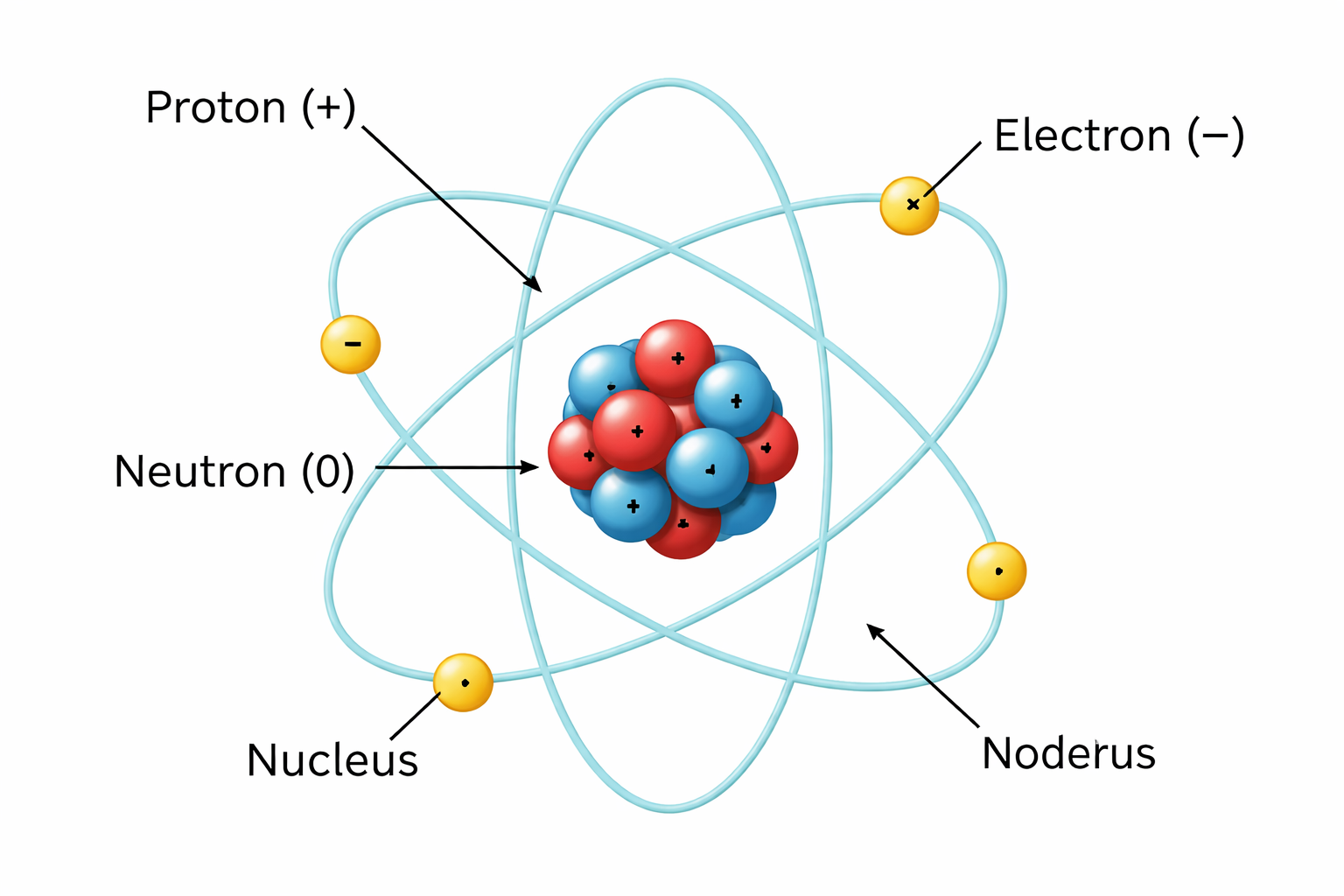
Atoms are more complex than individual dots. Each atom contains a nucleus, which has electrons, protons, and neutrons. These explain why the energy of an atom may or may not interact with other atoms, and why molecules are formed. To understand the atom's structure, we can find out the energy of an atom.
In this lesson, we are going to study various models of scientists for the components of an atom. I will try to build parts of the universe step by step.
Atoms– The Building Blocks of Matter
Atoms are the smallest unit of matter; they are the smallest units of an element that still maintain the properties of that element, in the same way that Lego blocks can connect and build something much greater than the individual block.
Key points:
- Atoms are around 0.1 nanometers across.
- Most of the space in an atom is a vacuum, and in the middle of the vacuum is the nucleus, which has electrons orbiting it.
Subatomic Particles
This atom has three fundamental particles that are the basis of its structure. They are:
Protons
- Positively charged particles (+1 charge)
- Located in the nucleus of the atom
- Identify the atomic number of an element, which characterizes the element.
- Mass ≈ 1 atomic mass unit (amu)
Neutrons
- Neutral particles (no charge)
- Located in the nucleus
- Provide stability to the nucleus
- Mass ≈ 1 amu (slightly heavier than protons)
Electrons
- Negatively charged particles (-1 charge).
- Move around the nucleus in regions called electron shells or energy levels. Mass is extremely small when compared to neutrons and protons (about 1/1836 amu). It is involved in chemical reactions and bonding.
Atomic Number and Mass Number
Two primary numbers outline every single atom:
Atomic Number (Z)
- Is the number of protons found in the nucleus.
- Determines the identity of that element.
- For example: Hydrogen has 1 proton → Z = 1.
Mass Number (A)
- Is the total of protons and neutrons in the nucleus.
- Quantifies the mass of that atom.
- Example: Carbon has 6 protons and 6 neutrons → A = 12.
Protons, Neutrons, and Electrons Relationship
In a neutral atom:
- Number of protons = Number of electrons.
- Number Neutrons = Mass number − Atomic number.
Isotopes
Atoms that have the same element but slightly differ in the number of neutrons are called isotopes.
They have different masses, and in terms of chemistry, they have the same properties (contain the same number of electrons). For instance, Carbon-12 and Carbon-14 are two carbon atoms that have 6 and 8 neutrons, respectively.
Isotopes play a crucial role in:
- Radioactivity (Carbon-14 dating)
- Medicine (radioactive tracers)
Atomic Models
Various models of the atom were suggested by scientists over the years in an attempt to explain the various structures of the atom.
Dalton's Model (1803)
- An atom is a solid, indivisible particle.
- They define elements and compounds but fail to discuss subatomic structure.
Thomson's Model (1897)
- Known as the "plum pudding model''.
- He proposed that an atom is a sphere of positive charge with small, negatively charged particles (electrons) embedded like raisins.
Rutherford's Model (1911)
- He is credited with discovering the nucleus as a result of the famous gold foil experiment.
- He considered that an atom is largely a vacuum and that electrons move around the nucleus like planets around the sun.
Bohr's Model (1913)
- He proposed that the electrons revolve around the nucleus at certain fixed distances, called orbits or shells.
- He explained the atomic spectra of hydrogen.
Quantum Mechanical Model (Modern Model)
- He proposed that electrons are found in clouds.
- He cannot define the exact path an electron takes, but he can provide the level of certainty that the electron will be found in a specific area.
Electron Configuration
Electrons are organized in different energy levels (also called shells) around the nucleus. The distribution of electrons in different energy levels aids in determining the chemical properties of an atom.
Rules for Electron Distribution
- The Aufbau Principle: electrons distribute themselves in increasing order of energy levels.
- The Pauli Exclusion Principle: No more than 2 electrons can be accommodated in any given sublevel.
- Hund's Rule: All electrons in the same sub-level should be placed in different orbitals before pairing up.
Oxygen has an atomic number of 8.
Its electron configuration is 1s² 2s² 2p⁴
Which means:
- There are 2 electrons in the first shell.
- As for the second shell, there are 6 electrons (2 in 2s and 4 in 2p).
Energy Levels and Shells
Electrons are arranged in energy levels and shells K, L, M, N… or are numbered 1, 2, 3, 4…
The maximum number of electrons in a shell can be calculated using the formula 2n² (where n = shell number)
- 1st shell → 2 x 1² = 2 electrons
- 2nd shell → 2 x 2² = 8 electrons
- 3rd shell → 2 x 3² = 18 electrons
The outermost shell contains valence electrons, which are responsible for the reactivity of an atom.
Ions
Ions are the charged particles.
There are two cases for ions:
- Cations: These are ions with positive charges as they have lost electrons.
- Anions: These are ions with negative charges as they have gained electrons.
Example:
- Chlorine (Cl) gains 1 electron → Cl⁻
- Sodium (Na) loses 1 electron → Na⁺
Ions are crucial for the formation of ionic compounds
Atomic Mass
Atomic mass is the average mass of all the isotopes of an element measured in atomic mass units (amu).
For example, the isotopes of chlorine are Cl-35 and Cl-37, so the average atomic mass of chlorine is ≈ 35.5 amu.
Key points to Remember
- Atoms are made up of protons, neutrons, and electrons.
- Both neutrons and protons are located in the nucleus, while the electrons orbit the nucleus.
- Atomic number is equal to the number of protons, while Mass number is the total number of protons and neutrons combined.
- Isotopes are nuclei that have the same number of protons and are the same element, but have a different number of neutrons.
- Models of the atom have changed from Dalton, then to Thomson, then to Rutherford, then to Bohr, and finally to the Quantum Model.
- Atoms exist in different energy levels called electron shells, and the distribution of electrons in the different shells determines the chemical nature of the atom.
- Atoms are neutral, but when they become charged by losing or gaining an electron, they are called ions.
- Atomic mass is found by averaging all the isotopes of the element.