

On this page:
Introduction What Is Air Composed Of? Water Vapor - The Variable Gas The Atmosphere has classified layers The Role of Oxygen in the Atmosphere The Role of Carbon Dioxide The Greenhouse Effect Air Pollution and Changes in Atmospheric Composition How Scientists Study Air Why the Composition of the Atmosphere is Important for Chemistry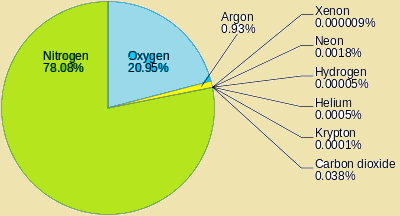
Take a deep breath in. Now let it out. You do this thousands of times each day, without even thinking. Have you ever stopped to wonder what stuff you just inhaled? Air is a mixture of gases that, most importantly, makes life on Earth possible. In chemistry, learning to breathe and understand the composition of air would help to form the basis of combustion, weather, climate, and even environmental issues.
The atmosphere is a thin layer of gases surrounding Earth, held by gravity. It protects the Earth from the Sun's harmful radiation and maintains temperatures that support life and the chemical processes required for life. If it were not for this protective layer, Earth would go on existing as a lifeless, cold hunk of rock floating in space.
Air is a mixture of gases; because of this, each gas has its own properties.
Most of the compositions of air include:
Most of the air is composed of nitrogen. Nitrogen gas is a non-reactive gas, so it dilutes and stops oxygen from readily combusting. Nitrogen is also essential for the nitrogen cycle, which supports the growth of plants.
Oxygen is essential for breathing, supports all combustion (burning), and is also important in oxidation processes like rusting. Oxygen also makes up roughly 21% of air.
As a noble gas, argon is also very unreactive and is used in light bulbs and welding to create an inert atmosphere.
While this is a small composition, it is extremely important due to the fact that it is used by plants in order to create food through a process called photosynthesis. Carbon dioxide is also a greenhouse gas, which is responsible for trapping heat and causing the Earth to become warmer than it would be otherwise.
In addition to the above components, there is also a small amount of other gases like neon, helium, methane, ozone, and hydrogen that are present. Some of these gases are extremely dangerous to the health of living creatures and can greatly affect the climate of the planet.
Water vapor is like no other gas because it is not present in fixed amounts. Its concentration changes due to the weather and the geographical location. On dry and cold days, the air has a high tendency to be devoid of moisture.
On the other hand, warm and humid days have a tendency to have higher amounts of moisture.
Evaporated water can also cause:
On top of all that, evaporated water is a greenhouse gas, meaning it helps heat the atmosphere and contributes to climate change.
The atmosphere has layers classified in degrees of temperature based on altitude. Each layer has its unique characteristics.
The higher we go above the surface of the earth, the more the composition of the air and its characteristics change.
One of the most vital elements is oxygen.
Oxygen is extremely reactive, and yet, the amount of oxygen in the atmosphere is relatively stable due to the following cycles.
The interdependence of humans, animals, and plants helps to maintain stable levels of oxygen in the atmosphere.
The following are sources of carbon dioxide:
The following are sinks of carbon dioxide:
The constant cycling of carbon throughout the atmosphere, living organisms, and the environment is known as the carbon cycle. When human activities introduce carbon dioxide in excess amounts, the carbon cycle becomes unbalanced, and this leads to climate change.
Some atmospheric gases can retain the sun's heat, and we refer to this phenomenon as the greenhouse effect.
Key greenhouse gases comprise:
Naturally, the greenhouse effect helps make the Earth hospitable by regulating the temperature. Due to human activities, in excessive quantities, the greenhouse effect causes:
Our knowledge of atmospheric composition reveals the relationship between climate and chemistry.
The activities of people modify the natural makeup of the air, and it is referred to as air pollution.
Traffic emissions release:
These substances can cause:
Pollutants are identified through chemistry.
Air is subjected to analysis by scientists using chemical processes and tools.
These methods show how the atmosphere is changing over time.
The composition of the atmosphere connects numerous topics in chemistry and daily life.
The air we breathe is a large chemical system, and small changes can affect life, health, and the environment. Knowing the composition of the atmosphere and the behavior of gases is a foundation for chemical reactions, environmental chemistry, and sustainability topics in the MYP chemistry curriculum.