

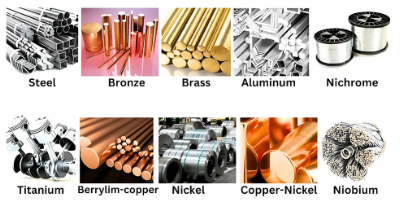
Look around the classroom. The metal parts of the chairs, the door handles, the taps, the windows, and even the wires in your devices are not pure metals. They are all metals that have been combined with other elements.
While pure metals have certain uses, they all have limitations. Some are too soft, some rust, and some break. In order to improve these characteristics, scientists have learned to mix metals with other elements to create stronger and more useful products. They call these products alloys.
Alloys help create modern life. In buildings, in bridges, in tools that we use in the kitchen, and in equipment that we use in medicine, alloys make products safer, stronger, and more durable.
To mix two or more elements, one of which is a metal, is called an alloy. The goal of creating an alloy is to enhance the properties of the base metal.
For example
Notes on alloys:
Alloys are necessary to work around the limitations of pure metals. The additions made to the pure metal alter the way the resulting metal behaves.
Alloys are made to:
In simple terms, alloys are made to make metals more practical for real-life use. Metals that rust or bend too easily are not practical to use for construction or tools.
Layers of atoms make up metals, and in a pure metal, the atoms are all the same size. With the same size atoms, the layers of atoms slide over each other really easily, and that is why metals are able to bend.
When making an alloy,
Although the above is a simplified description, it underscores the significance of subtle adjustments on a microscale.
Steel is a good example of a ferrous alloy, and it is composed of iron and carbon. Ferrous alloys are used in construction because of their durability, and because of their affordability, they are used in the manufacturing of vehicles and tools. Stainless steel is a type of ferrous alloy that is composed of iron, carbon, and chromium. Due to these compositions, it does not rust or corrode. Therefore, it is a good choice for kitchenware and medical tools, as well as sinks.
These are alloys that do not contain iron as a base metal.
Examples:
Non-ferrous alloys are:
Alloys are designed to have specific properties. These properties are determined by the constituent elements and their ratios.
Examples of important properties of alloys:
Modification of the alloying components enables scientists to manipulate these properties for particular applications.
Corrosion is the gradual destruction of metals as a result of chemical reactions with the surrounding environment. Common example: rusting of iron.
How Does Corrosion Affect Us?
How Do Alloys Help Corrosion?
Making alloys involves melting metals and mixing them in closed systems.
Key Steps:
It is required that:
The entire system is designed to create a material with specific properties, which is the essence of material science.
Alloys are found in several things in daily life; here are some of their specific usages:
Each of these usages is due to specific properties, be it strength, lightness, resistance to corrosion, or safety.
In the construction industry, if alloys are used, it can promote environmental safety:
From the previously stated examples, it is evident that the recycling of alloys will consume much less energy than if it were to produce alloys from ores. This also illustrates the Importance of alloys for the future.
Alloys are made from pure metals and other elements to enhance desirable properties. In comparison to pure metals, alloys can be made much stronger, more corrosion-resistant, and more practical for a given use. Innovation at the atomic level allows the modification of a metal's composition and structure, facilitating advancements in technology, construction, transport, and health. The development of alloys helps enhance the safety, strength, and durability of the materials used in everyday objects, positively impacting a wide range of everyday items.