

On this page:
Introduction What Is Organic Chemistry? Alkanes: Saturated Hydrocarbons Alkenes Alcohols: Organic compounds that have the -OH group Basic Nomenclature Overview of Alkanes, Alkenes, and Alcohols Similarities and Differences Environmental and Safety Considerations Importance of these Families in Chemistry
You come into contact with organic compounds every day. They are in the soap you use to wash your hands, the drink in the plastic bottle that you bought, the fuel that powers the cars, and in some of the medicine that you take. Organic compounds are large molecules that contain the element carbon. A unique feature of the element carbon is its ability to bond with itself to form long, branched chains. This is how large the field of Organic Chemistry is.
In this unit, you will learn about three important classes of organic compounds: alkanes, alkenes and alcohols. These groups of compounds provide the basis for understanding fuels, plastics, solvents, and a variety of other materials that you encounter in your day-to-day life.
Organic chemistry studies carbon compounds. Each carbon atom bonds covalently to four other atoms. These atoms can be other carbon atoms or elements such as hydrogen, oxygen, nitrogen, or halogens. As a result, simple molecules are formed, like methane or extremely large molecules like polymers and proteins.
Based on structure, chemistry, and reactions compounds are divided into families known as homologous series.
A homologous series has
Of the many homologous series, there are three most important ones that relate to the study of structure, properties, and reactions, and these are known as alkanes, alkenes, and alcohols.
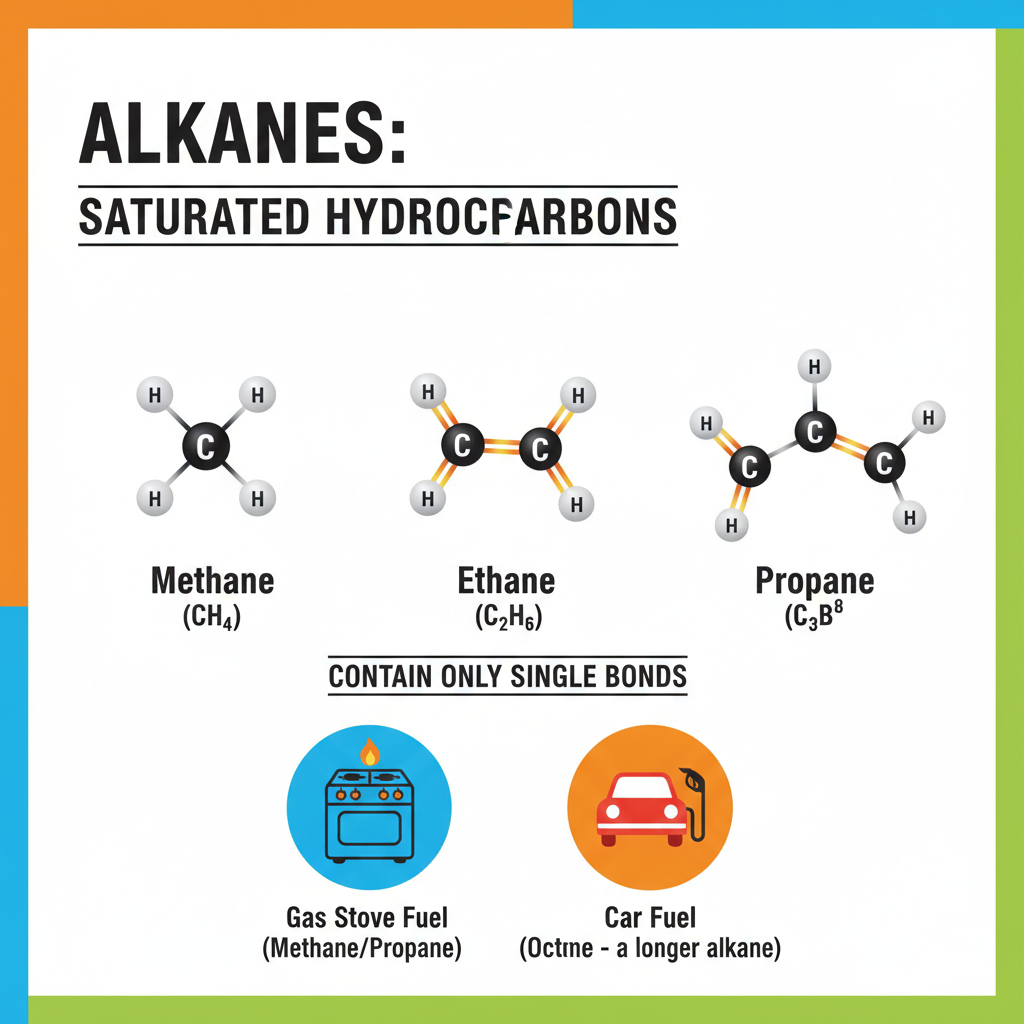
Alkanes are known as the simplest and most basic family of organic compounds. They contain carbon and hydrogen, which is why they are called hydrocarbons. In alkanes, there are only single carbon–carbon bonds. Therefore, alkanes are known as saturated hydrocarbons. This means that they have the maximum number of hydrogen atoms.
Examples of alkanes are methane (CH₄), ethane (C₂H₆), propane (C₃H₈), and butane (C₄H₁₀).
Alkanes are non-polar compounds, meaning that they are insoluble in water. They are less reactive than other organic compounds, and in the presence of oxygen they are easily combustible.
With increased carbon chain length, the greater the boiling point of the molecule. This is due to increased weight and stability of the molecule. Alkanes are gases from C1-C4, liquids from C5-C11, and solids from C12+.
Alkanes are raw materials in the chemical industry and comprise components of natural gas and petroleum. They also serve as fuels for transport and heating.
Alkanes combust with oxygen to release energy. This energy can be harnessed for heating and lighting and the products of the reaction are CO₂ and H₂O. An incomplete combustion reaction is termed as incomplete combustion and can produce toxic CO.
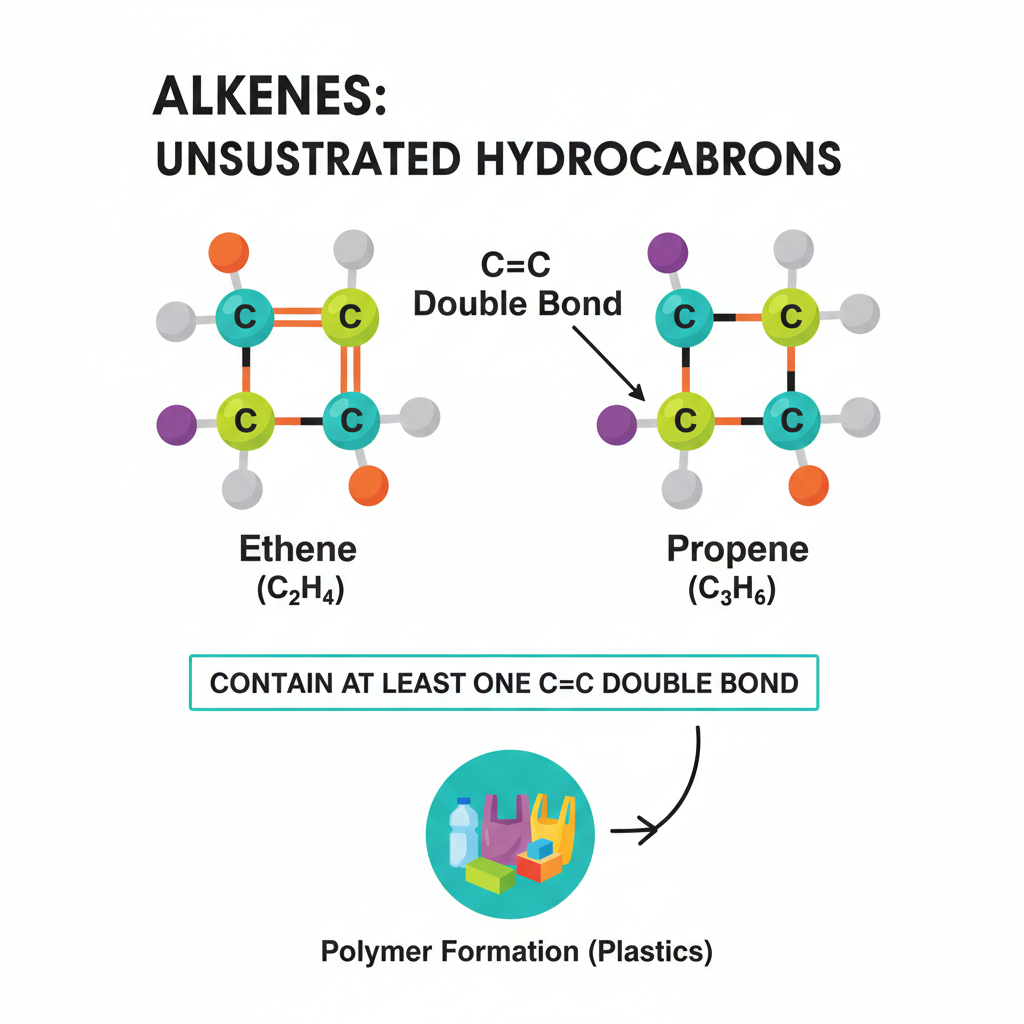
Alkenes are another category of hydrocarbons. Unlike alkanes, alkenes have at least one carbon–carbon double bond. This C=C double bond makes alkenes more reactive than alkanes. Because of this characteristic, alkenes are considered unsaturated hydrocarbons since they do not have the maximum amount of hydrogen.
Examples of alkenes include ethene (C₂H₄), propene (C₃H₆), and butene (C₄H₈).
Important points about alkenes:
Alkenes are unique and mainly take part in addition reactions. In these reactions, alkenes double bond break and saturate the integer.
Alkenes can also be tested with hydrogen and halogens. Alcohol can also be produced with alkenes and steam.
Applications of alkenes
The presence of -OH functional group distinguishes alcohols from alkanes and alkenes.
Examples of alcohols include methanol (CH₃OH), ethanol (C₂H₅OH), and propanol (C₃H₇OH).
Main characteristics of Alcohols:
Physical properties: Compared to longer-chain alcohols, shorter-chain alcohols have greater water solubility, this can be explained by the -OH being of higher polarity. Alcohols with longer carbon chains display low hydrocarbon-like water solubility.
Applications of alcohols:
Alcohols combustion: To release energy in the form of heat and light with the production of carbon dioxide and water, alcohols, like other fuels, can burn in the presence of oxygen. Due to the combustion of alcohols being cleaner than that of fossil fuels, they can be used as biofuels.
Based on the number of carbon atoms in the compound, each class of organic compounds has its own set of prefixes, and each class has its own type of suffixes.
Found in organic compounds prefixes:
Present in organic compounds suffixes:
This vertical system means scientists are able to communicate with each other easily on a global scale.
Even with their differences, these three families of compounds do have some things in common.
Similarities:
Differences:
Different functional groups and chemical bonds determine their reactivity and usefulness in our daily lives.
Global warming is exacerbated by the release of carbon dioxide from the combustion of most alkanes. Combustion of alkanes also leads to the formation of dangerous gases. Some alcohols are poisonous, while the alkenes used in making plastics are not biodegradable.
The careful use of organic compounds consists of:
Together these families provide us the foundation to build more advanced organic chemistry. In the coming lessons, we will concentrate on:
These topics will help you appreciate the importance of chemistry in our everyday lives.