

On this page:
Introduction What Are Acids and Bases? Properties of Acids and Bases Indicators: How to Identify Acids and Bases Measuring Acidity and Basicity Using pH Scales Strong Acids and Bases Vs Weak Acids and Bases Reactions with Neutralization Reactions with Acids and Metals Reactions of Bases Everyday Uses of Acids and Bases Conclusion / Key Points Why are Acids and Bases Important? Common Acids and Bases – Quick Reference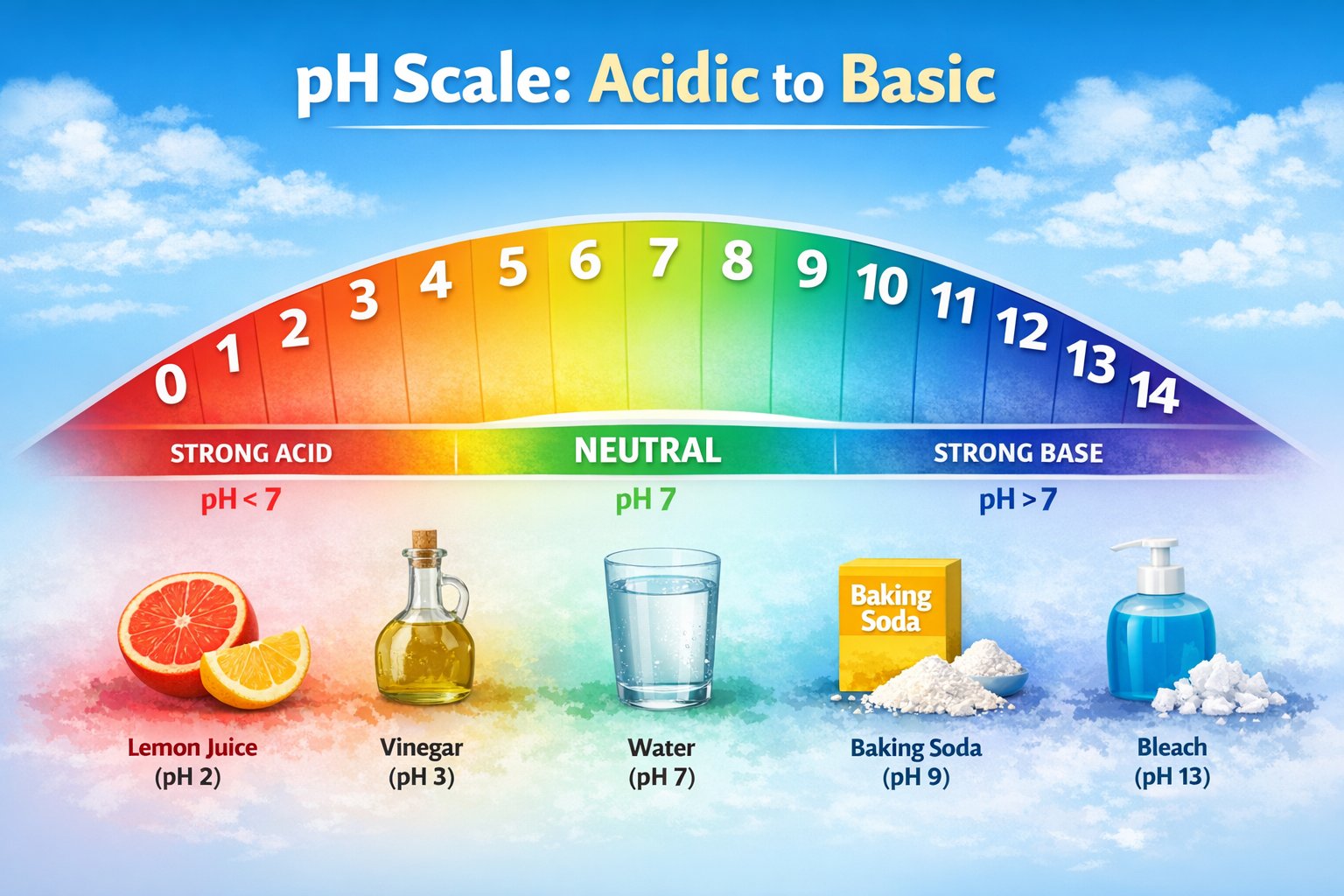
Have you ever wondered why lemons are sour or why soap is slippery? Or why vinegar can get rid of stains, but baking soda makes your cake rise? All of these examples are due to acids and bases. There are two major classifications of chemicals, and learning about them will help you understand why things happen the way they do in the world. Cleaning, digestion, and even helping plants grow are all affected by acids and bases.
Chemistry is the study of matter and what happens to it, and the study of matter would not be complete without the study of acids and bases, since they are involved in every reaction, whether in the lab, home, or in nature.
Acids are substances that, if you were to dissolve them in water, would release hydrogen ions (H⁺). Acids can be sour. For example, they can be lemon juice or vinegar. Because of the free ions (in the water), they can conduct electricity.
Common acids include:
Bases, on the other hand, are the exact opposite of acids. Bases are substances that release hydroxide ions (OH⁻) in water.
They usually have a bitter taste and a slippery texture similar to soap.
When mixed with water, they can conduct electricity.
Some common bases are
Key Concept: Acids are H⁺ donors, and bases are OH⁻ donors. Following this rule will help you predict the reactions.
An indicator is a substance that will change its color depending on whether it is an acid or a base. This concept is widely used in chemistry to determine unknown solutions
Fun Fact: Many natural indicators, like red cabbage juice (to name a few), show a variety of colors depending on the pH.
The range of the scale is from 0 to 14.
Key Concept: The pH scale is logarithmic, meaning each unit change represents a tenfold difference in H⁺ concentration.
Example: pH 3 is ten times more acidic than pH 4.
Not all acids or bases are equally powerful.
Completely dissociate into ions in water.
Example: [HCl, NaOH ]
Partially dissociate into ions in water.
Example: [CH₃COOH and NH₄OH ]
Why this matters: Strong acids react more vigorously and can be dangerous, while weak acids are milder and are safer to handle.
Reactions with neutralization occur when an acid and a base create a salt and water.
Acid + Base = Water + Salt
Acids react with certain metals to form hydrogen gas and salt. This is an important property for industries and labs.
Observation: Bubbling occurs when hydrogen gas is produced.
Note: Not all metals react with acids. For example, copper does not react with HCl because it is less reactive.
Bases react with metals, acids, and amphoteric substances.
Acid + Base → Salt + Water
Calculations for neutralization reactions are already mentioned in earlier papers.
Example: Al + NaOH → NaAlO₂ + H₂
Sodium Hydroxide (Caustic Soda) is used in cleaning and removing grease. Calcium Hydroxide (Lime) is used in agriculture for the neutralization of acidic soils.
Besides laboratory use, acids and bases are widely used in daily life.
Did you know? Rainwater is naturally slightly acidic (pH ~5.5). When there is CO₂ in the air, and it rains, the water droplets capture the CO₂ in the form of carbonic acid. When the acid rain falls to the ground, it has the ability to damage the environment.
In MYP Chemistry, knowledge of acids and bases enables you to:
In Chemistry, the measurement of acids and bases is considered to be as important as the measurement of distance or mass in Physics. This means that, just as a single measurement can determine the success or failure of a calculation in physics, a single measurement can determine the success or failure of a calculation in Chemistry.
In addition to cleaning and cooking, all chemical processes rely on the knowledge of acids and bases.
| Substance | Formula | pH Range | Everyday Use / Example |
|---|---|---|---|
| Hydrochloric acid | HCl | 1-2 | Stomach acid for digestion; cleaning metals |
| Sulfuric acid | H₂SO₄ | 1-2 | Car batteries; production of fertilizers |
| Nitric acid | HNO₃ | 1-2 | Fertilizers; explosives; lab reagent |
| Citric acid | C₆H₈O₇ | 2-3 | Lemon juice; food preservative |
| Acetic acid | CH₃COOH | 2-3 | Vinegar for cooking and cleaning |
| Carbonic acid | H₂CO₃ | 3-4 | Soft drinks; acid rain |
| Sodium hydroxide | NaOH | 13-14 | Soap making; drain cleaner |
| Potassium hydroxide | KOH | 13-14 | Soaps; industrial processes |
| Calcium hydroxide | Ca(OH)₂ | 12-13 | Agriculture (soil treatment); water treatment |
| Ammonium hydroxide | NH₄OH | 11-12 | Cleaning agent; fertilizer |
| Magnesium hydroxide | Mg(OH)₂ | 10-11 | Antacid; laxative |
| Baking soda | NaHCO₃ | 8-9 | Baking; neutralizing acids |
| Milk of magnesia | Mg(OH)₂ | 10-11 | Antacid for stomach relief |
| Water (neutral) | H₂O | 7 | Drinking; universal solvent |