

On this page:
Introduction What Is a Tropism? Auxins: The Hormones of Tropisms Phototropism Mechanism of Phototropism Evidence from Classic Experiments Gravitropism (Geotropism) Mechanism of Gravitropism Thigmotropism Hydrotropism Thermotropism Practical Importance of Tropisms Other Plant Hormones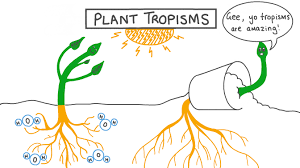
Plants cannot run from predators. They cannot chase food. They cannot migrate to warmer places in winter. Yet they are not passive. They respond to their environment continuously and precisely, growing toward light, orienting roots toward gravity, responding to touch, and tracking the Sun across the sky.
These growth responses to directional stimuli are called tropisms. They are among the most elegantly simple yet biochemically sophisticated mechanisms in biology, and they reveal that plants, despite their immobility, are highly responsive organisms.
A tropism is a directional growth response of a plant to a directional stimulus.
The direction of growth is determined by the direction of the stimulus.
Tropisms are not movements of the whole plant. They are differential growth, meaning cells on one side of a stem or root elongate more than cells on the other side, causing the organ to bend.
Tropisms are controlled primarily by a group of plant hormones called auxins, the most important of which is indoleacetic acid (IAA).
Auxins are produced in the growing tips (apical meristems) of shoots and roots and move downward through the plant.
The key to understanding tropisms is understanding how auxins affect cell elongation.
This difference in sensitivity between shoot and root cells explains why the same auxin distribution produces opposite growth responses in shoots and roots.
Phototropism is the growth response of a plant to light.
When light strikes a shoot from one side:
As the shoot bends, light strikes more evenly, auxin redistribution diminishes, and the shoot grows straight again.
This response ensures the shoot maximizes light absorption for photosynthesis.
Experiments on oat coleoptiles (shoot tips) by Boysen-Jensen, Went, and others in the early 20th century established the role of auxins in phototropism.
This chemical was later isolated and named auxin.
Gravitropism is the growth response of a plant to gravity.
When a plant is oriented horizontally:
This ensures shoots grow toward light and roots grow toward water and anchor the plant in soil, regardless of how a seed is oriented when it germinates.
Statoliths, dense starch-containing plastids in root cap cells, are thought to sediment under gravity and trigger the auxin redistribution that initiates gravitropism.
Thigmotropism is the growth response of a plant to touch or mechanical contact.
It is most clearly seen in climbing plants.
When a tendril of a climbing plant contacts a solid surface:
This allows vines, peas, and other climbing plants to attach to supports and grow upward without investing resources in a thick, self-supporting stem. Thigmotropism is the mechanism behind the spiraling growth of tendrils around supports.
Hydrotropism is the growth response of plant roots toward water.
Roots grow toward regions of higher moisture, helping plants find water in the soil. This response is important for establishing seedlings in soil where water availability is patchy.
Thermotropism is the growth response to temperature gradients.
Some flowers track temperature, opening in warm conditions and closing in cold. The tulip, for example, opens when warmed and closes when cooled, a response driven by differential cell expansion on the inner and outer surfaces of the petals.
Understanding tropisms has practical applications in agriculture and horticulture.
While auxins are the primary hormones of tropisms, other plant hormones also regulate plant growth and responses.