

On this page:
Introduction What Is a Species? Speciation Types of Reproductive Isolation Pre-zygotic Isolation Post-zygotic Isolation Allopatric Speciation Examples of Allopatric Speciation Sympatric Speciation Adaptive Radiation Extinction Causes of Extinction Natural Causes Human-Caused Extinction Mass Extinctions The Sixth Mass ExtinctionThe history of life on Earth is a story of constant change. Species appear, diversify, and disappear. Of all the species that have ever lived, it is estimated that over 99 percent are now extinct. The living world we see today, with its estimated 8 to 10 million species, represents a tiny fraction of the total diversity that has existed over 4 billion years of evolutionary history.
Understanding how species form and how they disappear is fundamental to understanding the history of life, the current biodiversity crisis, and the future of life on Earth.
Before exploring how species form, it is essential to be clear about what a species is.
The biological species concept defines a species as a group of organisms that share common characteristics, can interbreed with each other in nature, and produce fertile offspring, but are reproductively isolated from all other groups.
Reproductive isolation is the key. Two populations may look similar, but if they cannot successfully interbreed, they are different species. Conversely, two populations may look quite different, but if they can interbreed and produce fertile offspring, they remain the same species.
The biological species concept has limitations. It cannot be applied to asexually reproducing organisms or to fossils. Alternative species concepts based on morphology, genetics, or ecological role are also used by biologists depending on the context.
Speciation is the evolutionary process by which new species arise from existing species.
For speciation to occur, a single population must be divided into two or more groups that evolve independently. If the groups remain separated long enough and evolve sufficiently different characteristics, they eventually become reproductively isolated and are recognized as separate species.
The key requirement for speciation is reproductive isolation, the condition in which members of two populations cannot or do not interbreed.
Reproductive isolation can arise through several mechanisms.
Barriers that prevent mating or fertilization from occurring.
Barriers that prevent hybrid offspring from surviving or reproducing.
Allopatric speciation is speciation that occurs when a population is geographically separated into two or more isolated groups by a physical barrier.
This is the most common and well-documented mode of speciation.
Process of Allopatric Speciation:
Darwin's Galapagos finches: The ancestral finch population from South America colonized different islands of the Galapagos archipelago. Separated by the ocean on different islands with different food sources, populations evolved different beak shapes suited to different diets. The 15 species of Galapagos finch recognized today all descended from a common ancestor through allopatric speciation.
Cichlid fish of the African Great Lakes: Lake Victoria, Lake Malawi, and Lake Tanganyika each contain hundreds of cichlid fish species found nowhere else, all having diversified from a small number of founding populations through allopatric speciation within the lakes as water levels changed over geological time.
Sympatric speciation occurs within the same geographic area without physical separation.
It requires some other form of reproductive isolation to arise within a population. It is less common than allopatric speciation and has been debated more extensively by biologists.
Polyploidy is the most clear-cut mechanism of sympatric speciation, particularly in plants. If an individual arises with double the normal number of chromosomes (through an error in meiosis), it cannot successfully interbreed with the original diploid population. If it can self-fertilize or reproduce asexually, it may establish a new polyploid species.
Polyploidy has been enormously important in plant evolution. Many important crop species, including wheat, cotton, and coffee, are polyploids, having arisen through chromosome doubling events in their evolutionary history.
Adaptive radiation is the rapid diversification of a single ancestral species into multiple species filling different ecological niches.
It typically occurs when:
The Galapagos finches, the cichlid fish of African lakes, the mammals that diversified rapidly after the extinction of non-avian dinosaurs, and the Hawaiian honeycreepers all represent examples of adaptive radiation.
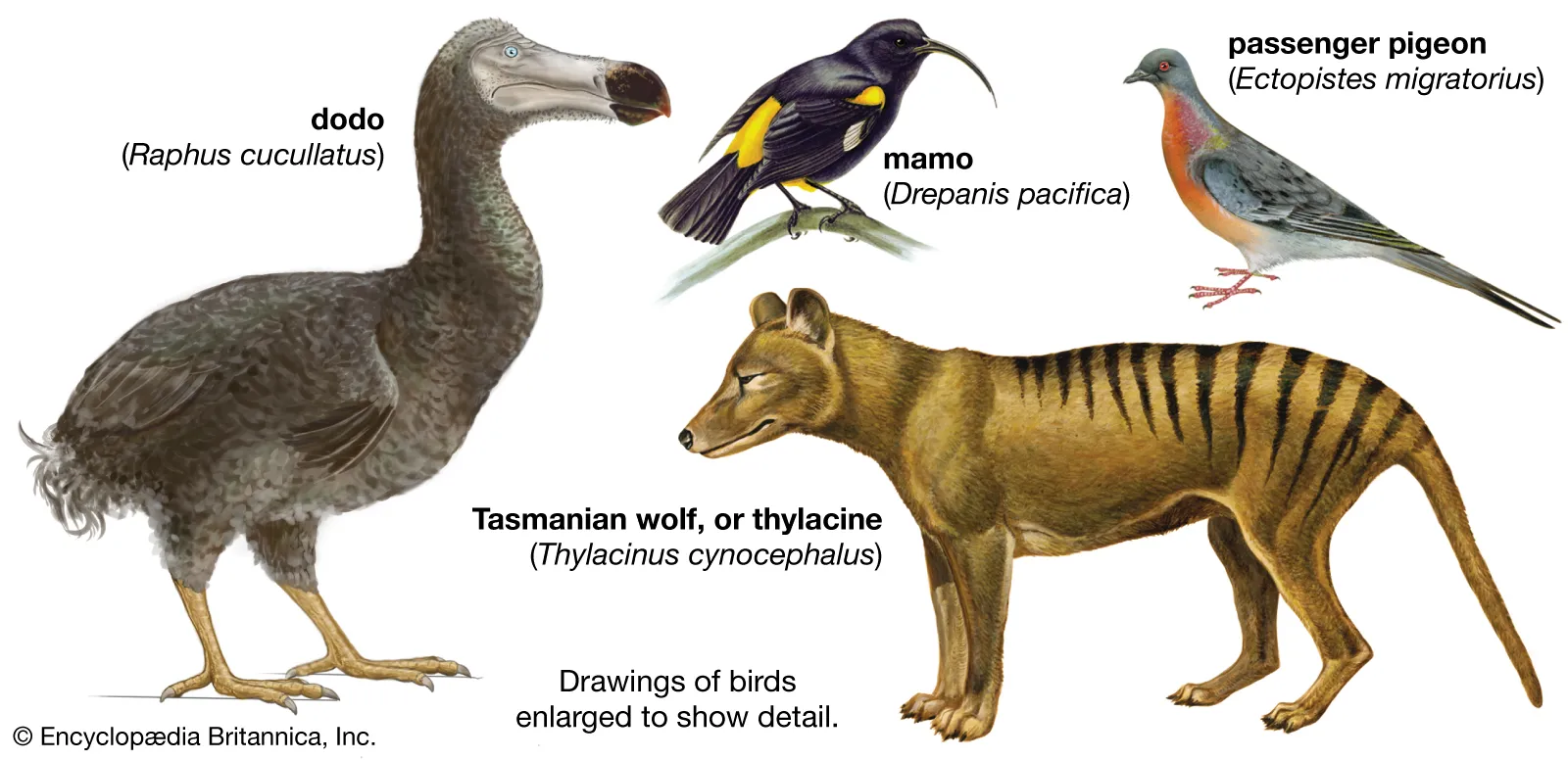
Extinction is the permanent disappearance of a species from Earth when the last member of that species dies.
Extinction is a natural part of the history of life. Background extinction rates, the rate at which species disappear in the absence of exceptional disturbance, have averaged perhaps one to five species per year throughout geological history. But mass extinctions have periodically increased extinction rates dramatically above background levels.
The current rate of species extinction is estimated to be 100 to 1,000 times the background rate, driven overwhelmingly by human activities.
A mass extinction is an event during which a large proportion of Earth's species disappear in a geologically short period of time.
Five major mass extinctions have been identified in the fossil record.
| Event | Time | Approximate species lost | Likely cause |
|---|---|---|---|
| End-Ordovician | 443 million years ago | 85% | Glaciation and sea level fall |
| Late Devonian | 375 million years ago | 75% | Multiple factors, including anoxia |
| End-Permian (Great Dying) | 252 million years ago | 96% | Volcanic eruptions, climate change |
| End-Triassic | 201 million years ago | 80% | Volcanic eruptions |
| End-Cretaceous (K-Pg) | 66 million years ago | 76% | Asteroid impact and volcanism |
The End-Permian extinction was the most severe in Earth's history, nearly wiping out all multicellular life. The End-Cretaceous extinction, caused primarily by the impact of a 10-kilometer asteroid near the present-day Yucatan Peninsula in Mexico, eliminated the non-avian dinosaurs along with three-quarters of all species but opened ecological space for the subsequent radiation of mammals.
Many biologists argue that Earth is currently experiencing a sixth mass extinction, driven not by geological or astronomical events but by human activity.
Current extinction rates are estimated at 100 to 1,000 times background rates. Thousands of species are classified as critically endangered. Populations of wild vertebrates have declined by an average of 68 percent since 1970, according to the WWF Living Planet Report.
Unlike all previous mass extinctions, this one has a known, identifiable cause operating over a timeframe of centuries rather than millions of years. This means, in principle, that it can be slowed or reversed through changes in human behavior, land use, and conservation policy.
Understanding speciation and extinction, therefore, has immediate and urgent practical importance, not just as academic biology but as the scientific foundation for conserving the living world that all human life ultimately depends upon.