Senses
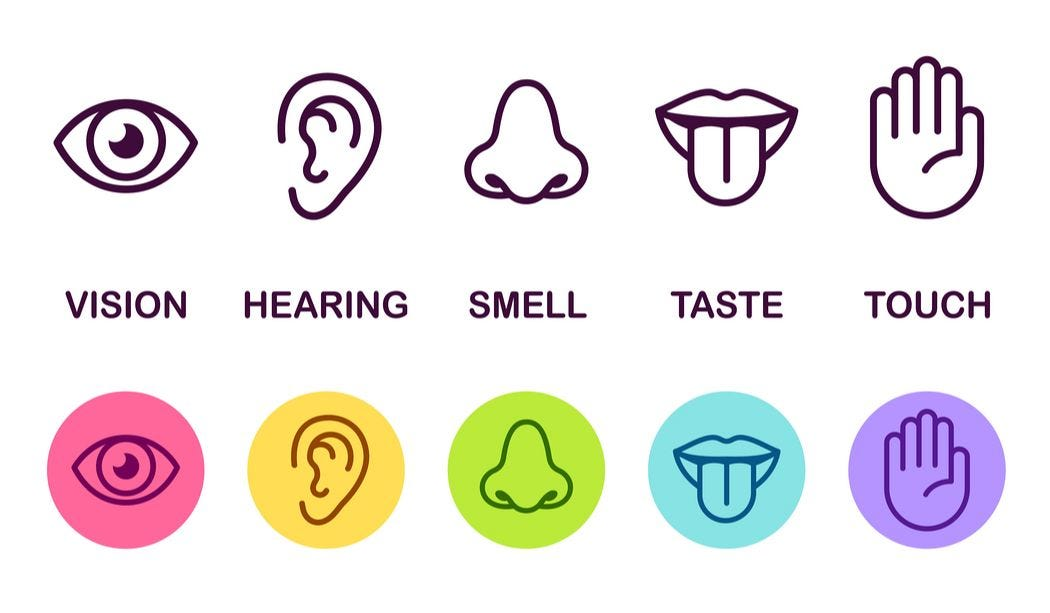
Close your eyes for a moment. You can still hear the sounds around you. You can feel the temperature of the air. You can smell what is nearby. You are aware of the position of your own body. Even with your eyes closed, your sensory systems are feeding your brain with a continuous stream of information about the world around you and the state of your own body.
Senses are the means by which living organisms detect stimuli from their internal and external environments. Without them, no organism could respond appropriately to its environment, find food, avoid predators, or maintain homeostasis.
Stimulus and Response
A stimulus is any change in the internal or external environment that an organism can detect and respond to.
A response is the reaction of an organism to a stimulus.
The pathway from stimulus to response follows a consistent pattern in animals:
Stimulus → Receptor → Sensory neuron → CNS → Motor neuron → Effector → Response
Receptors detect the stimulus. The central nervous system (brain and spinal cord) processes the information. Effectors (muscles or glands) produce the response.
Types of Sensory Receptors
Sensory receptors are specialized cells or nerve endings that convert specific types of stimuli into electrical impulses (action potentials) that travel along sensory neurons to the brain.
Different receptors are specialized for different types of stimuli.
| Receptor Type |
Stimulus Detected |
Location |
| Photoreceptors | Light | Retina of the eye |
| Mechanoreceptors | Pressure, touch, sound, movement | Skin, ear, joints |
| Thermoreceptors | Temperature | Skin, hypothalamus |
| Chemoreceptors | Chemicals | Nose, tongue, blood vessels |
| Nociceptors | Pain (tissue damage) | Throughout body |
| Proprioceptors | Body position and movement | Muscles, tendons, joints |
All sensory receptors perform transduction: converting the energy of one form of stimulus (light, sound, pressure, or chemicals) into the electrical energy of a nerve impulse.
The Eye
The eye is the organ of vision, detecting light and producing the visual information that the brain processes into images.
Structure of the Eye
- Sclera: The tough, white outer coat of the eye that maintains its shape and protects inner structures.
- Cornea: The transparent front section of the sclera. It refracts (bends) light as it enters the eye and is responsible for approximately 70 percent of the eye's total refractive power.
- Choroid: A heavily pigmented layer inside the sclera. The dark pigment absorbs stray light, preventing internal reflections that would blur the image. It also contains blood vessels supplying the retina.
- Iris: The colored ring of muscle surrounding the pupil. It controls the size of the pupil and, therefore, the amount of light entering the eye.
- Pupil: The opening in the center of the iris through which light passes. It appears black because the interior of the eye absorbs light.
- Lens: A transparent, biconvex structure that fine-tunes focusing by changing its shape. It is connected to the ciliary body by suspensory ligaments.
- Ciliary body and ciliary muscles: The ring of smooth muscle surrounding the lens. When ciliary muscles contract, they change the shape of the lens.
- Suspensory ligaments: Fibers connecting the lens to the ciliary body. They hold the lens under tension.
- Retina: The light-sensitive layer lining the back of the eye containing photoreceptor cells.
- Fovea (yellow spot): The region of highest visual acuity on the retina, packed densely with cone cells. When you look directly at something, its image falls on the fovea.
- Blind spot: The point where the optic nerve exits the eye. No photoreceptors are present here.
- Optic nerve: Carries electrical impulses from the retina to the visual cortex of the brain.
- Vitreous humor: Clear, gel-like fluid filling the main cavity of the eye.
- Aqueous humor: Clear, watery fluid between the cornea and lens.
Photoreceptors: Rods and Cones
The retina contains two types of photoreceptor cells.
Rod Cells
- Approximately 120 million per eye
- Spread across most of the retina except the fovea
- Sensitive to low light intensity
- Responsible for night vision
- Cannot distinguish colors
- All contain the same light-sensitive pigment: rhodopsin
- Many rods connect to the same sensory neuron, increasing sensitivity but reducing resolution
Cone Cells
- Approximately 6 million per eye
- Concentrated in the fovea
- Require bright light to function
- Responsible for color vision and fine detail
- Three types: sensitive to red, green, or blue wavelengths
- Each cone connects to its own sensory neuron, providing high resolution but low sensitivity
Accommodation
Accommodation is the process by which the lens changes shape to focus light from objects at different distances onto the retina.
Focusing on a near object:
- Ciliary muscles contract
- This reduces tension on the suspensory ligaments
- The lens becomes more rounded (more convex)
- Light is refracted more strongly, bringing the near image into focus
Focusing on a distant object:
- Ciliary muscles relax
- Suspensory ligaments pull taut under their own tension
- The lens is pulled into a flatter shape
- Light is refracted less strongly, bringing the distant image into focus
Pupil Reflex
The pupil reflex adjusts the amount of light entering the eye.
In bright light:
- Circular muscles of the iris contract
- Radial muscles relax
- Pupil constricts (becomes smaller)
- Less light enters, protecting the retina
In dim light:
- Radial muscles of the iris contract
- Circular muscles relax
- Pupil dilates (becomes larger)
- More light enters, improving vision in low light
The Ear
The ear detects sound waves (hearing) and detects changes in head position and movement (balance).
Structure of the Ear
Outer ear:
- Pinna: the external flap that collects and directs sound waves into the ear canal
- Ear canal (auditory meatus): channels sound to the eardrum
- Eardrum (tympanic membrane): a thin membrane that vibrates when sound waves strike it
Middle ear:
- Three small bones (ossicles): malleus (hammer), incus (anvil), and stapes (stirrup)
- They transmit and amplify vibrations from the eardrum to the oval window
- Eustachian tube: connects the middle ear to the throat, equalizing pressure on both sides of the eardrum
Inner ear:
- Cochlea: a fluid-filled, coiled structure containing mechanoreceptor hair cells. Sound vibrations travel through the fluid, bending hair cells at different positions depending on frequency. This bending generates action potentials in the auditory nerve.
- Semicircular canals: three fluid-filled loops oriented in three perpendicular planes, detecting rotational movements of the head for balance
- Utricle and saccule: detect linear acceleration and the position of the head relative to gravity
How Hearing Works
- Sound waves enter the ear canal and cause the eardrum to vibrate
- Vibrations are transmitted and amplified by the three ossicles
- The stapes vibrates against the oval window, creating pressure waves in the fluid of the cochlea
- Pressure waves travel through the cochlear fluid, causing the basilar membrane to vibrate
- Hair cells on the basilar membrane are bent by the vibrations
- Bending of hair cells generates action potentials in the auditory nerve
- Action potentials travel to the auditory cortex of the brain, where they are interpreted as sound
Different frequencies cause maximum vibration at different positions along the basilar membrane, allowing the ear to distinguish pitch.
Skin Receptors
The skin contains several types of sensory receptors that together provide the sense of touch.
| Receptor |
Stimulus |
Sensation |
| Meissner's corpuscles | Light touch, texture | Fine touch, texture discrimination |
| Pacinian corpuscles | Deep pressure, vibration | Deep pressure, vibration |
| Ruffini endings | Sustained pressure, skin stretch | Sustained pressure |
| Merkel's discs | Fine touch, pressure | Fine detail, sustained touch |
| Free nerve endings | Temperature, pain, crude touch | Temperature, pain |
Receptor density varies across the body. Areas with the highest density of touch receptors, such as fingertips and lips, have the greatest sensitivity and can distinguish the finest detail. Areas with low receptor density, like the back, have poor spatial resolution.
Chemoreception: Smell and Taste
Smell (Olfaction)
The olfactory epithelium in the roof of the nasal cavity contains approximately 10 million olfactory receptor neurons, each bearing receptor proteins specific to different odorant molecules.
When airborne chemicals dissolve in the mucus covering the olfactory epithelium and bind to receptor proteins, action potentials are generated and travel to the olfactory bulb in the brain. The olfactory system connects directly to the limbic system, explaining the strong link between smell and memory or emotion.
Taste (Gustation)
Taste buds on the tongue and other mouth surfaces contain chemoreceptor cells that detect dissolved chemicals in food.
Humans can detect five basic tastes:
- Sweet: sugars and some other energy-rich molecules
- Salty: sodium ions
- Sour: hydrogen ions (acidity)
- Bitter: alkaloids and other potentially toxic compounds
- Umami: amino acids, particularly glutamate, indicating protein-rich food
Much of what we perceive as flavor is actually a combination of taste and smell, which is why food tastes bland when the nose is blocked.