
Reproduction in nature

Welcome to MindMentor!

Reproduction biology

Middle School Biology

Reproduction

Types of reproduction

Every organism alive today is descended from an unbroken chain of successful reproducers stretching back billions of years. Not a single ancestor in your lineage failed to reproduce before passing on their genes. Reproduction is so fundamental to life that it is included in the definition of living things.

But not all reproduction is the same. Some organisms produce offspring that are perfect genetic copies of themselves. Others invest enormous energy in sexual reproduction, combining genetic material from two parents. These different strategies have profound consequences for survival, adaptation, and evolution.

What Is Reproduction?

Reproduction is the biological process by which organisms produce offspring. It ensures the continuation of species across generations and is one of the defining characteristics of life.

All reproduction ultimately involves the passing of genetic information from parent to offspring. What differs between types of reproduction is how this genetic information is assembled and how many parents contribute to it.

Asexual Reproduction

Asexual reproduction is the production of offspring from a single parent without the fusion of gametes. All offspring are genetically identical to the parent and to each other. They are clones.

Types of Asexual Reproduction

  • Binary fission: The parent organism divides into two equal daughter cells. Used by bacteria and some protists. This is essentially mitosis in prokaryotes.
  • Budding: A small outgrowth (bud) forms on the parent through mitosis, grows, and eventually separates. Used by yeast and hydra.
  • Fragmentation: The parent breaks into fragments, each of which can regenerate into a complete organism. Occurs in some worms, starfish, and plants.
  • Vegetative propagation: Plants produce new individuals from non-reproductive structures.
    • Runners (strawberries, grass)
    • Bulbs (onions, tulips)
    • Tubers (potatoes)
    • Rhizomes (ginger, bamboo)
    • Cuttings used in horticulture exploit this capacity
  • Sporulation: Production of spores that can develop into new organisms without fertilization. Common in fungi, mosses, and ferns.
  • Parthenogenesis: Development of an unfertilized egg into a new organism. Occurs in some insects (aphids, bees), reptiles, and fish.

Advantages of Asexual Reproduction

  • Rapid. One organism can produce many offspring quickly
  • Energy-efficient. No need to find a mate
  • All offspring can reproduce, not just females
  • Successful in stable, unchanging environments where the parent's genotype is well adapted
  • Useful for colonizing new habitats rapidly

Disadvantages of Asexual Reproduction

  • No genetic variation among offspring
  • Entire population vulnerable to the same disease or environmental change
  • Cannot adapt rapidly to changing conditions
  • Harmful mutations accumulate over generations without being diluted by recombination

Sexual Reproduction

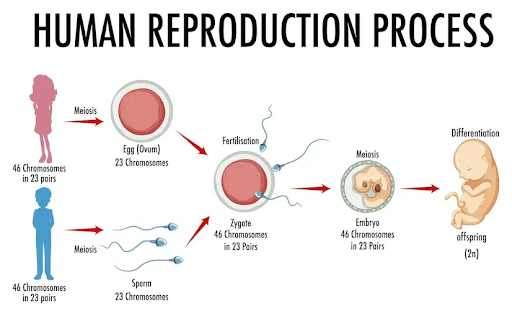
Sexual reproduction is the production of offspring through the fusion of two haploid gametes from two parents, producing a genetically unique diploid offspring.

Sexual reproduction requires:

  • Production of haploid gametes by meiosis
  • Fertilization: the fusion of gametes to form a diploid zygote
  • Development of the zygote into a new organism

Gametes

Gametes are the specialized sex cells produced by meiosis. They are haploid, containing half the chromosome number of the parent.

In animals, male gametes are sperm cells and female gametes are egg cells (ova). Sperm are small, mobile, and produced in enormous numbers. Eggs are large, non-motile, and contain nutrient reserves for early development.

In flowering plants, male gametes are contained in pollen and female gametes are contained in the ovule.

Fertilization

External Fertilization

Fertilization occurs outside the body, typically in water. Eggs and sperm are released into the water where they meet by chance. Used by most fish and amphibians. Large numbers of gametes are produced to compensate for the low probability of fertilization.

Internal Fertilization

Fertilization occurs inside the female's body after mating. Sperm are deposited directly into the female reproductive tract, greatly increasing the probability of fertilization. Used by reptiles, birds, and mammals. Fewer gametes are produced because fertilization is more reliable.

Advantages of Sexual Reproduction

  • Produces genetic variation among offspring
  • Variation provides raw material for natural selection
  • Harmful mutations can be eliminated through recombination
  • Populations can adapt to changing environments
  • New combinations of alleles may produce individuals better suited to new conditions

Disadvantages of Sexual Reproduction

  • Requires finding and attracting a mate
  • Only females reproduce offspring directly, reducing reproductive efficiency
  • Slower than asexual reproduction
  • Genetic information is diluted with each generation

Reproductive Strategies

Different organisms have evolved very different strategies for maximizing reproductive success.

r-strategists

Produce large numbers of offspring with minimal parental investment. Most offspring die before reproducing, but the sheer numbers ensure some survive. Examples: fish (millions of eggs), insects, most plants.

K-strategists

Produce small numbers of offspring with high parental investment. Most offspring survive to reproduce. Examples: elephants, whales, humans.

Neither strategy is inherently superior. Each is an adaptation to a particular ecological context.

Human Reproduction

Human reproduction is sexual and involves internal fertilization.

Male Reproductive System

  • Testes produce sperm by meiosis and secrete testosterone
  • Sperm mature in the epididymis
  • During ejaculation, sperm travel through the vas deferens
  • Seminal vesicles, prostate gland, and Cowper's glands add secretions forming semen
  • Sperm are deposited in the female reproductive tract during intercourse

Female Reproductive System

  • Ovaries produce eggs by meiosis and secrete estrogen and progesterone
  • Each month, one egg is released from an ovary in ovulation
  • The egg travels along the fallopian tube toward the uterus
  • Fertilization typically occurs in the fallopian tube
  • The fertilized egg (zygote) implants in the uterine wall and develops into an embryo

The Menstrual Cycle

The menstrual cycle is a monthly hormonal cycle in females that prepares the uterus for potential implantation of a fertilized egg.

  • Approximately days 1-5: Menstruation. The uterine lining breaks down and is shed
  • Days 1-13: Follicular phase. FSH stimulates follicle development in the ovary. Estrogen builds up the uterine lining
  • Day 14: Ovulation. LH surge triggers release of the egg
  • Days 15-28: Luteal phase. The empty follicle becomes the corpus luteum, secreting progesterone to maintain the uterine lining. If fertilization does not occur, the corpus luteum degenerates, progesterone falls, and menstruation begins again