Photosynthesis
Every meal you have ever eaten traces back to the same source. The bread, the rice, the vegetables, the meat of animals that ate grass — all of it began with a single process happening inside the cells of green plants, algae, and some bacteria.
That process is photosynthesis. And without it, almost no life on Earth would be possible.
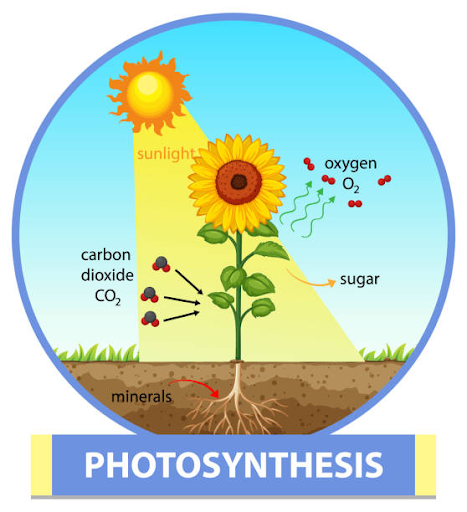
Photosynthesis is the process by which producers convert light energy from the Sun into chemical energy stored in glucose. It is the entry point for energy into virtually every food chain on the planet and the source of nearly all the oxygen in the atmosphere.
Where Does Photosynthesis Happen?
Photosynthesis occurs in the chloroplasts of plant cells and algae. Chloroplasts are organelles found mainly in the cells of green parts of plants, particularly leaves.
Inside the chloroplast, two distinct regions carry out the two stages of photosynthesis.
- The thylakoid membranes are stacked into columns called grana. They contain the green pigment chlorophyll, which absorbs light energy. The light-dependent reactions of photosynthesis occur here.
- The stroma is the fluid-filled space surrounding the grana. The light-independent reactions, also called the Calvin cycle, occur here.
The Raw Materials and Products
Photosynthesis requires two raw materials from the environment:
- Carbon dioxide is absorbed from the air through tiny pores in the leaf called stomata. It diffuses through the leaf tissue to reach photosynthesizing cells.
- Water is absorbed from the soil by root hair cells, transported up through xylem vessels in the stem, and delivered to leaf cells.
- Light energy is absorbed by chlorophyll in the thylakoid membranes.
The products of photosynthesis are:
- Glucose which is used by the plant for cellular respiration, growth, and storage.
- Oxygen which is released as a byproduct through the stomata into the atmosphere.
Word and Chemical Equations
Word Equation
Carbon dioxide + Water → Glucose + Oxygen
This occurs in the presence of light energy and chlorophyll.
Chemical Equation
6CO₂ + 6H₂O → C₆H₁₂O₆ + 6O₂
This equation is carried out using light energy absorbed by chlorophyll.
Reading this equation:
- Six molecules of carbon dioxide combine with six molecules of water
- Using light energy captured by chlorophyll
- To produce one molecule of glucose
- And six molecules of oxygen as a byproduct
The equation must balance on both sides:
- Carbon: 6 on left (6CO₂), 6 on right (C₆H₁₂O₆)
- Hydrogen: 12 on left (6H₂O), 12 on right (C₆H₁₂O₆)
- Oxygen: 18 on left (6CO₂ + 6H₂O), 18 on right (C₆H₁₂O₆ + 6O₂)
The Two Stages of Photosynthesis
Photosynthesis does not happen in a single step. It occurs in two connected stages.
Stage 1: Light-Dependent Reactions
These reactions occur on the thylakoid membranes and require direct light energy.
What happens:
- Chlorophyll absorbs light energy, primarily from red and blue parts of the visible spectrum
- This energy is used to split water molecules in a process called photolysis
Photolysis of water: 2H₂O → 4H⁺ + 4e⁻ + O₂
- The oxygen produced is released as a byproduct through the stomata
- The hydrogen ions and electrons released from water are used to produce ATP and NADPH, two energy-carrying molecules
- ATP and NADPH are then passed to the second stage
Stage 2: Light-Independent Reactions (Calvin Cycle)
These reactions occur in the stroma and do not require direct light, though they depend on the ATP and NADPH produced by the light-dependent reactions.
What happens:
- Carbon dioxide from the atmosphere is absorbed and combined with a five-carbon compound called RuBP (ribulose bisphosphate)
- This reaction is catalyzed by the enzyme RuBisCO
- The resulting six-carbon compound immediately splits into two three-carbon molecules called GP (glycerate-3-phosphate)
- ATP and NADPH from the light-dependent reactions are used to convert GP into G3P (glyceraldehyde-3-phosphate)
- Some G3P is used to synthesize glucose and other organic molecules
- The remaining G3P is used to regenerate RuBP, allowing the cycle to continue
The Calvin cycle is a cycle because the starting compound, RuBP, is continuously regenerated, allowing the process to continue as long as CO₂, ATP, and NADPH are available.
Leaf Structure and Adaptations for Photosynthesis
The leaf is the primary organ of photosynthesis in most plants. Its structure contains several adaptations that maximize the efficiency of photosynthesis.
External Adaptations
- Large, flat surface area maximizes the area available to absorb sunlight.
- Thin profile minimizes the distance that carbon dioxide must diffuse to reach photosynthesizing cells.
- Transparent upper epidermis allows light to pass through to the photosynthetic cells below.
Internal Adaptations
- Palisade mesophyll layer sits directly below the upper epidermis. These cells are column-shaped, densely packed, and contain large numbers of chloroplasts aligned to maximize light absorption. This is where most photosynthesis occurs.
- Spongy mesophyll layer lies below the palisade layer. These cells are loosely arranged with large air spaces between them, allowing carbon dioxide to diffuse freely to all photosynthesizing cells.
- Stomata are tiny pores on the lower surface of the leaf, each surrounded by two guard cells. They allow carbon dioxide to enter and oxygen to exit. Guard cells can open and close the stomata by changing their water content, regulating gas exchange and water loss.
- Xylem vessels in the leaf veins deliver water directly to photosynthesizing cells.
- Phloem vessels in the leaf veins transport glucose away from the leaf to other parts of the plant.
- Chloroplasts are found in the highest density in the palisade mesophyll cells, positioned close to the upper surface where light is strongest.
Factors Affecting the Rate of Photosynthesis
Photosynthesis is affected by several environmental factors. The rate of photosynthesis is controlled by whichever factor is in shortest supply at any given moment. This is called the limiting factor.
Light Intensity
- As light intensity increases, the rate of photosynthesis increases because more light energy is available for the light-dependent reactions.
- At very high light intensities, other factors such as CO₂ concentration or temperature become limiting and the rate plateaus.
- At zero light intensity, photosynthesis stops entirely.
Carbon Dioxide Concentration
- As CO₂ concentration increases, the rate of photosynthesis increases because more substrate is available for the Calvin cycle.
- At very high CO₂ concentrations, light intensity or temperature becomes the limiting factor and the rate levels off.
Temperature
- Photosynthesis is controlled by enzymes, including RuBisCO in the Calvin cycle. Like all enzyme-controlled reactions, photosynthesis has an optimal temperature range.
- As temperature increases up to the optimum, the rate of photosynthesis increases because enzyme activity and molecular movement increase.
- Above the optimum temperature, enzymes begin to denature, their active sites change shape, and the rate of photosynthesis falls sharply.
- Below optimum temperature, enzyme activity decreases and the rate falls.
Water Availability
- Water is a raw material for photosynthesis. Severe water shortage slows the rate of photosynthesis.
- Additionally, when plants are water-stressed, guard cells close the stomata to prevent further water loss, which simultaneously reduces CO₂ entry and limits photosynthesis.
Uses of Glucose Produced by Photosynthesis
The glucose produced during photosynthesis is not only used for energy. Plants use it in several ways.
- Cellular respiration: Glucose is broken down in mitochondria to release ATP for all cellular activities.
- Storage as starch: Glucose molecules are joined into long chains to form starch, the main carbohydrate storage molecule in plants. Starch is insoluble and does not affect water potential, making it ideal for storage.
- Cellulose synthesis: Glucose is used to make cellulose for cell walls.
- Sucrose transport: Glucose is converted to sucrose for transport through phloem to non-photosynthetic parts of the plant.
- Lipid synthesis: Glucose is converted to glycerol and fatty acids for fat storage, particularly in seeds.
- Protein synthesis: Combined with nitrogen absorbed from the soil, glucose-derived carbon skeletons are used to build amino acids and proteins.
Photosynthesis and the Atmosphere
Photosynthesis has had a transformative effect on Earth's atmosphere over geological time. Before photosynthesis evolved approximately 3.5 billion years ago, there was virtually no free oxygen in the atmosphere. Photosynthetic organisms gradually released oxygen as a byproduct, transforming the atmosphere into one that could support aerobic life.
Today, photosynthesis by plants, algae, and cyanobacteria continuously replenishes atmospheric oxygen while absorbing CO₂. This makes photosynthesis not just the foundation of food chains but the process that maintains the atmospheric conditions on which almost all life on Earth depends.