

Overfishing and wildlife trade

Welcome to MindMentor!

Overexploitation of species

Middle School Biology

Overexploitation

The passenger pigeon was once the most abundant bird in North America. Flocks of billions darkened the sky for hours as they passed overhead. By 1914, the last individual, a female named Martha, died in the Cincinnati Zoo. The species went from billions to zero in less than a century, hunted for meat and sport until there was nothing left.

The passenger pigeon is the most dramatic example of a pattern that has repeated throughout human history and continues today. When humans exploit a species faster than it can reproduce, the population collapses. When the collapse is severe enough, the species disappears entirely. Understanding overexploitation, its causes, its consequences, and how to prevent it, is one of the most urgent challenges in conservation biology.
What Is Overexploitation?

Overexploitation is the harvesting of a species at a rate that exceeds its capacity to reproduce and maintain its population size.

All exploited species can sustain some level of harvesting. A fish population can sustain fishing that removes individuals at the same rate the population produces new ones. A forest can sustain timber harvesting at the rate at which trees grow. The problem arises when harvesting exceeds the biological productivity of the species, leading to population decline.

Overexploitation is not limited to deliberate hunting or fishing. It includes any extraction of living organisms from natural populations at unsustainable rates, including the collection of wild plants, shells, coral, and other natural products.

Overfishing

Overfishing is the removal of fish from a population faster than the population can reproduce and replenish itself.

Scale of the Problem

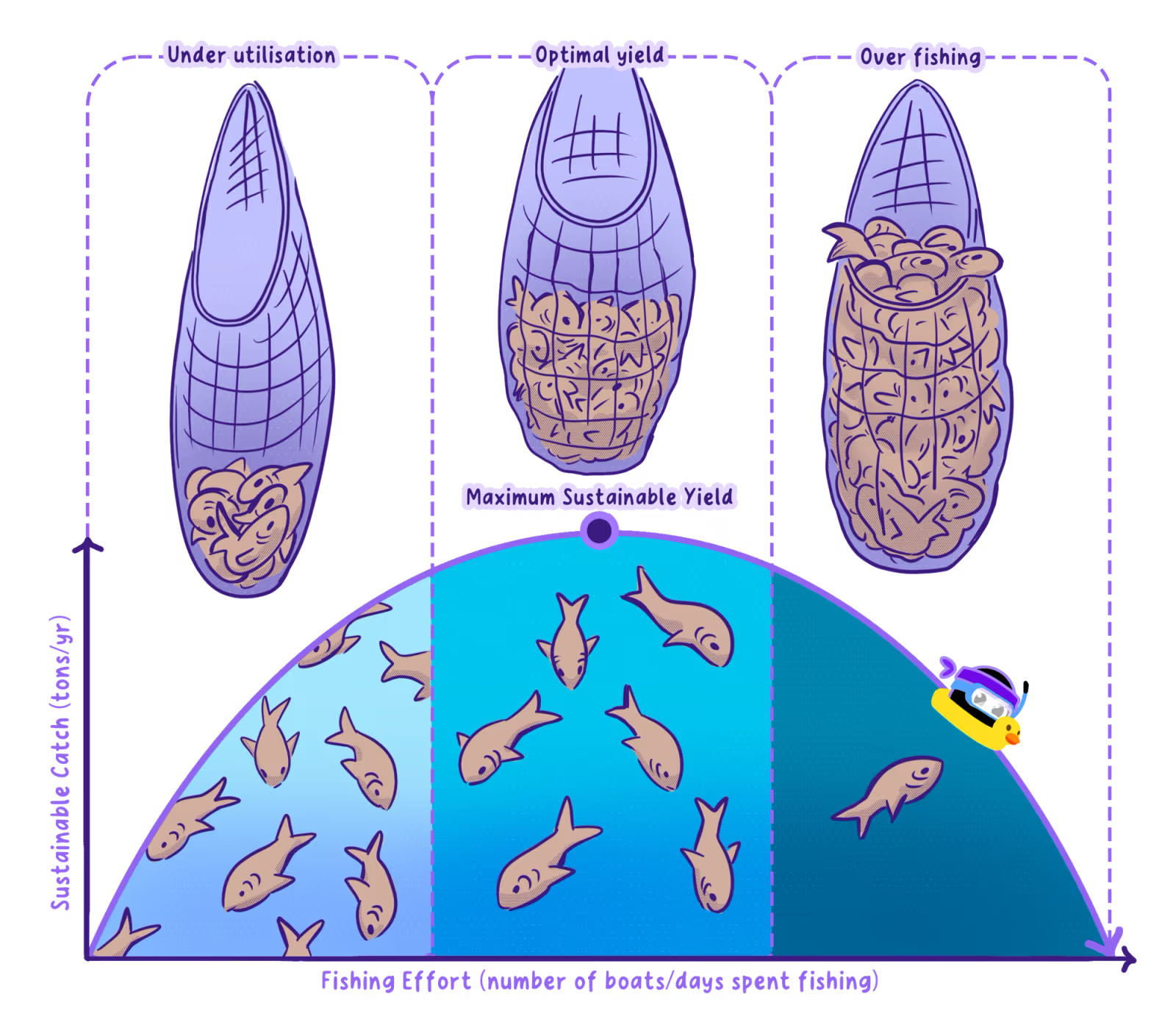
The Food and Agriculture Organization of the United Nations estimates that approximately 34 percent of the world's fish stocks are now overfished, meaning they are being harvested faster than they can reproduce. A further 60 percent are being fished at maximum sustainable levels, leaving virtually no buffer. Only 6 percent are underfished.

Global fish catches peaked in the late 1980s and have declined since, despite increasing fishing effort, a clear signal of overexploitation.

Mechanisms of Overfishing

  • Growth overfishing: Fish are caught before they reach reproductive maturity, preventing them from contributing to the next generation.
  • Recruitment overfishing: So many adults are removed that too few remain to produce the next generation. The population cannot replace itself and collapses.
  • Ecosystem overfishing: The ecological relationships within the marine community are disrupted as key species are removed.

Consequences of Overfishing

  • Population collapse: When fish stocks fall below a critical threshold, they may fail to recover even when fishing stops entirely. The collapse of the Grand Banks cod fishery off Newfoundland in 1992 is a warning. Cod populations were so severely depleted that the fishery was closed. Thirty years later, populations have not recovered to commercially viable levels.
  • Trophic cascade: Removing top predatory fish releases their prey from predation pressure. Prey populations explode, overconsuming their own food sources and restructuring the entire marine food web.
  • Ecosystem simplification: Repeated overfishing of successive species progressively simplifies marine ecosystems, replacing diverse communities with jellyfish-dominated systems.
  • Bycatch: Industrial fishing methods capture enormous quantities of non-target species, including seabirds, marine mammals, sea turtles, and juvenile fish of many species. Global bycatch is estimated at approximately 40 percent of total catch, representing tens of millions of tonnes of waste.

Destructive Fishing Methods

  • Bottom trawling drags weighted nets across the seafloor, destroying coral, sponges, and other benthic habitat while catching fish. It is one of the most destructive human activities in the ocean.
  • Dynamite fishing uses explosives to stun fish, destroying coral reef structure and killing all organisms in the blast zone.
  • Cyanide fishing uses sodium cyanide to stun fish for the live reef fish trade, killing corals and other non-target organisms.

Hunting and Poaching

Historical Extinctions from Hunting

The historical record documents numerous species driven to extinction by hunting.

  • Dodo (Raphus cucullatus): Flightless bird of Mauritius, extinct by 1681. Killed by Dutch sailors and their introduced animals within 80 years of European arrival on the island.
  • Steller's sea cow (Hydrodamalis gigas): Massive marine mammal discovered in 1741, hunted to extinction by 1768, just 27 years after its discovery.
  • Great auk (Pinguinus impennis): Flightless seabird of the North Atlantic, hunted for feathers, oil, and meat until the last pair was killed in 1844.
  • Passenger pigeon (Ectopistes migratorius): Once the most abundant bird in North America, with populations of 3 to 5 billion. Commercial hunting for the urban meat market, combined with habitat destruction, drove it to extinction by 1914.

Current Poaching Crisis

Poaching is the illegal killing or capture of wildlife. It continues to threaten numerous species.

  • African elephants: Killed for ivory. Populations declined by approximately 30 percent between 2007 and 2014 due to the illegal ivory trade. An estimated 20,000 to 30,000 elephants are killed annually by poachers.
  • Rhinoceros: All five species are threatened. Three are critically endangered. Killed for the horn, which is falsely believed to have medicinal properties in some Asian markets. Poaching has devastated populations despite intensive anti-poaching efforts.
  • Tigers: An estimated fewer than 4,000 remain in the wild. Killed for skins and body parts used in traditional medicine. Their bones, claws, and organs command high prices in illegal markets.
  • Pangolins: The world's most trafficked mammal. All eight species are threatened. Hundreds of thousands are taken annually for meat and for scales used in traditional medicine.
  • Sharks: Approximately 100 million sharks are killed annually, primarily for the shark fin soup trade. Many species have declined by over 90 percent.

Bushmeat Trade

Bushmeat hunting is the killing of wild animals for food, particularly in tropical Africa, Southeast Asia, and South America.

At subsistence levels, bushmeat hunting represents a traditional, sustainable food source for forest communities. The problem arises when commercial hunting scales up dramatically.

Commercial bushmeat hunting driven by demand from urban populations is emptying forests of wildlife even where forest cover remains intact. This phenomenon has been described as the empty forest syndrome: forests that appear intact but have been stripped of their larger animals through unsustainable hunting.

Great apes, forest antelopes, and forest elephants are among the most heavily affected species.

Overexploitation of Plants

Plant overexploitation receives less attention than animal poaching but is equally significant.

  • Timber extraction: Illegal logging removes valuable timber species faster than forests can regenerate. Species like mahogany, rosewood, and teak are particularly targeted.
  • Medicinal plant collection: Many plant species used in traditional medicine are collected from the wild at unsustainable rates. Goldenseal, American ginseng, and many orchid species are threatened by collection for medicinal or horticultural use.
  • Coral collection: Live corals and coral skeletons are collected for the aquarium trade and the souvenir trade, removing reef-building organisms and damaging reef structure.
  • Wild orchid collection: Many orchid species are collected from the wild for horticulture. Some are now rarer in the wild than in cultivation.

Maximum Sustainable Yield

Maximum sustainable yield (MSY) is the largest catch that can be taken from a population indefinitely without causing it to decline.

It is calculated from the population's growth rate and carrying capacity. At intermediate population sizes, a population grows fastest and can sustain the highest harvest. Fishing at MSY should theoretically maintain populations indefinitely.

In practice, MSY is difficult to calculate accurately because:

  • Population sizes and growth rates are hard to measure in the ocean
  • Environmental conditions change from year to year
  • Fishing at the theoretical maximum leaves no safety margin for uncertainty
  • Fishing industries have strong economic incentives to resist harvest limits

Solutions to Overexploitation

  • Fishing quotas: Setting legally binding catch limits based on stock assessments. Effective when enforced, but subject to political pressure from fishing industries.
  • Marine protected areas: Closing areas to fishing allows populations to recover and provides spillover benefits to surrounding fished areas.
  • Gear restrictions: Banning destructive methods such as bottom trawling, dynamite fishing, and drift nets.
  • CITES: The Convention on International Trade in Endangered Species regulates and, in some cases, bans international trade in threatened species. Listing a species on Appendix I prohibits all commercial trade.
  • Anti-poaching enforcement: Increasing ranger presence, improving surveillance technology, and strengthening penalties for poaching.
  • Demand reduction: Changing consumer behavior in countries that drive demand for illegally traded wildlife products. Public awareness campaigns in China, Vietnam, and other major markets have had some success in reducing demand for ivory, shark fins, and rhino horn.
  • Aquaculture: Farming fish and shellfish can reduce pressure on wild populations if well managed. Currently provides approximately 50 percent of global seafood consumption.