
Think about what your body needs to keep running every second of every day. Oxygen must reach every one of your 37 trillion cells. Glucose must be delivered continuously. Carbon dioxide must be removed before it becomes toxic. Hormones must travel from glands to target organs. Waste products must reach the kidneys.
None of this happens by accident. Living organisms have evolved precise mechanisms to move substances exactly where they are needed, exactly when they are needed. These mechanisms operate at two scales: movement across cell membranes and transport through the whole organism.
Diffusion is the net movement of particles from a region of higher concentration to a region of lower concentration, down a concentration gradient, until equilibrium is reached.
Diffusion is a passive process. It requires no energy from the cell because particles move naturally from where they are more concentrated to where they are less concentrated.
Osmosis is the net movement of water molecules through a selectively permeable membrane from a region of higher water potential to a region of lower water potential.
Water potential is a measure of the tendency of water molecules to move. Pure water has the highest water potential. Dissolving solutes in water lowers its water potential. The more solutes dissolved, the lower the water potential.
Osmosis is a special case of diffusion, applying only to water molecules crossing a selectively permeable membrane.
Turgor pressure created by osmosis is what keeps non-woody plants upright. When plants wilt, it is because cells have lost water and turgor pressure has fallen.
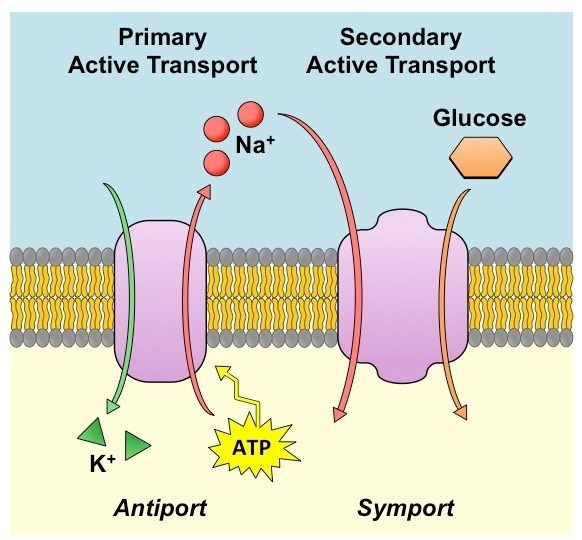
Active transport is the movement of substances across a cell membrane against a concentration gradient, from lower to higher concentration, using energy in the form of ATP.
Active transport requires carrier proteins embedded in the membrane. These proteins use ATP to change shape and move specific molecules across the membrane against the concentration gradient.
| Feature | Diffusion | Osmosis | Active Transport |
|---|---|---|---|
| Direction | High to low concentration | High to low water potential | Low to high concentration |
| Energy required | No | No | Yes (ATP) |
| Membrane needed | Not always | Yes (selectively permeable) | Yes |
| Substances moved | Any small molecule | Water only | Specific molecules |
| Speed | Moderate | Moderate | Can be rapid |
Individual cells can obtain substances by diffusion over very short distances. But in large multicellular organisms, diffusion alone is far too slow to supply all cells. Specialized transport systems have evolved to move substances rapidly over long distances.
Plants have two transport systems running through roots, stems, and leaves.
Xylem transports water and dissolved mineral ions upward from roots to leaves. Xylem vessels are dead cells with no cytoplasm, forming hollow tubes. Water moves through xylem by a combination of three mechanisms:
Phloem transports dissolved sugars and other organic molecules from leaves to all other parts of the plant. This process is called translocation. Unlike xylem, phloem consists of living cells and can transport substances in any direction, both upward and downward.
In animals, substances are transported through the circulatory system, consisting of the heart, blood vessels, and blood.
Blood transports:
The circulatory system ensures that every cell in the body is close to a capillary, so that diffusion over the short final distance from capillary to cell is sufficient to supply all cellular needs.
One of the most important principles governing transport in biology is the relationship between surface area and volume.
As an organism or cell increases in size, its volume increases faster than its surface area. This means that larger organisms have a smaller surface area relative to their volume.
For very small organisms and individual cells, the surface area is large enough relative to their volume that diffusion across the outer surface is sufficient to supply all internal needs.
For large multicellular organisms, the surface area to volume ratio is far too small for diffusion across the body surface to supply all cells. This is why large organisms require specialized transport systems, gas exchange organs, and circulatory systems to move substances between the environment and every internal cell.
Biological transport systems show remarkable structural adaptations that maximize efficiency.
Every physiological process in a living organism depends on substances being in the right place at the right time. Understanding the mechanisms of diffusion, osmosis, active transport, and bulk transport systems reveals how organisms solve the fundamental challenge of supplying every cell with what it needs and removing what it does not need, continuously, reliably, and efficiently.