
On this page:
Introduction What Is Meiosis? Before Meiosis: Interphase Meiosis I: Separating Homologous Chromosomes Prophase I Metaphase I Anaphase I Telophase I and Cytokinesis Meiosis II: Separating Sister Chromatids Prophase II Metaphase II Anaphase II Telophase II and Cytokinesis Sources of Genetic Variation Comparing Meiosis and Mitosis Errors in Meiosis: Non-Disjunction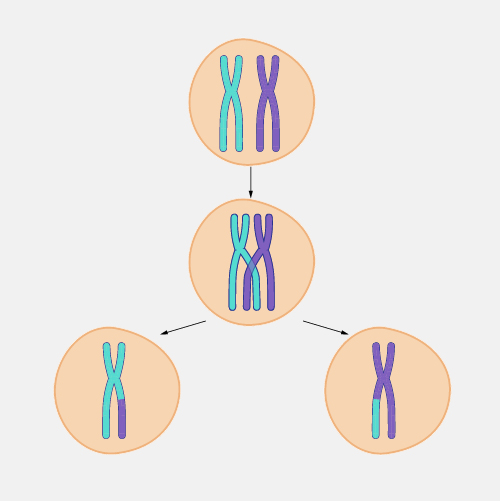
Sexual reproduction presents biology with a fundamental mathematical problem. If both parents contribute a full set of chromosomes to their offspring, the number of chromosomes would double with every generation. Within just a few generations, cells would contain an unmanageable number of chromosomes.
The solution is meiosis. A type of cell division that deliberately halves the chromosome number, producing cells that can then fuse at fertilization to restore the correct full number.
But meiosis does more than just reduce chromosome numbers. It also generates genetic variation through two mechanisms, making every gamete genetically unique and ensuring that no two sexually produced offspring are ever genetically identical.
Meiosis is a type of cell division that produces four haploid daughter cells from one diploid parent cell, each with half the chromosome number of the parent and each genetically unique.
In humans, meiosis occurs in the testes (producing sperm) and ovaries (producing eggs). A diploid parent cell with 46 chromosomes produces four haploid cells each with 23 chromosomes.
When a haploid sperm (23 chromosomes) fuses with a haploid egg (23 chromosomes) at fertilization, the resulting zygote has the correct diploid number of 46 chromosomes.
Like mitosis, meiosis is preceded by interphase during which DNA replication occurs. Each chromosome is copied to produce two identical sister chromatids joined at the centromere.
However, unlike mitosis, meiosis involves two consecutive divisions: meiosis I and meiosis II.
Meiosis I is the reductive division. It separates the pairs of homologous chromosomes.
Prophase I is the longest and most complex phase of meiosis.
Meiosis II is similar to mitosis but occurs in both cells produced by meiosis I. There is no further DNA replication between meiosis I and meiosis II.
Meiosis generates enormous genetic variation through two mechanisms.
During prophase I, homologous chromosomes exchange segments of DNA at chiasmata. This recombination produces chromosomes with new combinations of alleles that did not exist in either parent chromosome.
The more chiasmata that form, the more genetic recombination occurs and the more variation is produced.
During metaphase I, bivalents align at the equator with either the maternal or paternal chromosome facing each pole. This orientation is random and independent for each pair of homologous chromosomes.
In humans with 23 pairs of homologous chromosomes, the number of possible chromosome combinations produced by independent assortment alone is 2²³, which is over 8 million different combinations.
When crossing over is also considered, the number of genetically distinct gametes a human can produce is essentially limitless.
| Feature | Mitosis | Meiosis |
|---|---|---|
| Number of divisions | One | Two |
| Daughter cells | Two | Four |
| Chromosome number | Diploid (2n) | Haploid (n) |
| Genetic identity | Identical to parent | Unique, different from parent |
| Crossing over | Does not occur | Occurs in prophase I |
| Independent assortment | Does not occur | Occurs in metaphase I |
| Purpose | Growth, repair | Gamete production |
| Location | All body tissues | Reproductive organs only |
Occasionally, chromosomes fail to separate correctly during meiosis. This is called non-disjunction.
Non-disjunction during meiosis I results in both chromosomes of a homologous pair going to the same pole. Non-disjunction during meiosis II results in both sister chromatids going to the same pole.
In either case, some resulting gametes have an extra chromosome and some are missing a chromosome.
If such gametes participate in fertilization, the resulting zygote will have an abnormal chromosome number, called aneuploidy.
Down syndrome results from trisomy 21, where three copies of chromosome 21 are present instead of two. This results from non-disjunction of chromosome 21 during meiosis. The risk of non-disjunction increases with maternal age.