

On this page:
Introduction Gregor Mendel Key Terminology Law of Segregation Monohybrid Cross Law of Independent Assortment Dihybrid Cross Punnett Squares Incomplete Dominance Codominance Sex Determination and Sex-Linked Inheritance Variation Continuous Variation Discontinuous Variation Sources of VariationYou have your mother's eyes and your father's nose. Your blood group is different from that of both your parents. Your hair color is a shade that nobody else in your family quite matches. Some of your characteristics were predictable from your parents' traits. Others seem to have appeared from nowhere.
The patterns of inheritance that explain these observations were first worked out by Gregor Mendel in the 1860s through painstaking experiments with pea plants, decades before anyone knew that DNA existed.
Gregor Mendel was an Austrian monk who conducted careful breeding experiments with garden peas between 1856 and 1863. He chose pea plants because they have clearly distinct traits, they self-fertilize naturally (allowing pure-breeding lines to be established), and they produce large numbers of offspring quickly.
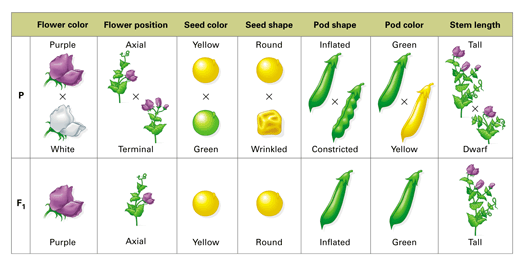
Mendel studied seven pairs of contrasting characteristics, including seed color, seed shape, and plant height. He crossed plants with different traits and carefully counted the offspring in each generation.
His meticulous analysis revealed patterns that he described as two laws. These laws, now explained by our understanding of genes and chromosomes, remain the foundation of genetics.
The two alleles of a gene separate during meiosis so that each gamete contains only one allele for each gene.
At fertilization, gametes from two parents combine randomly, restoring the diploid condition.
A monohybrid cross examines the inheritance of one gene with two alleles.
Example: Flower color in peas. Purple is dominant (P), white is recessive (p).
Parental cross: PP (pure-breeding purple) x pp (pure-breeding white)
Gametes: P and p
F1 generation: All Pp (purple phenotype, heterozygous genotype)
F1 x F1 cross: Pp x Pp
| P | p | |
|---|---|---|
| P | PP | Pp |
| p | Pp | pp |
F2 genotype ratio: 1 PP : 2 Pp : 1 pp
F2 phenotype ratio: 3 purple : 1 white
This 3:1 phenotype ratio in the F2 generation was Mendel's key observation, and it is explained by the segregation of alleles during meiosis and their random combination at fertilization.
Alleles of different genes are inherited independently of each other during meiosis.
This law applies to genes on different chromosomes. During meiosis I, homologous chromosome pairs align independently at the equator, so the alleles of one gene are sorted independently of the alleles of another gene.
A dihybrid cross examines the inheritance of two genes simultaneously.
Example: Seed color (Y = yellow dominant, y = green recessive) and seed shape (R = round dominant, r = wrinkled recessive).
Parental cross: YYRR x yyrr
F1 generation: All YyRr (yellow round)
F1 x F1 cross: YyRr x YyRr
F2 phenotype ratio: 9 yellow round : 3 yellow wrinkled : 3 green round : 1 green wrinkled
This 9:3:3:1 ratio is the expected result when two independently assorting genes are crossed in the heterozygous condition.
A Punnett square is a diagram used to predict the genotype and phenotype ratios of offspring from a genetic cross.
How to construct a Punnett square:
In some cases, neither allele is fully dominant over the other. The heterozygous phenotype is intermediate between the two homozygous phenotypes.
Example: Snapdragon flower color. RR produces red flowers, rr produces white flowers, Rr produces pink flowers.
The pink phenotype is not a blend of the alleles themselves but a result of the intermediate amount of pigment produced by one dose of the red allele.
In codominance, both alleles are fully expressed in the heterozygous phenotype. Neither masks the other.
Example: ABO blood groups. The I^A allele codes for the A antigen and the I^B allele codes for the B antigen. An individual with genotype I^A I^B expresses both A and B antigens and has blood group AB.
In humans, sex is determined by the sex chromosomes.
Females have two X chromosomes (XX). Males have one X and one Y chromosome (XY).
The Y chromosome is much smaller than the X and carries very few genes. Many genes on the X chromosome have no corresponding allele on the Y chromosome. These are called X-linked or sex-linked genes.
Males (XY) have only one copy of X-linked genes. A recessive allele on the X chromosome will be expressed in males even if it would be masked by a dominant allele in females (who have two X chromosomes).
Example: Red-green color blindness is caused by a recessive allele on the X chromosome.
Color blindness is much more common in males than females because males need only one copy of the recessive allele to express the condition.
Variation is the differences between individuals of the same species.
Continuous variation shows a range of phenotypes between two extremes with no distinct categories. Most individuals cluster around an intermediate value.
Examples: Height, body mass, skin color, intelligence
Continuous variation is typically influenced by many genes (polygenic inheritance) and by environmental factors. This produces a normal distribution (bell curve) when phenotype frequencies are plotted.
Discontinuous variation shows distinct categories with no intermediate forms.
Examples: ABO blood groups, ability to roll the tongue, attached or free earlobes
Discontinuous variation is typically controlled by one or a few genes with little environmental influence.