

On this page:
Introduction What Is Homeostasis? Why Is Homeostasis Necessary? Negative Feedback Temperature Regulation When Body Temperature Rises When Body Temperature Falls Fever Blood Glucose Regulation When Blood Glucose Rises When Blood Glucose Falls Diabetes Mellitus Osmoregulation The Role of the Kidneys When Blood is Too Concentrated When Blood is Too Dilute Homeostasis: The Foundation of PhysiologyYour body temperature right now is approximately 37 degrees Celsius. It was 37 degrees when you woke up this morning. It was 37 degrees while you were sleeping. It stays at 37 degrees whether you are in a tropical country or standing in snow.
Your blood glucose concentration is carefully maintained within a narrow range despite eating meals that flood the blood with glucose and then fasting overnight when no glucose enters at all.
Your blood pH stays between 7.35 and 7.45 with extraordinary precision, despite the continuous production of acids by cellular respiration.
How does the body maintain such stability in the face of constant change? The answer is homeostasis.
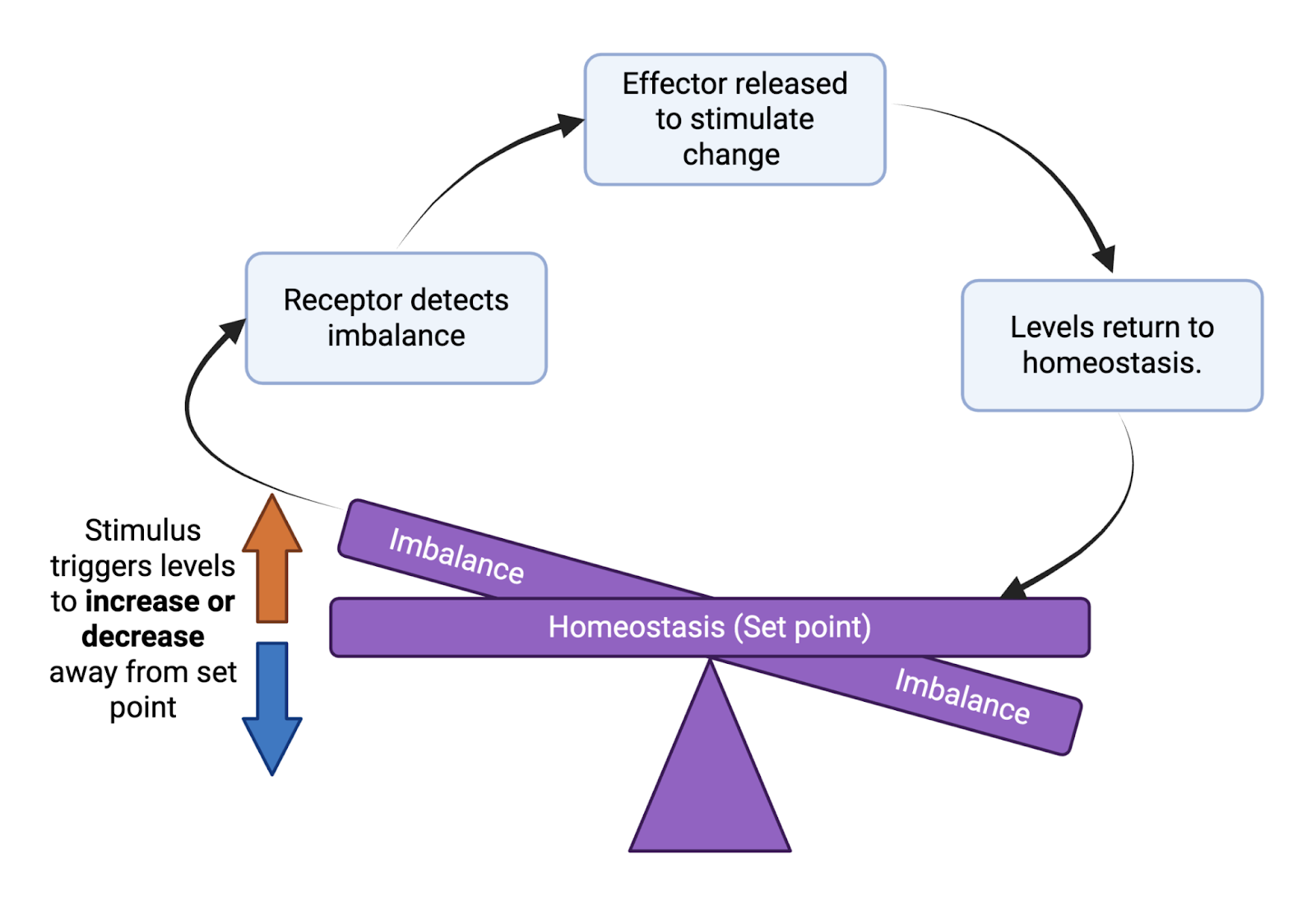
Homeostasis is the maintenance of a relatively stable internal environment despite changes in the external environment and in the body's own activity.
The term comes from the Greek words homoios (same) and stasis (standing still). The internal environment never truly stands still. It fluctuates continuously around a set point. But homeostatic mechanisms detect deviations and make corrections, keeping variables within the narrow range that cells require to function.
The internal environment that must be regulated includes:
Cells function optimally only within narrow ranges of temperature, pH, and chemical composition. Even small deviations can significantly impair enzyme function, membrane integrity, or metabolic processes.
Temperature: Enzymes have an optimal temperature. Below optimum, reactions slow. Above the optimum, enzymes denature. The precise regulation of body temperature at the enzyme optimum ensures all metabolic processes proceed at their maximum efficiency.
Blood glucose: Cells, particularly brain cells, depend on a continuous supply of glucose. Blood glucose that is too low (hypoglycemia) impairs brain function. Blood glucose that is too high (hyperglycemia) causes osmotic damage to cells and blood vessels.
pH: Enzyme structure and function are highly sensitive to pH. Even small changes in blood pH can denature enzymes and disrupt ion transport across membranes.
All homeostatic systems operate through negative feedback. This is the fundamental control principle underlying homeostasis.
How negative feedback works:
The response is called negative because it opposes the change that triggered it. This self-correcting mechanism continuously fine-tunes the variable around the set point.
Humans are endotherms, generating body heat internally through metabolism and regulating temperature through physiological mechanisms.
Set point: Approximately 37°C
Receptor: Thermoreceptors in the skin detect external temperature changes. Thermoreceptors in the hypothalamus of the brain detect changes in blood temperature directly.
Control center: The hypothalamus integrates temperature information and coordinates responses.
Fever is a temporary elevation of the set point of the hypothalamic thermostat, usually in response to infection.
Pathogens and immune cells release chemical signals called pyrogens that act on the hypothalamus to raise the set point. The body then activates heat-generating mechanisms (shivering, vasoconstriction) to raise the temperature to the new, higher set point.
Elevated body temperature may inhibit pathogen reproduction and enhance immune cell activity. However, a very high fever can be dangerous and impair enzyme function.
Blood glucose concentration is regulated within approximately 4 to 7 mmol per liter of blood.
The primary organs involved are the pancreas (which detects blood glucose changes and produces regulating hormones) and the liver (which is the main organ for glucose storage and release).
Detection: Beta cells in the islets of Langerhans in the pancreas detect rising blood glucose.
Response: Beta cells secrete insulin into the blood.
Effects of insulin:
Result: Blood glucose falls back toward the set point.
Detection: Alpha cells in the islets of Langerhans detect falling blood glucose.
Response: Alpha cells secrete glucagon into the blood.
Effects of glucagon:
Result: Blood glucose rises back toward the set point.
Diabetes mellitus is a condition in which blood glucose regulation fails, resulting in chronically elevated blood glucose (hyperglycemia).
Chronic hyperglycemia damages blood vessels and nerves throughout the body, leading to complications including blindness, kidney failure, heart disease, and loss of sensation in the extremities.
Osmoregulation is the regulation of water and solute concentrations in the blood and body fluids.
The kidneys are the primary organs of osmoregulation in humans.
The kidneys filter approximately 180 liters of blood plasma per day, producing a filtered fluid called the glomerular filtrate. They then selectively reabsorb useful substances and water while allowing waste products to remain in the filtrate, which becomes urine.
The concentration of urine is regulated by the hormone ADH (antidiuretic hormone), produced by the hypothalamus and released from the pituitary gland.
This negative feedback system continuously adjusts urine concentration to maintain the water balance of the blood within narrow limits, regardless of water intake or loss through sweating.
Every physiological system ultimately serves homeostasis. The circulatory system delivers the substances needed for cellular function. The respiratory system maintains blood oxygen and carbon dioxide levels. The digestive system replenishes glucose and other nutrients. The excretory system removes waste products. The endocrine and nervous systems coordinate all of these processes.
Homeostasis is not a single mechanism but the integrated result of all body systems working together to maintain the stable internal environment without which life at the cellular level would be impossible.