Habitat Change and Destruction
In the time it takes you to read this lesson, approximately 2,000 hectares of tropical forest will have been cleared. That is roughly the size of 2,000 football fields, gone in an hour. The species living there, many of them undescribed by science, were displaced or destroyed along with the trees.
Habitat change and destruction are the single greatest threats to biodiversity on Earth today. It is more damaging than pollution, more widespread than overexploitation, and more immediate than climate change for most species. Understanding what it is, what drives it, and what it destroys is the starting point for understanding the biodiversity crisis humanity now faces.
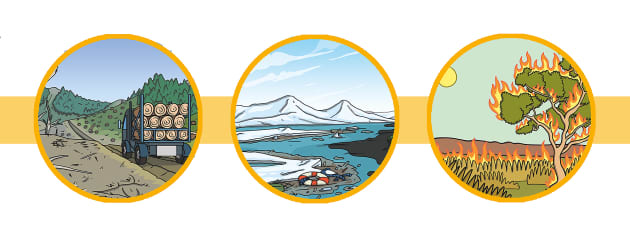
What Is Habitat?
A habitat is the natural environment in which a species lives and to which it is adapted. It provides everything an organism needs: food, water, shelter, suitable temperatures, and opportunities for reproduction.
Every species has a specific set of habitat requirements shaped by millions of years of evolution. When those requirements are no longer met, the species cannot survive in that location. When habitat loss is widespread enough, the species faces extinction.
Habitat change refers to any alteration of a natural environment that reduces its suitability for the species that depend on it. This can be gradual or sudden, partial or complete.
Deforestation
Deforestation is the large-scale removal of forests, primarily for agriculture, timber, and urban development.
Forests cover approximately 30 percent of Earth's land surface, but are being cleared at a rate of approximately 10 million hectares per year. Tropical forests are the most severely affected.
Causes of Deforestation
- Agricultural expansion: conversion to cropland (soybeans, palm oil, cattle pasture) is the leading cause globally
- Logging: both legal commercial timber extraction and illegal logging
- Infrastructure development: roads, dams, and settlements penetrate previously intact forest
- Mining: forest cleared to access mineral and fossil fuel deposits
- Fuelwood collection in developing regions
Ecological Consequences of Deforestation
- Loss of biodiversity: Tropical forests contain over half of all species despite covering less than 6 percent of the land surface.
- Disruption of water cycles: Forests return enormous quantities of water to the atmosphere through transpiration. Deforestation reduces rainfall in affected regions.
- Soil erosion: Tree roots hold soil in place. Without trees, rainfall washes topsoil away, causing erosion, landslides, and siltation of rivers.
- Carbon release: Living trees store large amounts of carbon. When forests are cleared and burned, this carbon is released as CO₂, contributing to climate change.
- Disruption of nutrient cycles: The rapid nutrient cycling of tropical forests breaks down, leaving soils depleted and unsuitable for sustained agriculture within a few years.
Wetland Drainage and Loss
Wetlands include marshes, swamps, bogs, fens, mangroves, and estuaries. Despite covering less than 9 percent of Earth's land surface, they support approximately 40 percent of all species.
Approximately 35 percent of the world's wetlands have been lost since 1970, primarily due to:
- Drainage for agriculture
- Urban development in coastal and floodplain areas
- Water diversion for irrigation reduces river flows to deltas and estuaries
Consequences of Wetland Loss
- Loss of nursery habitats for fish. Most commercial fish species spend part of their life cycle in wetlands
- Loss of flood regulation. Wetlands absorb and store floodwater, reducing downstream flooding
- Loss of water filtration. Wetlands filter pollutants and excess nutrients from water
- Loss of carbon storage. Peatlands store more carbon per unit area than any other ecosystem. Draining peat releases stored carbon
Grassland Conversion
Temperate and tropical grasslands have been more extensively converted to agriculture than any other biome. Less than 10 percent of the original extent of many grassland types remains intact.
Grasslands support distinctive communities of large mammals, ground-nesting birds, and invertebrates. Their conversion to cropland has caused the decline of many grassland specialists that cannot survive in fragmented or cultivated landscapes.
Coral Reef Degradation
Coral reefs cover less than 1 percent of the ocean floor but support approximately 25 percent of all marine species. They are among the most threatened ecosystems on Earth.
Physical destruction of reefs occurs through:
- Dynamite fishing and cyanide fishing destroying reef structure
- Trawl fishing dragging nets across reef surfaces
- Coastal development causing siltation that smothers corals
- Boat anchors and tourist damage
Habitat Fragmentation
Habitat fragmentation is the process by which large, continuous areas of habitat are divided into smaller, isolated patches by human development.
Even when the total habitat area is reduced only modestly, fragmentation can have severe consequences that go far beyond the proportion of habitat directly lost.
Effects of Fragmentation
- Reduced patch size: Small habitat fragments support smaller populations. Small populations are more vulnerable to extinction from random events such as disease outbreaks, extreme weather, or demographic accidents.
- Isolation of populations: When patches are separated by developed land, individuals cannot move between them. Populations become genetically isolated, inbreeding increases, and genetic diversity declines. Species that go locally extinct in one patch cannot be replaced by recolonization from other patches.
- Edge effects: The boundary between a habitat patch and the surrounding developed land creates edge habitat with different conditions: more light, more wind, greater temperature fluctuation, and more invasive species and predators. As fragments become smaller, the proportion of edge habitat increases and the area of true interior habitat shrinks. Many forest interior specialists cannot survive in edge habitat.
- Loss of wide-ranging species: Large mammals, migratory birds, and other species requiring extensive territories cannot survive in small fragments, regardless of fragment quality. Tigers, wolves, and large eagles need thousands of square kilometers of habitat and are among the first species lost from fragmented landscapes.
- Disruption of ecological processes: Pollination, seed dispersal, predator-prey dynamics, and nutrient cycling all depend on species moving across landscapes. Fragmentation disrupts these processes even in remaining habitat patches.
Urbanization
Urban areas cover approximately 3 percent of Earth's land surface, but their ecological impact extends far beyond their physical footprint.
- Direct habitat loss: Natural habitats are replaced by impervious surfaces, buildings, and infrastructure.
- Altered hydrology: Impervious surfaces increase runoff, cause flash flooding, and reduce groundwater recharge.
- Light pollution: Artificial light at night disrupts nocturnal animals, disorients migratory birds and sea turtle hatchlings, and interferes with breeding behavior.
- Noise pollution: Urban noise masks the acoustic signals animals use for communication, territory establishment, and predator detection.
- Heat island effect: Urban areas are significantly warmer than the surrounding countryside, altering local species communities.
However, well-designed urban areas can support significant biodiversity through green spaces, urban forests, green roofs, and wildlife corridors connecting urban parks to surrounding natural areas.
Agricultural Intensification
Modern intensive agriculture has transformed vast areas of previously diverse landscapes into simplified monocultures.
Consequences for biodiversity:
- Removal of hedgerows, field margins, and non-crop vegetation eliminates habitat for farmland birds, insects, and small mammals
- Pesticide use reduces insect diversity, including pollinators essential for crop production
- Herbicide use eliminates wild plants from field margins that provide food and shelter for wildlife
- Drainage and irrigation alter the hydrology of entire regions
- Monoculture crops support far fewer species than the diverse habitats they replace
Farmland bird populations across Europe have declined by approximately 57 percent since 1980, largely due to agricultural intensification.
Mountain and Polar Habitat Change
Climate change is driving habitat change in mountain and polar regions, even in the absence of direct human disturbance.
- Alpine species are being pushed to higher elevations as temperatures warm. For species already near the summit, there is nowhere left to go.
- Arctic sea ice loss is destroying the habitat of polar bears, walruses, and the ice-dependent algae that form the base of the Arctic food chain.
- Permafrost thaw in tundra regions is transforming the physical structure of these habitats and releasing stored carbon.
Why Habitat Protection Is the Priority
Given that habitat destruction is the leading driver of species extinction, protecting remaining natural habitats is the single most important conservation action available.
The effectiveness of habitat protection is well demonstrated. Protected areas with adequate management maintain significantly higher biodiversity than unprotected areas subject to human disturbance. However, the quality of protection matters enormously. A protected area on paper that is not enforced provides little actual benefit. Effective habitat protection requires not just legal designation but management, monitoring, and the involvement of local communities whose livelihoods depend on the same landscapes.
Every moment counts. The ongoing destruction of habitats means that conservation action delayed is conservation action denied.