Gas Exchange
Every cell in your body needs oxygen for aerobic respiration and produces carbon dioxide as a waste product. Your lungs bring in approximately 11,000 liters of air every day to meet this demand. Fish extract dissolved oxygen from water using gills. Plants exchange gases silently through microscopic pores.
Gas exchange is the process of obtaining oxygen from the environment and releasing carbon dioxide, driven entirely by diffusion across specialized exchange surfaces. The details differ between organisms, but the underlying principle is always the same.
Principles of Gas Exchange
Gas exchange in all organisms is driven by diffusion. Gases move from regions of higher partial pressure or concentration to regions of lower partial pressure or concentration across exchange surfaces.
For efficient gas exchange, all exchange surfaces share the same key features:
- Large surface area to maximize the rate of diffusion
- Thin walls to minimize diffusion distance
- Moist surfaces allow gases to dissolve before crossing
- Good ventilation to maintain concentration gradients on the external side
- Good blood supply or transport to maintain concentration gradients on the internal side
The Respiratory System
The respiratory system brings air to the gas exchange surface and removes waste gases.
Air enters through the nose, where it is filtered, warmed, and humidified. It passes through the trachea, which divides into two bronchi, one entering each lung. Each bronchus divides repeatedly into smaller bronchioles that end in clusters of alveoli.
The Alveoli
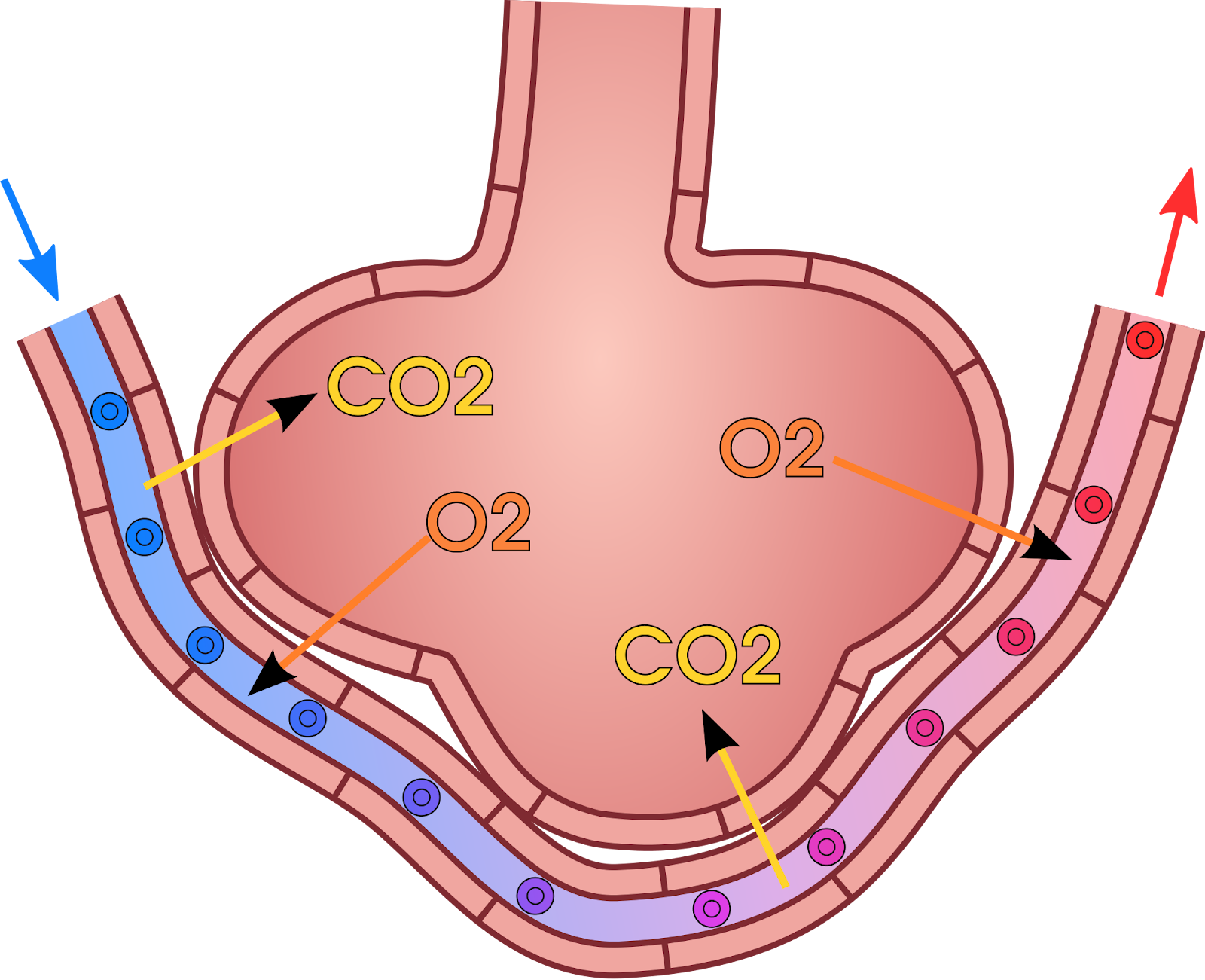
Alveoli are the actual sites of gas exchange.
Structure:
- Tiny air sacs approximately 0.2 mm in diameter
- Approximately 500 million in the adult human lung
- Total surface area of 70 to 100 square meters
- Walls are just one cell layer thick
- Surrounded by a dense network of capillaries
- Inner surface is moist with a thin fluid layer
Gas exchange process:
Oxygen:
- The partial pressure of oxygen is high in fresh alveolar air
- The partial pressure of oxygen is low in the blood arriving from the tissues
- Oxygen diffuses from alveolar air into the blood
- In blood, oxygen binds to hemoglobin in red blood cells, forming oxyhemoglobin
Carbon dioxide:
- The partial pressure of carbon dioxide is high in the blood arriving from the tissues
- The partial pressure of carbon dioxide is low in alveolar air
- Carbon dioxide diffuses from the blood into the alveolar air
- Carbon dioxide is exhaled with the next breath
Maintaining Concentration Gradients
The steep concentration gradients essential for rapid diffusion are maintained by two continuous processes.
- Breathing continuously brings fresh air rich in oxygen into the alveoli and removes air rich in carbon dioxide. Without breathing, alveolar oxygen would fall, and carbon dioxide would rise until diffusion stopped.
- Blood flow continuously brings blood depleted in oxygen and rich in carbon dioxide from tissues to alveoli and carries oxygenated blood away to the tissues. Without blood flow, oxygen would accumulate in the blood and diffusion would stop.
Transport of Gases in Blood
Oxygen transport:
- 98.5% of oxygen is carried bound to hemoglobin in red blood cells as oxyhemoglobin
- 1.5% is dissolved in plasma
- Hemoglobin loads oxygen readily in the high-oxygen environment of the lungs
- Hemoglobin releases oxygen in the low-oxygen, high-carbon dioxide environment of active tissues
Carbon dioxide transport:
- 70% is transported as bicarbonate ions (HCO₃⁻) in plasma
- 20% is bound to hemoglobin
- 10% is dissolved directly in plasma
Gas Exchange in Fish: Gills
Fish extract dissolved oxygen from water using gills.
Structure of Gills
Gills are located on both sides of the fish's head, protected by the operculum (gill cover). Each gill consists of gill arches supporting two rows of gill filaments. Each filament is covered in many tiny projections called lamellae.
The lamellae are the actual gas exchange surfaces. They are:
- Extremely thin (one or two cells thick)
- Richly supplied with blood capillaries
- Arranged to maximize surface area
Ventilation of Gills
Fish maintain a continuous flow of water over the gills by:
- Opening the mouth to draw water in
- Closing the mouth while opening the operculum
- Muscle contractions pump water continuously over the gill surfaces in one direction
Countercurrent Exchange
One of the most elegant adaptations in biology is the countercurrent exchange system in fish gills.
Blood flows through the gill lamellae in the opposite direction to water flowing over them. This means that blood encountering water has already had its oxygen reduced by a short contact distance. The water still has more oxygen than the blood, so diffusion continues.
Because of this counter-current arrangement, blood can become almost as oxygen-rich as the incoming water. If blood and water flowed in the same direction (parallel flow), equilibrium would be reached quickly and the maximum oxygen uptake would be much lower.
Gas Exchange in Plants
Plants exchange gases for both photosynthesis and respiration.
For photosynthesis they need carbon dioxide and release oxygen. For respiration they need oxygen and release carbon dioxide. During the day when light is available, the demands of photosynthesis greatly exceed those of respiration, so the net gas exchange is CO₂ in and O₂ out.
Stomata
Stomata are microscopic pores in the epidermis of leaves, each surrounded by two guard cells.
Gases diffuse between the leaf interior and the atmosphere through stomata. Carbon dioxide diffuses in and oxygen diffuses out during photosynthesis. The reverse occurs during respiration.
Guard cells control stomatal opening and closing by changing their water content. When guard cells absorb water by osmosis they become turgid and bend outward, opening the pore. When they lose water they become flaccid and the pore closes.
Stomata typically open during the day when photosynthesis requires CO₂, and close at night. They also close in conditions of water stress to reduce transpiration.
Internal Structure of the Leaf
The spongy mesophyll layer inside the leaf has loosely arranged cells with large air spaces between them. This allows gases to diffuse freely to all photosynthesizing cells throughout the leaf interior.
The flat shape of most leaves and their thinness ensures that no photosynthesizing cell is far from a stoma, minimizing diffusion distances for CO₂.