
You consume food. Within 48 hours, all the useful parts of that food will be absorbed and spread to every cell in your body, and everything that isn't useful will be eliminated.
That food also underwent one of the most incredible biological processes. The food was transformed from large, complex molecules to small, soluble molecules that can cross cell membranes and be transported to every cell.
These processes are referred to as digestion.
Digestion is the entire process of breaking down food into smaller molecules that can enter the body.
Food is made of large complex molecules that include polysaccharides like starch, proteins, and triglyceride fats. These complex molecules are too large to cross cell membranes, and thus, they are not usable by the body.
Digestion is divided into two processes that work in harmony.
Mechanical digestion breaks food down into smaller pieces without changing the food's chemical structure. Mechanical digestion increases the food's surface area in order for chemical digestion to occur.
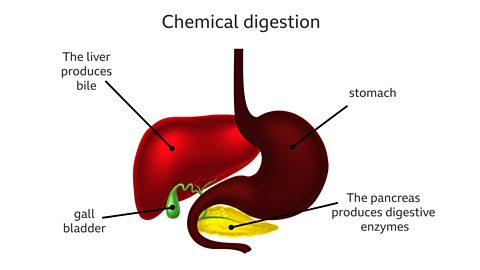
Chemical digestion breaks down large molecules using enzymes to initiate the hydrolysis reaction, which breaks the large molecules into smaller components.
The digestive system consists of a long tube from the mouth to the anus with glands along the tube that produce secretions used for digestion. Various segments are specialized for different aspects of the digestion process.
Before food is even swallowed, digestion starts in the mouth.
Mechanical digestion is performed by the teeth, which cut, tear, and grind food into smaller pieces, and the tongue, which shapes the food into a smooth, rounded mass known as a bolus.
Chemical digestion takes place as the salivary glands secrete saliva that contains the enzyme salivary amylase, which begins the hydrolysis of starch, thus converting it to maltose. Saliva also acts as a lubricant for the bolus to ensure smooth swallowing.
The bolus is now swallowed and moves into the esophagus.
The esophagus is a muscular tube that leaves the mouth to enter the stomach. There is no digestion occurring in the esophagus; food is moved by a process known as peristalsis. Peristalsis is the coordinated waves of contraction and relaxation of the circular and longitudinal smooth muscle in the walls of the esophagus. Regardless of the body's position, the food is pushed toward the stomach.
The stomach is an important organ of the body that is muscular and J-shaped.
Mechanical digestion: The stomach wall is made of muscle and contracts in rhythmic movements that churn food and mix it with digestive juices/gastric secretions. This breaks food into smaller pieces and produces a semi-liquid substance called chyme.
Chemical digestion: The gastric glands in the walls of the stomach secrete gastric juice. This juice contains:
Chyme is released gradually into the small intestine through the pyloric sphincter, a muscular valve that prevents premature emptying and regulates the rate of delivery to the small intestine.
The small intestine is the organ in which the absorption of food and most of the chemical digestion takes place. Although it is small, it is approximately 6 meters long and is the most important organ in the digestive system.
Secretions released into the duodenum include:
From the liver via the gallbladder:
Enzymes produced by cells in the small intestine wall:
The products of digestion are transported by the blood and lymphatic systems through the intestinal walls. The small intestine's structure is highly adapted to increase the surface area to increase the rate of absorption.
Absorption of various products:
When the material arrives at the large intestine, the majority of the vital nutrients have already been absorbed. The primary functions of the large intestine include:
The large intestine hosts billions of bacteria known as the gut microbiome. These bacteria are critical to digestion, the production of vitamins, the development of the immune system, and the defense against pathogenic bacteria.
The table below summarizes the digestive enzymes:
| Enzyme | Source | Substrate | Product | Optimal pH |
|---|---|---|---|---|
| Salivary amylase | Salivary glands | Starch | Maltose | 7 |
| Pepsin | Stomach | Proteins | Polypeptides | 2 |
| Pancreatic amylase | Pancreas | Starch | Maltose | 8 |
| Lipase | Pancreas | Triglycerides | Fatty acids and glycerol | 8 |
| Trypsin | Pancreas | Polypeptides | Shorter peptides | 8 |
| Maltase | Small intestine wall | Maltose | Glucose | 7 |
| Lactase | Small intestine wall | Lactose | Glucose and galactose | 7 |
| Peptidases | Small intestine wall | Peptides | Amino acids | 7-8 |
Absorption refers to the digestion of food molecules from the gut into the bloodstream or lymphatic system.
Assimilation refers to the process by which cells use absorbed substances for functions such as energy production, growth, and the repair of cellular structures and membranes. For example, during cellular respiration, glucose is assimilated, and in the process of protein synthesis, amino acids are assimilated. In the case of fatty acids, they are either assimilated to form cellular membranes or are stored for use as energy reserves.