

On this page:
Introduction What is Diffusion? Concentration Gradient Factors Affecting the Rate of Diffusion Fick's Law Diffusion Within Living Systems Gas Exchange in Lungs Absorption in the Small Intestine Gas Exchange in Leaves Uptake by Cells Simple vs Facilitated Diffusion Diffusion and Active Transport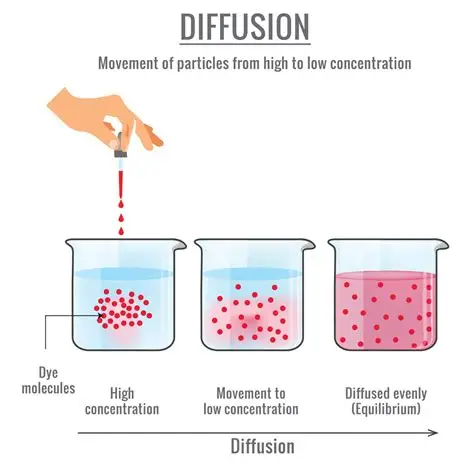
Take a drop of ink and place it in a container of still water. Don't stir the water. What do you see? After a few minutes, the ink begins to spread evenly in all directions, coloring some of the water in the container, some of the water throughout the container, all the way from that original drop. Eventually, the water color looks the same everywhere.
No one pushed those molecules in the water. There was no effort used to move the molecules. They moved from a high concentration (where the ink is) to a low concentration (the place where there are no molecules) by their own random movement. That is diffusion.
Diffusion is the net movement of particles in a random way. Particles are considered in a random state of movement and are located in the upper part of the container and then diffuse down to the lower part of the container, toward the less concentrated end of the concentration gradient.
Every particle in a fluid—be it a liquid or a gas—undergoes random motion. This random motion provides no predictable path or direction. However, in some areas, if there are more particles than in other areas, the net flow will be directed from the more concentrated area to the less concentrated area due to their random motion.
Diffusion is a passive process, meaning that it does not require any external energy to stimulate it. The sole driver of this process is the concentration gradient, the difference in concentration between two adjacent areas.
Diffusion will continue until there is a uniform distribution of the substance across the areas considered. This state is defined as an equilibrium. This occurs when there is no net movement of the substance in any direction.
The measurement of the concentration difference between two areas is defined as the concentration gradient.
A concentration gradient is said to be steep when the differences in concentration across two areas are large. This is often the case where there are few particles in one area compared to the adjacent area.
The opposite is also true. That is when there is a more even distribution of particles across two areas, the concentration gradient is said to be very shallow, and diffusion will occur more slowly.
It's worth noting that at equilibrium, even though the concentration gradient is zero and there is no net diffusion, individual particles will continue to move randomly.
In biological systems, concentration gradients are maintained by:
Numerous factors can affect the rate of diffusion. Some examples of these factors include:
The larger the concentration difference between two regions, the faster the rate of diffusion. With significant concentration differences, the driving force behind diffusion increases.
With a larger surface area, more particles can be present simultaneously. Doubling the area also doubles the rate of diffusion. The diffusion rate explains the elaborate folds and projections that increase surface area in biological surfaces.
The distance that particles have to travel for diffusion to occur is directly proportional to the rate of diffusion. The rate of diffusion is also inversely proportional to the thickness of the area that is being diffused. This is the reason for the small thickness of biological exchange surfaces.
Higher temperature results in increased kinetic energy in particles. This leads to faster and more frequent collisions, which increases the rate of diffusion.
Smaller molecules at the same temperature will always diffuse faster than larger ones.
The interdependence of the above factors can be expressed as follows:
This means the rate of diffusion is directly proportional to the surface area and concentration gradient, and inversely proportional to the diffusion distance.
Every biological exchange surface strives to maximize the numerator while minimizing the denominator. The alveoli have a very large surface area, while a steep concentration gradient of oxygen is promoted by breathing, and their walls are only one cell thick. All of the above provide the active aerobic organisms with the extreme gas exchange that they require.
Oxygen diffuses from the air within alveoli (high concentration) to the blood of the surrounding capillaries (low concentration). Carbon dioxide is diffused in the opposite direction from blood (high concentration) to alveolar air (low concentration).
Adaptations to increase diffusion:
Glucose and amino acids in the small intestine (after digestion) diffuse into the blood capillaries (lower concentration).
Adaptations maximizing diffusion rate:
Carbon dioxide diffuses from the air (relatively high concentration outside) through stomata into the leaf air spaces and then into photosynthesizing cells (low concentration as CO₂ is continuously consumed).
Oxygen produced by photosynthesis diffuses outward in the opposite direction.
Glucose, oxygen and other consumed substances diffuse from blood plasma into cells.
Waste products and CO₂ from cells diffuse into blood.
Small, non-polar molecules just diffuse through the bilayer.
Large molecules and polar molecules cannot cross the lipid bilayer directly so they depend on the presence of specific protein channel or carrier proteins that span the membrane.
Both simple diffusion and facilitated diffusion are passive processes that are a result of concentration gradients.
| Feature | Diffusion | Active Transport |
|---|---|---|
| Direction | High to low concentration | Low to high concentration |
| Energy | Not required | ATP required |
| Proteins | Not always needed | Carrier proteins required |
| Speed | Depends on gradient | Can be rapid regardless of gradient |
| Examples | O₂ into cells, CO₂ out | Mineral ion uptake by roots |