

On this page:
Introduction The Nutrient Cycle: General Principles The Carbon Cycle Carbon in the Atmosphere Photosynthesis Cellular Respiration Long-Term Carbon Storage Human Impact on the Carbon Cycle The Nitrogen Cycle Nitrogen Fixation Nitrification Assimilation Decomposition and Ammonification Denitrification Human Impact on the Nitrogen Cycle The Water Cycle Why Cycles Matter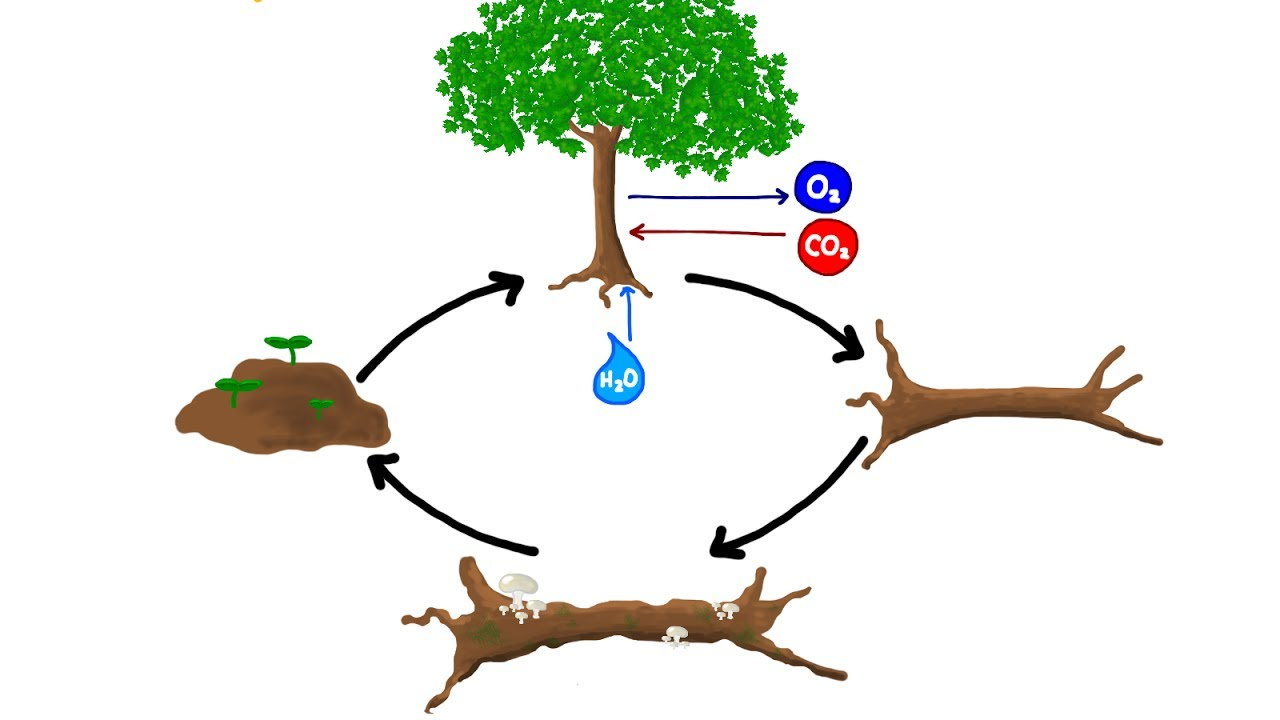
Energy flows through ecosystems in one direction only. It enters through photosynthesis, passes through food chains, and exits as heat. It cannot be reused.
Matter, however, is completely different. The atoms making up living organisms are used, released, and used again in a continuous cycle. The carbon in your body has been part of countless other organisms before you. The nitrogen in your muscles was once in the soil, then in a plant, then in an animal. These same atoms will cycle through other organisms long after you.
Understanding how matter cycles through ecosystems is fundamental to understanding how life sustains itself on Earth.
A nutrient cycle describes how chemical elements and compounds move through the living (biotic) and non-living (abiotic) components of an ecosystem in a continuous cycle.
All nutrient cycles involve the same basic pattern:
Decomposers are therefore essential to nutrient cycling. Without them, nutrients would remain locked in dead organic matter and become unavailable to living organisms.
Carbon is the fundamental element of all organic molecules. Every carbohydrate, fat, protein, and nucleic acid contains carbon. Understanding how carbon moves between living organisms and the environment is, therefore, central to understanding life itself.
Carbon exists in the atmosphere primarily as carbon dioxide (CO₂). This atmospheric carbon dioxide is the entry point for carbon into most living systems.
Producers absorb CO₂ from the atmosphere and use it in photosynthesis to build organic carbon compounds (glucose and other molecules).
This process removes carbon from the atmosphere and incorporates it into living matter.
All living organisms, including producers, carry out cellular respiration, breaking down organic molecules to release energy and returning CO₂ to the atmosphere.
Carbon also returns to the atmosphere through:
Some carbon is removed from the active cycle for long periods.
The burning of fossil fuels releases carbon that was locked away for millions of years back into the atmosphere as CO₂. Deforestation simultaneously reduces the capacity of ecosystems to absorb atmospheric CO₂ through photosynthesis.
The result is a rapid increase in atmospheric CO₂ concentration, which enhances the greenhouse effect and drives global climate change. This represents a fundamental disruption of the natural carbon cycle.
Nitrogen is essential for making amino acids and therefore all proteins, as well as nucleic acids (DNA and RNA). The atmosphere is approximately 78 percent nitrogen gas (N₂), yet most organisms cannot use this nitrogen directly because the N₂ molecule is extremely stable and unreactive.
The nitrogen cycle describes how nitrogen moves between the atmosphere, soil, living organisms, and back.
Nitrogen fixation is the conversion of atmospheric nitrogen (N₂) into ammonia (NH₃) or related compounds that living organisms can use.
This is carried out by:
Ammonia produced by nitrogen fixation and decomposition is toxic in high concentrations. Nitrifying bacteria in the soil convert ammonia first into nitrites and then into nitrates.
Nitrates are the form of nitrogen most readily absorbed by plant roots.
Plants absorb nitrates from the soil through their roots and use them to synthesize amino acids and proteins. Animals obtain nitrogen by eating plants or other animals and breaking down proteins into amino acids.
When organisms die or produce waste, decomposing bacteria break down nitrogen-containing organic compounds and release ammonia back into the soil. This process is called ammonification.
Denitrifying bacteria in the soil convert nitrates back into nitrogen gas (N₂), which is released into the atmosphere, completing the cycle.
This process is most active in waterlogged, oxygen-poor soils.
The large-scale use of synthetic nitrogen fertilizers in agriculture has significantly disrupted the natural nitrogen cycle.
Although not a nutrient cycle in the strict sense, the water cycle is closely linked to nutrient cycling and ecosystem function.
Water moves between the atmosphere, land, and living organisms through:
Living organisms are heavily involved in the water cycle. Forests, for example, contribute enormous amounts of water vapor to the atmosphere through transpiration, influencing rainfall patterns across entire regions.
Nutrient cycles are what make life on Earth sustainable over geological timescales. The same atoms have been cycling through living and non-living systems for billions of years. When human activities disrupt these cycles, such as through the addition of excess carbon to the atmosphere or excess nitrogen to waterways, the consequences extend far beyond the immediate point of disruption, affecting ecosystems globally.