

On this page:
Introduction What Is Competition? Intraspecific Competition Effects of Intraspecific Competition Examples Interspecific Competition Effects of Interspecific Competition The Competitive Exclusion Principle The Ecological Niche Resource Partitioning Examples of Resource Partitioning Competition and Community StructureResources in nature are never unlimited. There is only so much sunlight, so much water, so much food, and so much territory. When the organisms that need these resources outnumber what the environment can supply, competition begins.
Competition is one of the most powerful forces shaping the structure of ecological communities, driving the evolution of species, and determining which organisms survive and which do not. It operates between individuals of the same species and between entirely different species, and its outcomes shape ecosystems in ways that are both predictable and profound.
Competition is an interaction between organisms that require the same limited resource, where the use of that resource by one individual reduces its availability to others.
Competition is a negative interaction for both parties. Unlike predation, where one organism benefits at the expense of another, in competition, both organisms are potentially harmed by the reduction in available resources.
Resources that organisms commonly compete for include:
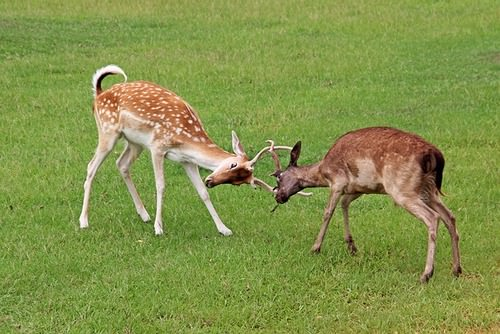
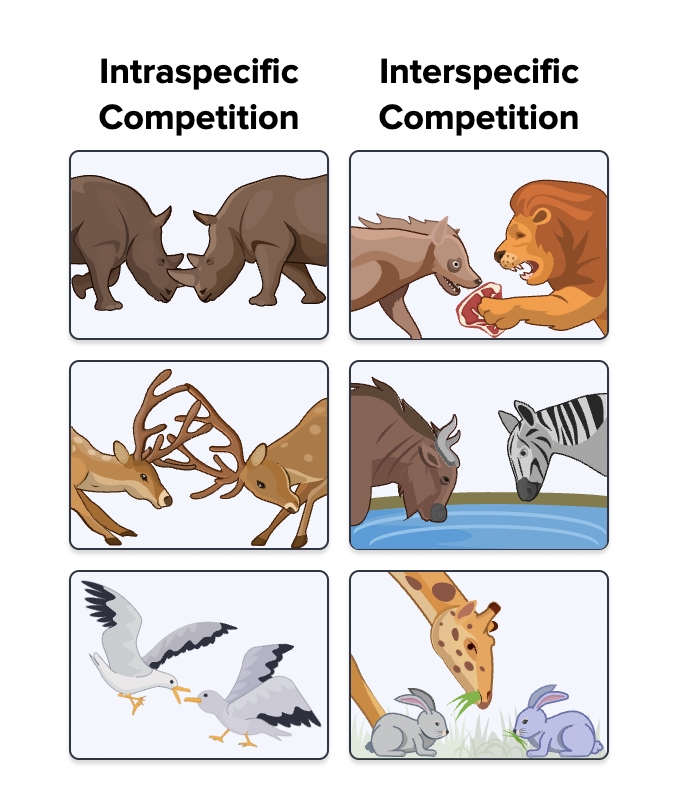
Intraspecific competition is competition between individuals of the same species for the same resources.
Because members of the same species have identical resource requirements, intraspecific competition is typically the most intense form of competition an organism faces.
Population regulation: As a population grows and resources become more limited, intraspecific competition intensifies. Individuals with poorer access to resources have lower survival and reproduction rates. This reduces the population growth rate and eventually limits the population size. Intraspecific competition is therefore a key density-dependent factor regulating population size.
Natural selection: Intraspecific competition drives natural selection within a population. Individuals with characteristics that allow them to obtain resources more effectively leave more offspring. Over generations, the population becomes better adapted to competing for the available resources.
Territory establishment: Many animals establish territories, areas that individuals defend against members of the same species. Territory holders gain exclusive access to the resources within their territory. Individuals unable to establish territories may fail to reproduce.
Dominance hierarchies: In social species, individuals establish rank orders (pecking orders) that determine priority of access to resources. Dominant individuals have first access to food, mates, and shelter.
Interspecific competition is competition between individuals of different species for the same limited resource.
It is generally less intense than intraspecific competition because different species, even if they compete for some of the same resources, typically have somewhat different ecological requirements.
Darwin's finches in the Galapagos Islands show clear character displacement. Species living on the same island have evolved more different beak sizes than populations of the same species living on different islands without competitors. Different beak sizes allow exploitation of different food sources, reducing competition.
The competitive exclusion principle states that two species competing for exactly the same limiting resource cannot coexist indefinitely in the same habitat.
The more efficient competitor will eventually drive the less efficient one to local extinction or force it to use different resources or a different habitat.
This principle was demonstrated experimentally by G.F. Gause in the 1930s using two species of Paramecium. When grown separately, both species flourished. When grown together in the same culture, competing for the same food, one species always drove the other to extinction.
The principle implies that the stable coexistence of competing species requires some degree of ecological differentiation. If two species truly occupy the same ecological niche, one will outcompete the other.
The ecological niche of a species describes its complete role in the ecosystem, including all the resources it uses, the conditions it requires, and all its interactions with other species.
Two species cannot indefinitely occupy exactly the same niche in the same place. Niche differentiation, even subtle differences in resource use, allows competing species to coexist.
Resource partitioning is the phenomenon by which competing species use the same general resources but in different ways, at different times, or in different parts of the habitat, reducing direct competition and allowing coexistence.
Habitat partitioning: Five species of warbler studied by Robert MacArthur in New England spruce forests each foraged in different zones of the tree, some in the crown, some in the middle branches, and some near the base. All ate insects, but in different microhabitats, reducing competition.
Temporal partitioning: Lions and leopards in the African savanna both hunt similar prey, but lions are predominantly diurnal (active in day) and leopards are predominantly nocturnal, reducing direct competition for the same prey at the same time.
Size partitioning: Species eating similar types of food but of different sizes avoid direct competition. Hawk species hunting rodents take different-sized prey depending on their own body size.
Microhabitat partitioning: Several species of lizard may share the same desert environment but occupy different microhabitats, some in open areas, some under rocks, some in vegetation.
Competition is a major force shaping the structure of ecological communities.
The diversity of species within a community reflects the partitioning of resources among competing species. The more ways a resource can be divided, the more species can coexist. Tropical rainforests have the highest biodiversity on Earth partly because their structural complexity provides an extraordinary range of microhabitats and resources, allowing hundreds of competing species to coexist through resource partitioning.
Understanding competition is essential for conservation biology. When invasive species are introduced into new ecosystems, they compete with native species for resources. Native species, which have not co-evolved with the invader, are often outcompeted and decline rapidly. This is one of the primary mechanisms by which invasive species cause extinctions of native species.