

On this page:
Q1. Gradient and y-intercept of a line Q2. Equation of a line through two points Q3. Quadratic function evaluation & axis of symmetry Q4. Domain and range of square root function Q5. Composite functions Q6. Inverse function (linear) Q7. Transformations of quadratic Q8. Perpendicular lines & intersection Q9. Perpendicular bisector Q10. Rational function - domain, inverse, asymptotes Q11. Exponential growth model Q12. Sinusoidal function (transformed sine) Q13. Cubic equation solving (GDC) Q14. Logarithmic function - domain, graph, inverse Q15. Multiple transformations & mapping domain/range Q16. Logistic function (carrying capacity, inflection) Q17. Triangle geometry - altitude, centroid, circumcentre Q18. Inverse of ln function & composition Q19. Sinusoidal transformations & area Q20. Piecewise function & its properties Q21. Rational function with unknowns & inverse (HL) Q22. Sinusoidal temperature model Q23. Exponential and quadratic intersection (HL) Q24. Cubic function - intercepts, turning points, extrema Q25. Logistic vs exponential model comparison (HL)Practice questions covering lines, quadratics, domain and range, composite functions, inverse functions, transformations, perpendicular bisector, asymptotes, exponential and logistic models, sinusoidal models, piecewise functions, curve sketching, and more.
Find the gradient and y-intercept of the line 3x − 2y + 6 = 0.
Answer: Gradient = 3/2; y-intercept = (0, 3)
Line L passes through (2, −1) and (6, 7). Find the equation of L in the form y = mx + c.
Answer: m = (7−(−1))/(6−2) = 2; y−(−1) = 2(x−2) → y = 2x − 5
Given f(x) = 3x² − 2x + 1. Find: (a) f(0), (b) f(−2), (c) the axis of symmetry.
Answer: (a) 1 (b) 17 (c) x = 1/3
State the domain and range of f(x) = √(x − 3).
Answer: Domain: x ≥ 3 (i.e. [3,+∞)); Range: y ≥ 0 (i.e. [0,+∞))
Given f(x) = 2x + 1 and g(x) = x². Find (a) f∘g(x), (b) g∘f(x), (c) f∘g(3).
Answer: (a) 2x²+1 (b) (2x+1)² (c) 19
Find the inverse of f(x) = 4x − 7. State its domain and range.
Answer: f⁻¹(x) = (x+7)/4; Domain and range: all real numbers
Describe the transformations that map f(x) = x² onto g(x) = −(x+3)² + 5.
Answer: Translate left 3, reflect in x-axis, translate up 5
Line L₁ has equation 2x + 3y = 12. Line L₂ is perpendicular to L₁ and passes through (4, 1).
(a) Find the gradient of L₁.
(b) Write the equation of L₂.
(c) Find the intersection of L₁ and L₂.
Answer: (a) m₁=−2/3 (b) y=1.5x−5 (c) (126/13, 3/13)
Find the perpendicular bisector of the segment joining A(1, 4) and B(7, −2). Write in the form ax + by = c.
Answer: Midpoint (4,1), slope=1, equation: x − y = 3
Consider f(x) = (x−2)/(x+1).
(a) State the domain.
(b) Find f⁻¹(x).
(c) State the domain of f⁻¹.
(d) Find the equations of the asymptotes of f.
Answer: (a) x∈ℝ, x≠−1 (b) f⁻¹(x)=−(x+2)/(x−1) (c) x≠1 (d) x=−1, y=1
The exponential model P(t) = 1200·e^(0.03t) represents a population after t years.
(a) Find P(0).
(b) Find the population after 10 years.
(c) Find when P = 3600 (give t to 1 d.p.).
(d) State the meaning of 0.03 in context.
Answer: (a) 1200 (b) ≈1619 (c) t≈36.6 years (d) 3% per year continuous growth rate
f(x) = 3sin(2x − π/4) − 1. Find: (a) amplitude, (b) period, (c) principal axis, (d) phase shift, (e) maximum and minimum values.
Answer: (a) 3 (b) π (c) y=−1 (d) π/8 right (e) Max=2, Min=−4
Use your GDC to solve 2x³ − 5x + 1 = 0, giving all solutions to 3 s.f.
Answer: x ≈ −1.66, x ≈ 0.201, x ≈ 1.46
f(x) = ln(2x−3).
(a) State the domain and range.
(b) Sketch the graph, showing the x-intercept and vertical asymptote.
(c) Find f⁻¹(x) and state its domain.
Answer: (a) x>3/2, y∈ℝ (b) x-int=(2,0), VA: x=1.5 (c) f⁻¹(x)=(eˣ+3)/2
The graph of f(x) is transformed to g(x) = 2f(3x−6) + 4.
(a) Describe each transformation in the correct order.
(b) If f(x) has domain [0,6] and range [−2,4], find the domain and range of g.
Answer: (a) Horizontal compression ×1/3, right 2; vertical stretch ×2, up 4 (b) Domain [2,4], Range [0,12]
The logistic function is P(t) = 500/(1 + 4e^(−0.2t)).
(a) Find P(0).
(b) Find the carrying capacity (horizontal asymptote as t→∞).
(c) Find t when P=450 to 1 d.p.
(d) State the point of inflection.
Answer: (a) 100 (b) 500 (c) t≈17.9 (d) At P=250, t≈6.93
Points A(1,3), B(5,7), C(8,2) form a triangle. Find:
(a) the equation of the altitude from A to BC,
(b) the centroid,
(c) the circumcentre.
Answer: (a) y=(3/5)x+12/5 (b) Centroid=(14/3, 4) (c) Circumcentre≈(4.5, 4.1)
f(x) = ln(x) + 2 and its inverse f⁻¹(x) = e^(x−2).
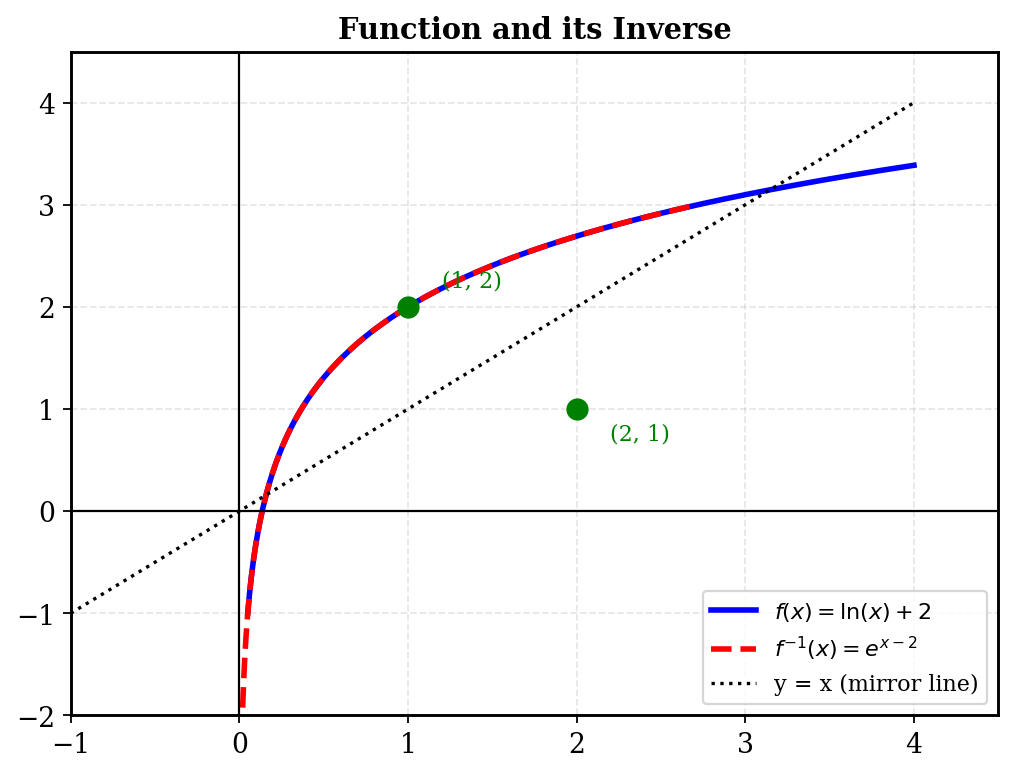
(a) Verify algebraically that f and f⁻¹ are inverse functions.
(b) Find the point(s) where f(x) = f⁻¹(x) and where both cross y=x.
(c) Find (f∘f⁻¹)(e) and (f⁻¹∘f)(4).
(d) Solve f(f(x)) = 3, giving answer to 3 d.p.
Answer: (a) Verified (b) Solve numerically via GDC (c) e and 4 (d) x≈5.575
g(x) = 3sin(2x − π/3) + 1 and original f(x) = sin(x).
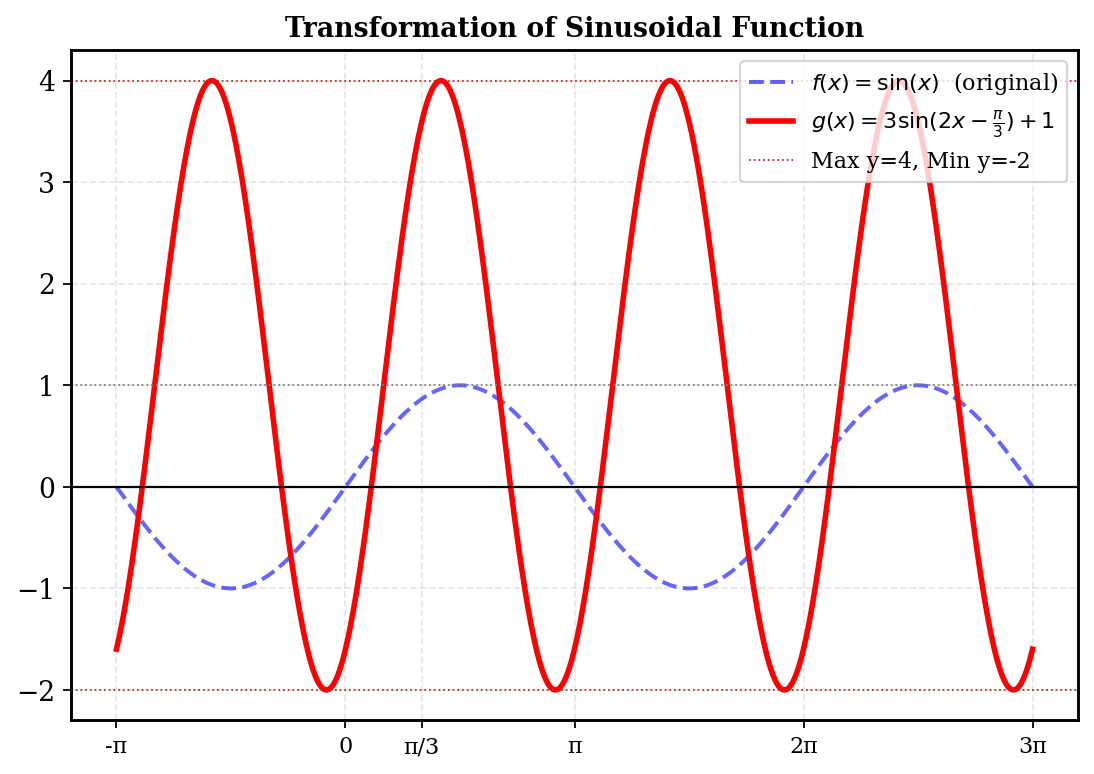
(a) Show the transformations step by step from f to g.
(b) State the range of g and find all x ∈ [0, 2π] where g(x) = 0.
(c) Find the area enclosed between g(x) and y=1 over one full period.
(d) [HL] Find all x ∈ ℝ where g(x) = f(x), i.e. 3sin(2x−π/3)+1 = sin(x).
Answer: (a) Shown (b) Range [−2,4]; zeros at x≈0.71,1.34,3.85,4.48 (approx) (c) 6 (d) Via GDC
Piecewise function: for x<0: f(x)=x²+1; for 0≤x≤2: f(x)=−2x+4; for x>2: f(x)=2^(x−2)−1.
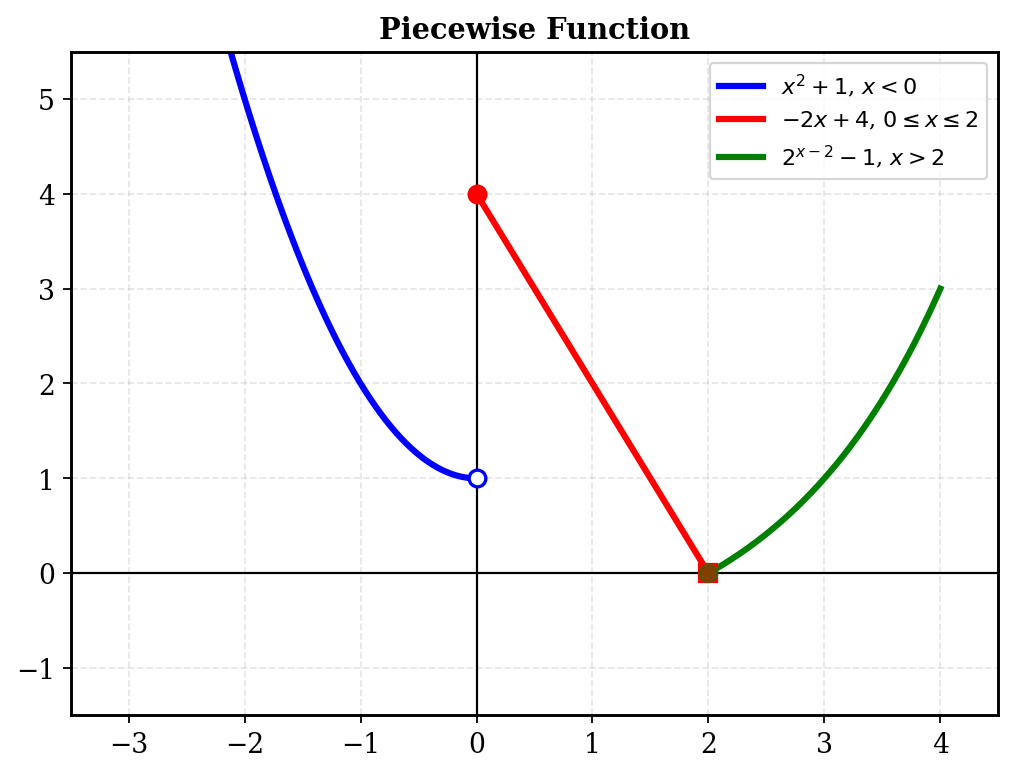
(a) Show f is NOT continuous at x=0.
(b) Find any zeros of f.
(c) Find the domain and range.
(d) Find f⁻¹(x) for the linear piece, and state its domain.
(e) Evaluate ∫₀² f(x) dx.
Answer: (a) Shown (lim=1≠f(0)=4) (b) x=2 (c) Domain ℝ, Range (−1,∞) (d) f⁻¹(x)=(4−x)/2, x∈[0,4] (e) 4
f(x) = (2x+a)/(bx+3) has a vertical asymptote at x=1 and passes through (0,2) and (2,5).
(a) Use the asymptote to find b.
(b) Use (0,2) to find a.
(c) Verify with point (2,5).
(d) Find f⁻¹(x) and state its domain.
(e) Find all x where f(x) = f⁻¹(x).
Answer: (a) b=−3 (b) a=6 (c) Verify with GDC (d) f⁻¹(x)=(3−3x)/(3x+2) (e) x=1±√(7/3) via GDC
Sinusoidal model: temperature T(t) = a·cos(bt) + d. Max 34°C at 2pm (t=14), min 18°C at 2am (t=2).
(a) Find a, d, b, and the period.
(b) Write the full equation T(t).
(c) Find the times when T = 28°C during one day.
(d) Find the average temperature over a 24-hour period.
Answer: (a) a=8, d=26, b=π/12, period=24h (b) T(t)=8cos(π(t−14)/12)+26 (c) t≈8.9h and t≈19.1h (d) 26°C
Let f(x) = e^x and g(x) = 3x².
(a) Find all solutions to f(x) = g(x) to 3 s.f.
(b) For the smallest positive solution, find the angle between the two curves.
(c) Find the area enclosed between f and g for x ∈ [−1, 0].
(d) Show (f∘g)(x) = e^(3x²) and find its minimum value and the x-values where it occurs.
Answer: (