

On this page:
Q1. Differentiation - Basic Rules Q2. Tangent & Normal Lines Q3. Basic Integration Q4. Definite Integral Evaluation Q5. Stationary Points & Classification Q6. Trapezoidal Rule Q7. Kinematics - Velocity & Displacement Q8. Product Rule & Inflection Points Q9. Integration by Substitution Q10. Area Between Curves Q11. Quotient Rule & Tangent Q12. Volume of Revolution (HL) Q13. Particle Motion - Distance Q14. Separable Differential Equation (HL) Q15. Optimization - Rectangle Area Q16. Euler's Method (HL) Q17. Trigonometric Integration & Integration by Parts Q18. Area Between Cubic and Linear Function Q19. Slope Field & Euler's Method (HL) Q20. Volume & Surface Area of Revolution (HL) Q21. Kinematics - Total Distance & Position Q22. Optimization - Open Box (HL) Q23. Newton's Law of Cooling (HL) Q24. Advanced Integration (HL) Q25. Predator-Prey Model (HL)Practice questions covering differentiation rules, tangents and normals, stationary points, integration (definite and indefinite), trapezoidal rule, substitution, areas between curves, volumes of revolution, kinematics, differential equations (separable, Newton's cooling), slope fields, Euler's method, optimization, and more. Click "Show Answer" to reveal the solution for each question.
Differentiate: (a) f(x)=5x³−3x²+7x−2,
(b) g(x)=4√x − 3/x,
(c) h(x)=e^(2x).
Answer: (a) 15x²−6x+7
(b) 2/√x + 3/x²
(c) 2e^(2x)
Find the equation of the tangent and normal to y=x²−3x+1 at the point where x=2.
Answer: Tangent: y=x−3; Normal: y=−x+1
Find:
(a) ∫(6x²−4x+3) dx,
(b) ∫e^(3x) dx,
(c) ∫(1/x) dx.
Answer: (a) 2x³−2x²+3x+C
(b) e^(3x)/3+C
(c) ln|x|+C
Evaluate: ∫₁⁴ (3x − 2) dx.
Answer: 16.5
f(x) = 2x³ − 9x² + 12x − 4
(a) Find f'(x)
(b) Find all stationary points
(c) Classify them using the second derivative.
Answer: (a) 6x²−18x+12
(b) (1,1) max and (2,0) min
(c) x=1 max, x=2 min
Use the trapezoidal rule with n=4 strips to estimate ∫₀² √(1+x²) dx.
Answer: ≈2.977 (exact ≈3.056)
An object moves with velocity v(t) = 3t² − 6t + 2 m/s
(a) Find the acceleration at t=1
(b) Find the displacement from t=0 to t=3
(c) Find when v=0.
Answer: (a) 0 m/s²
(b) 6 m
(c) t≈0.42 s and t≈1.58 s
f(x) = x·eˣ
(a) Use the product rule to find f'(x)
(b) Find f''(x)
(c) Find the x-coordinate of any inflection point
(d) Sketch the key features.
Answer: (a) eˣ(1+x)
(b) eˣ(2+x)
(c) x=−2
(d) Min at x=−1
Use integration by substitution to find:
(a) ∫ 2x(x²+3)⁴ dx,
(b) ∫ sin(3x+1) dx,
(c) ∫ xe^(x²) dx.
Answer: (a) (x²+3)⁵/5+C
(b) −cos(3x+1)/3+C
(c) eˣ²/2+C
Find the exact area enclosed between y=x² and y=6x−x². Show all working.
Answer: 9 square units
f(x) = (2x+1)/(x−3). Find:
(a) f'(x) using the quotient rule
(b) the equation of the tangent at x=5
(c) whether f is increasing or decreasing for x>3.
Answer: (a) −7/(x−3)²
(b) y=−7x/4+47/4
(c) Strictly decreasing
Volume of revolution: the region bounded by y=√x, x=0, x=4, and the x-axis is rotated about the x-axis.
(a) Set up the integral.
(b) Evaluate exactly.
(c) Find volume when same region rotated about y-axis.
Answer: (a) V=π∫₀⁴x dx
(b) 8π
(c) 128π/5
A particle: s(t)=t³−6t²+9t+2 for t≥0
(a) Find velocity and acceleration
(b) When is particle at rest?
(c) Find total distance (not displacement) from t=0 to t=4
(d) When is acceleration=0?
Answer: (a) v=3t²−12t+9, a=6t−12
(b) t=1,3
(c) 12 m
(d) t=2
Separable ODE: dy/dx = y·cos(x)
(a) Separate and integrate
(b) Find the particular solution with y(0)=3
(c) Find y(π/2)
(d) Describe the long-term behaviour.
Answer: (a) y=Ae^(sinx)
(b) y=3e^(sinx)
(c) 3e≈8.15
(d) y oscillates between ≈1.10 and 8.15
Find the dimensions of a rectangle with perimeter 40cm that has the maximum possible area. Use calculus to verify it is a maximum.
Answer: Square with side 10 cm; maximum area = 100 cm²
Euler's method: dy/dx=x+y, y(0)=1. Use step h=0.25 to estimate y(1).
Answer: y(1) ≈ 2.883 (exact: 2e−1≈4.436; Euler underestimates as f is concave up)
Find:
(a) ∫ sin²(x) dx using the identity cos(2x)=1−2sin²(x)
(b) ∫₀^(π/2) sin²(x) dx exactly
(c) ∫ x·sin(x) dx using integration by parts.
Answer: (a) x/2−sin(2x)/4+C
(b) π/4
(c) −xcos(x)+sin(x)+C
The diagram shows the area between f(x)=x³−4x²+4x (blue) and g(x)=x (red), with two shaded regions
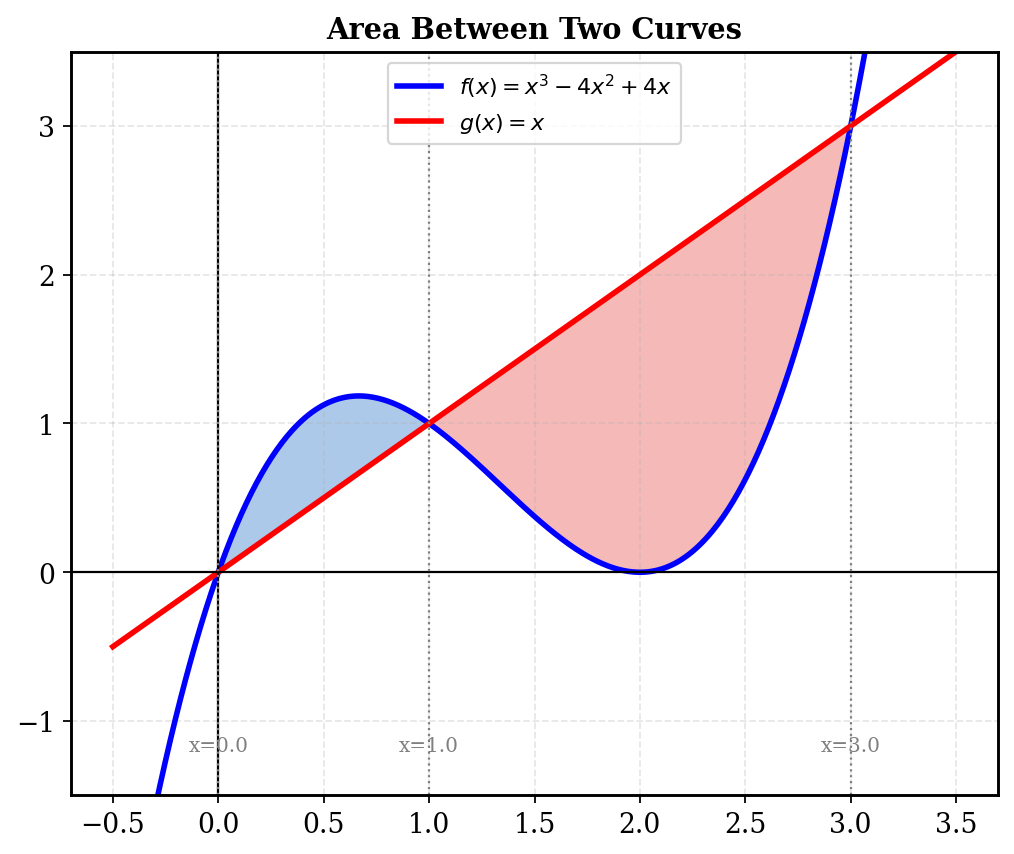
(a) Find all x-coordinates where f(x)=g(x)
(b) Determine which function is greater in each interval
(c) Find the total enclosed area
(d) Set up and evaluate ∫₀¹(f−g)dx and ∫₁³(g−f)dx separately, then sum the absolute values.
Answer: (a) x=0,1,3
(b) f>g on [0,1]; g>f on [1,3]
(c) 37/12
(d) 5/12+8/3=37/12
The slope field shows dy/dx=y−x². A particular solution with y(0)=3 is drawn.
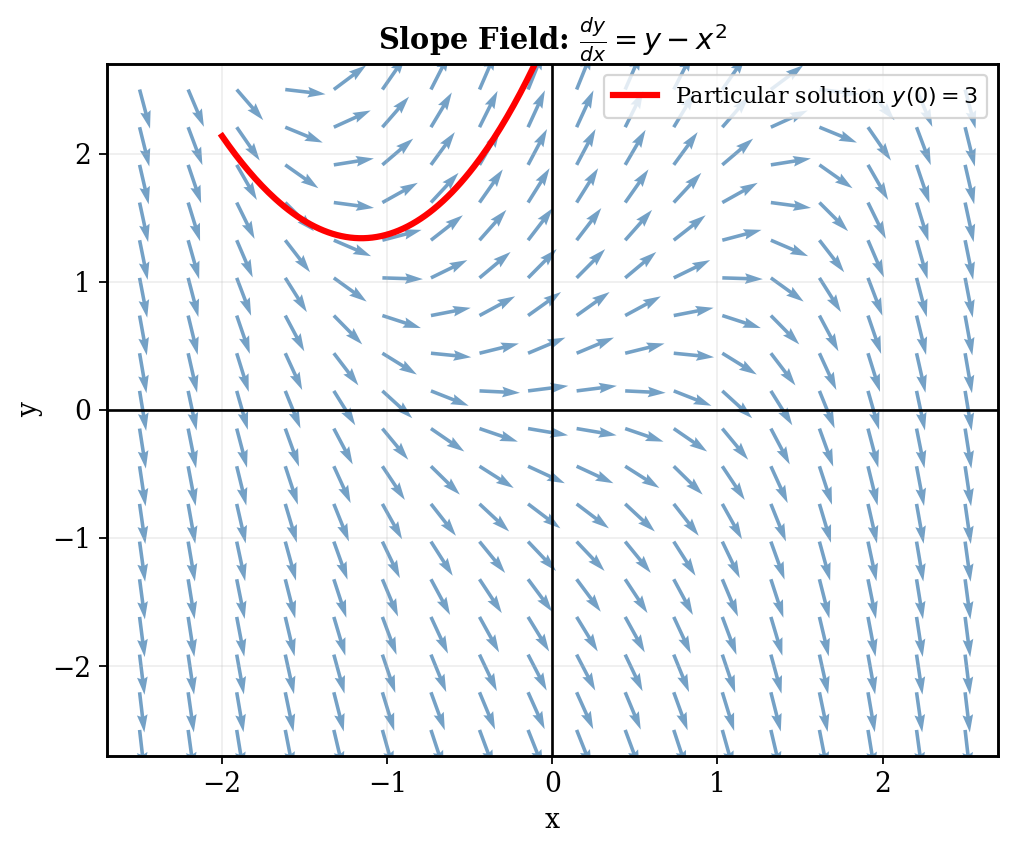
(a) Verify the solution y=eˣ+x²+2x+2 satisfies the ODE and initial condition
(b) Find y(2) and the gradient of the curve at x=2
(c) Use Euler's method with h=0.5 to estimate y(2) starting from y(0)=3. Compare with exact
(d) Find all equilibrium solutions (where dy/dx=0 always).
Answer: (a) Verified
(b) y(2)=e²+10≈17.4, slope≈13.4
(c) Euler gives ≈13.03, error≈4.36
(d) No equilibrium
Volume of revolution: region bounded by y=√x+0.5, x-axis, x=0, x=3. The diagram shows a disk at x=2
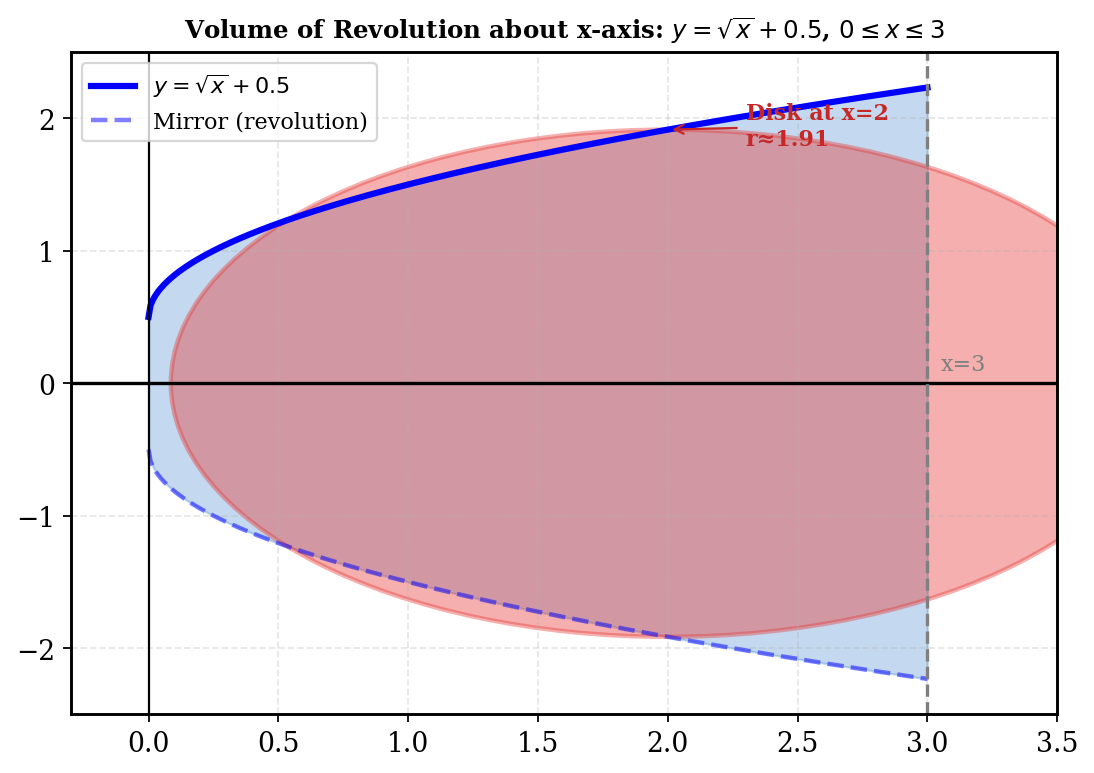
(a) Set up the integral for volume about x-axis
(b) Evaluate exactly
(c) Set up the integral for volume about y-axis
(d) Find the surface area of revolution about the x-axis using SA=2π∫₀³y√(1+(dy/dx)²)dx.
Answer: (a) π∫₀³(√x+0.5)²dx
(b) π(5.25+3√3)≈31.1
(c) ≈57.2
(d) SA≈47.3
v(t)=3t²−12t+9 m/s (blue), a(t)=6t−12 m/s² (red) shown
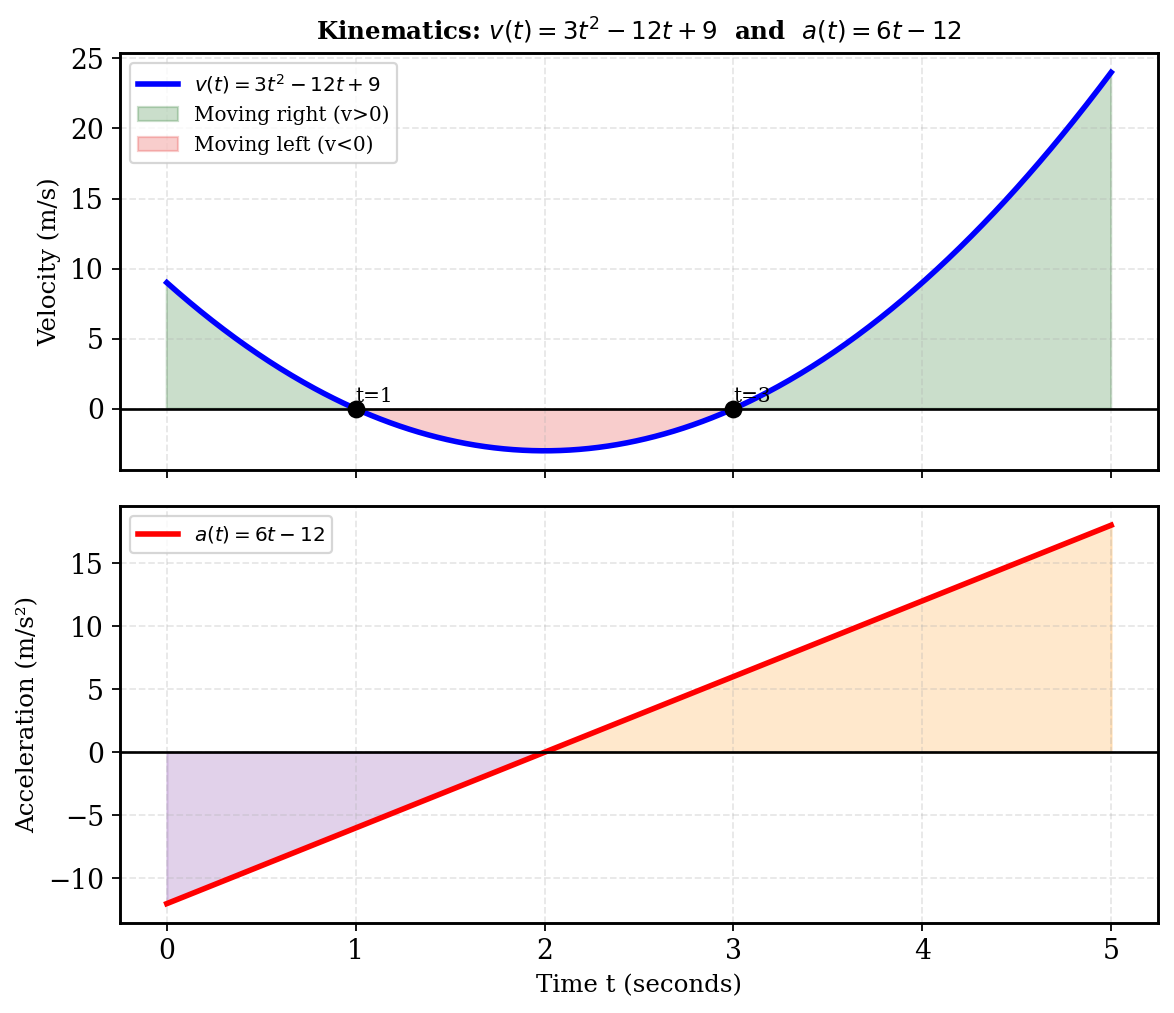
(a) Find when the particle momentarily stops. State direction of motion on each interval
(b) Find total distance from t=0 to t=5
(c) Find the maximum speed in [0,5]
(d) Show the displacement from t=0 to t=5 equals ∫₀⁵v(t)dt and compute it
(e) Find the position function s(t) if s(0)=0, and find when s is at its initial position again.
Answer: (a) t=1,3; right,left,right (b) 28 m (c) 24 m/s at t=5 (d) Displacement=20m (e) t=3
Optimization (hard): An open-topped rectangular box is made from a 20cm×30cm sheet of metal by cutting squares of side x from each corner and folding up.
(a) Show the volume is V(x)=x(20−2x)(30−2x)
(b) Expand and find V'(x)
(c) Find the exact value(s) of x that maximize V
(d) Show the second derivative confirms it is a maximum
(e) Find the dimensions and maximum volume.
Answer: (a) Shown
(b) V'=12x²−200x+600
(c) x=(25−5√7)/3≈3.93
(d) V''<0
(e) V≈1056 cm³
Differential equation application: Newton's Law of Cooling: dT/dt=−k(T−20), where T is temperature(°C), t is time(min), 20°C is room temp. A cup of coffee cools from 90°C to 70°C in 5 minutes.
(a) Solve the ODE to get T(t)=20+Ae^(−kt)
(b) Use initial condition to find A
(c) Use T(5)=70 to find k exactly
(d) Find T(20)
(e) Find how long until T=30°C
(f) If the room temp changes to 25°C after t=10, set up the new IVP.
Answer: (a) T=20+Ae^(−kt)
(b) A=70
(c) k=ln(7/5)/5
(d) ≈38.2°C
(e) ≈49.1 min
(f) dT/dt=−k(T−25), T(10)=known
Further integration:
(a) Find ∫ x²·ln(x) dx using integration by parts
(b) Evaluate ∫₁² x²·ln(x) dx exactly
(c) Find ∫ cos²(x)·sin(x) dx using substitution
(d) Find ∫₀^(π/2) cos²(x)·sin(x) dx
(e) Show that ∫₀^(π/2) sinⁿ(x)dx = (n−1)/n · ∫₀^(π/2) sinⁿ⁻²(x)dx and use it for n=4.
Answer: (a) x³lnx/3−x³/9+C
(b) 8ln2/3−7/9
(c) −cos³x/3+C
(d) 1/3
(e) ∫₀^(π/2)sin⁴x dx=3π/16
Coupled differential equations / Euler's method hybrid: A predator-prey model: dx/dt = 0.4x − 0.02xy (prey), dy/dt = −0.3y + 0.01xy (predator), where x=prey (hundreds), y=predator (tens). Initial: x(0)=40, y(0)=9
(a) Find the equilibrium points (dx/dt=dy/dt=0)
(b) Interpret the equilibrium biologically
(c) Use Euler's method with h=0.5 to estimate x(1) and y(1)
(d) Find dx/dt and dy/dt at t=0 and interpret
(e) This system is called the Lotka-Volterra model. Describe qualitatively what happens to x and y over time.
Answer: (a) (0,0) and (30,20)
(b) Stable coexistence
(c) x(1)≈49.1, y(1)≈10.1
(d) Both growing
(e) Cyclic oscillations