

On this page:
1. Exponential Equation 2. Induction: r·2^r 3. Partial Fractions 4. Geometric Series 5. Bouncing Ball 6. Complex Numbers: De Moivre 7. Divisibility by 6 8. Odd Integers Proof 9. Induction: Sum of Odds 10. √3 is Irrational 11. Binomial Expansion (1+x)^(-2) 12. Eiffel Tower Replicas 13. Complex Roots 14. Compound Interest 15. Arithmetic Sequence 16. Infinite Segments 17. Bank Loan 18. Binomial Expansion (2+3x)^5 19. System of Equations 20. Induction: 4ⁿ−1 divisible by 3 21. Induction: r·r! 22. Complex Operations 23. √3+i Roots 24. cos(4θ) Identity 25. System with Parameter 26. Binomial Series Sum 27. Committee Selection 28. Seating Arrangements 29. Partial Fractions 30. Quadratic DenominatorPractice questions covering exponential equations, mathematical induction, partial fractions, geometric series, complex numbers, De Moivre's theorem, irrationality proofs, binomial expansions, combinatorics, and financial mathematics.
Solve the equation 3^(2x) − 12·3^x + 27 = 0, giving your answers in exact form.
(a) Let y = 3^x. Write the equation in terms of y.
(b) Solve for y and hence find the values of x.
Answer (a): y² − 12y + 27 = 0
Answer (b): x = 1 or x = 2
Explanation: y² - 12y + 27 = (y-3)(y-9)=0 → y=3 or y=9 → 3^x=3 → x=1; 3^x=9 → x=2.
Prove by mathematical induction that Σ(r=1 to n) r · 2^r = 2 + (n − 1) · 2^(n+1) for all n ∈ ℤ⁺.
(a) Verify the result for n = 1.
(b) State the inductive hypothesis for n = k.
(c) Complete the inductive step to show the result is true for n = k + 1.
Answer (a): LHS = 1·2 = 2; RHS = 2 + 0·4 = 2 ✓
Answer (b): Assume Σᵣ₌₁ᵏ r·2ʳ = 2 + (k−1)·2ᵏ⁺¹ for some k ≥ 1
Answer (c): Add (k+1)·2ᵏ⁺¹: RHS = 2 + (k−1)·2ᵏ⁺¹ + (k+1)·2ᵏ⁺¹ = 2 + 2ᵏ⁺¹·2k = 2 + k·2ᵏ⁺² = 2 + ((k+1)−1)·2^((k+1)+1) ✓
Express (5x + 1) / [(x + 3)(x − 1)] in partial fractions.
(a) Write the expression in the form A/(x + 3) + B/(x − 1).
(b) Find the values of A and B.
(c) Hence find ∫ (5x + 1) / [(x + 3)(x − 1)] dx.
Answer (a): A/(x+3) + B/(x−1)
Answer (b): A = -7/2, B = 3/2
Answer (c): -(7/2) ln|x+3| + (3/2) ln|x-1| + C
An infinite geometric series has first term a and common ratio r, where |r| < 1. The sum to infinity is 20 and the sum of the first 3 terms is 19.
(a) Show that a = 20(1 − r).
(b) Hence form an equation in r and solve to find r.
(c) Find the first term a.
Answer (a): S∞ = a/(1−r) = 20 ⇒ a = 20(1−r) ✓
Answer (b): r = (−20 ± √(400−80))/40 → r ≈ -0.0513 or r ≈ -0.9487
Answer (c): For r ≈ -0.0513, a ≈ 21.03; For r ≈ -0.9487, a ≈ 38.97
A bouncing ball is dropped from a height of 4 m. Each bounce reaches 75% of the previous height.
(a) Find the height of the 6th bounce.
(b) Find the total distance travelled by the ball before it comes to rest.
(c) After how many bounces does the total distance first exceed 24 m?
Answer (a): h₆ ≈ 0.949 m
Answer (b): Total distance = 28 m
Answer (c): After 7 bounces
Let z = 2(cos(π/6) + i·sin(π/6)).
(a) Write z in Cartesian form a + bi.
(b) Find z⁴ using De Moivre's theorem. Give your answer in Cartesian form.
(c) Find all cube roots of z³. Write answers in polar form.
Answer (a): z = √3 + i
Answer (b): z⁴ = −8 + 8√3·i
Answer (c): w₀ = 2(cos(π/6)+i·sin(π/6)), w₁ = 2(cos(5π/6)+i·sin(5π/6)), w₂ = 2(cos(3π/2)+i·sin(3π/2))
Prove by deduction that for any integer n, the expression n³ − n is always divisible by 6.
(a) Factorise n³ − n completely.
(b) Using part (a), show that n³ − n is divisible by 6 for all integers n.
Answer (a): n³ − n = (n−1)n(n+1)
Answer (b): Product of 3 consecutive integers: divisible by 2 (one even) and 3 (one multiple of 3) ⇒ divisible by 6 ✓
Let m and n be odd integers.
(a) Prove that mn is odd.
(b) Prove that m² + n² is even but not divisible by 4.
Answer (a): m = 2a+1, n = 2b+1; mn = 2(2ab+a+b)+1 ⇒ odd ✓
Answer (b): m²+n² = 4(a²+a+b²+b)+2; divisible by 2, not by 4 ✓
Prove by mathematical induction that Σᵣ₌₁ⁿ (2r − 1) = n² for all n ∈ ℤ⁺.
(a) Verify the base case n = 1.
(b) State the inductive hypothesis for n = k.
(c) Complete the inductive step to prove true for n = k + 1.
Answer (a): LHS = 1; RHS = 1² = 1 ✓
Answer (b): Assume Σᵣ₌₁ᵏ (2r−1) = k² for some k ≥ 1
Answer (c): Add (2k+1): k² + 2k + 1 = (k+1)² ✓
Prove by contradiction that √3 is irrational.
(a) State the assumption for proof by contradiction.
(b) By writing √3 = p/q in lowest terms (gcd(p,q) = 1), derive a contradiction.
Answer (a): Assume √3 = p/q where p,q∈ℤ, q≠0, gcd(p,q)=1
Answer (b): 3q² = p² ⇒ p divisible by 3. Let p=3k: q²=3k² ⇒ q divisible by 3. Contradicts gcd=1 ✓
(a) Use the binomial theorem with negative/fractional indices to expand (1 + x)^(−2) up to and including the term in x³, stating the range of x for which the expansion is valid.
(b) Use your expansion to find an approximation for 1/(1.02)² correct to 4 decimal places.
(c) Compare with the exact value and comment.
Answer (a): 1 − 2x + 3x² − 4x³ + … valid for |x| < 1
Answer (b): x = 0.02 → 1 − 0.04 + 0.0012 − 0.000032 = 0.961168 ≈ 0.9612 (4 d.p.)
Answer (c): Exact: 1/1.0404 = 0.961168... Very close — small x gives excellent approximation.
Eiffel Tower replicas exist at different scales. The largest is 324 m tall. A collection of 8 replicas has heights in geometric sequence. The smallest replica is 0.5 m and the largest is 324 m.
(a) Show that the common ratio is r = (648)^(1/7).
(b) Find the heights of all 8 replicas. Give answers to 3 significant figures.
(c) Find the total height of all 8 replicas.
(d) Which replica has height closest to 10 m?
Answer (a): 0.5·r⁷ = 324 ⇒ r⁷ = 648 ⇒ r = 648^(1/7) ✓
Answer (b): u₁=0.500, u₂=1.45, u₃=4.22, u₄=12.3, u₅=35.6, u₆=103, u₇=301, u₈=324
Answer (c): S₈ ≈ 169.8 m
Answer (d): u₄ ≈ 12.3 m is closest to 10 m.
(a) Express z = −1 + i√3 in modulus-argument form.
(b) Find z⁶ and show it is a real number.
(c) The 4th roots of z are w₀, w₁, w₂, w₃. Find all four roots and plot them on an Argand diagram. Describe which geometric shape they form.
Answer (a): |z|=2, arg(z)=2π/3 → z = 2(cos(2π/3)+i·sin(2π/3))
Answer (b): z⁶ = 64 (real) ✓
Answer (c): wₖ = 2^(1/4)[cos((2π/3+2kπ)/4)+i·sin((2π/3+2kπ)/4)] for k=0,1,2,3. They form a square on the Argand diagram.
A bank offers compound interest at rate r% per annum. Alice invests $P at the start of each year for n years.
(a) Show that the total value after n years is V = P·[(1+r/100)^n − 1]/(r/100).
(b) Alice wants $50 000 after 10 years. If r = 5%, find the annual payment P.
(c) If instead Alice invests a lump sum of $20000 at 5%, find the number of years for her investment to exceed $50000.
Answer (a): V = P[(1+r/100)^n − 1]/(r/100) [annuity formula] ✓
Answer (b): P ≈ $3975 per year
Answer (c): 20000(1.05)^n > 50000 → n > ln(2.5)/ln(1.05) ≈ 18.8 → 19 years
The arithmetic sequence has sixth term u₆ = ln 2 and eighth term u₈ = (3/2) ln 4.
(a) (i) Show that the common difference is ln 2.
(ii) Find u₁.
(iii) Hence show that the sum of n terms is given by Sₙ = (n² − 9n) ln √2.
(b) (i) Write down the equation of the axis of symmetry of f(x).
(ii) Sketch f(x) on the grid below.
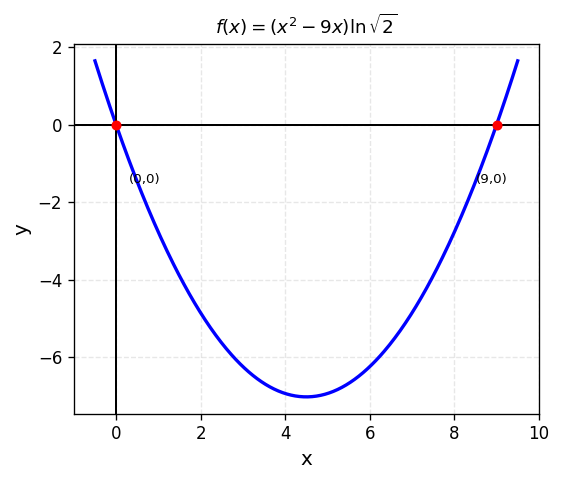
(c) (i) Find the minimum value of Sₙ, giving your answer in the form a ln b where a,b∈ℤ.
(d) Consider g(x) = (6 − 3x) ln √2.
(i) Solve f(x)=g(x).
(ii) Solve f(x) < g(x).
(iii) Find the range of values of n that satisfy Sₙ < g(n).
Answer (a)(i): d = ln 2; (ii): u₁ = -4 ln 2; (iii): Sₙ = (n²-9n) ln √2 ✓
Answer (b)(i): Axis of symmetry: x = 9/2 = 4.5
Answer (c)(i): Minimum value = -20 ln √2 = -10 ln 2 = ln(2⁻¹⁰)
Answer (d)(i): x = 0 or x = 12; (ii): 0 < x < 12; (iii): 1 ≤ n ≤ 11, n ∈ ℤ⁺
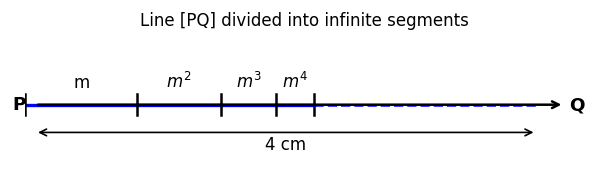
(a) The diagram shows [PQ], with length 4 cm. The line is divided into an infinite number of line segments. The lengths of the line segments are m cm, m² cm, m³ cm, …, where 0 < m < 1. Show that m = 4/5.
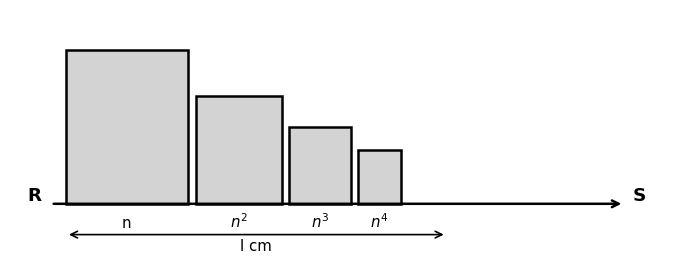
(b) The following diagram shows [RS], with length l cm, where l > 1. Squares with side lengths n cm, n² cm, n³ cm, …, where 0 < n < 1, are drawn along [RS]. The total sum of the areas of all the squares is 25/11. Find the value of l.
Answer (a): m + m² + m³ + … = 4 ⇒ m/(1-m) = 4 ⇒ m = 4/5 ✓
Answer (b): n²/(1-n²) = 25/11 ⇒ 11n² = 25 - 25n² ⇒ 36n² = 25 ⇒ n = 5/6; l = n/(1-n) = (5/6)/(1/6) = 5
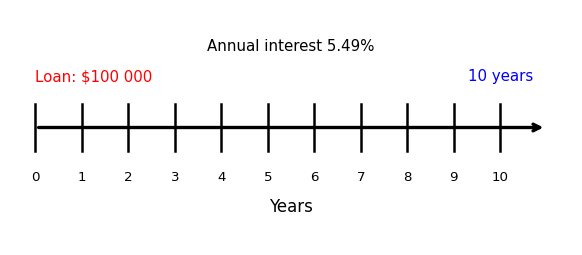
Bill takes out a bank loan of $100 000 at an annual interest rate of 5.49%. The interest is calculated at the end of each year and added to the amount outstanding.
(a) Find the amount of money Bill would owe after 10 years.
To pay off the loan, Bill makes quarterly deposits of $P at the end of every quarter in a savings account, paying a nominal annual interest rate of 3.2%. He makes his first deposit at the end of the first quarter after taking out the loan.
(b) Show that the total value after 10 years is P[(1.008⁴⁰ − 1)/(1.008 − 1)].
(c) Find the value of P to the nearest dollar.
(d) Melinda makes a single deposit of $Q at 3.5% annual interest. She wishes to withdraw $8000 at the end of each year for n years. Find the minimum value of Q that permits indefinite withdrawals.
Answer (a): 100000 × (1.0549)¹⁰ ≈ $170,763
Answer (b): Geometric series with first term P(1.008) and ratio 1.008, 40 terms → P[(1.008⁴⁰−1)/(0.008)] ✓
Answer (c): P ≈ $3,552
Answer (d): Q_min = 8000/0.035 = $228,571
(a) Use the binomial theorem to expand (2 + 3x)⁵, writing each coefficient as an integer.
(b) The coefficient of x³ in the expansion of (2 + kx)⁵ is 2160. Find the value of k.
(c) Consider the expansion of (1 + x)⁻³. Write down the first four terms and state the range of x for which the expansion is valid.
(d) Use your expansion to find an approximation of (0.97)⁻³ correct to 4 significant figures.
Answer (a): 32 + 240x + 720x² + 1080x³ + 810x⁴ + 243x⁵
Answer (b): C(5,3)·2²·k³ = 10·4·k³ = 2160 ⇒ k³ = 54 ⇒ k = 3·³√2
Answer (c): 1 − 3x + 6x² − 10x³ + …, valid for |x| < 1
Answer (d): x = −0.03 → 1 + 0.09 + 0.0054 + 0.00027 ≈ 1.0957 (Exact: 1.09274…)
Consider the system: x + 2y + z = 4; 2x − y + 3z = 9; x + 5y + kz = 1, where k ∈ ℝ.
(a) Find the value of k for which the system does not have a unique solution.
(b) When k = 2, use row reduction to find the unique solution.
(c) For the value of k found in part (a), determine whether the system has no solution or infinitely many solutions.
Answer (a): k = −1
Answer (b): x = 2, y = −1, z = 3
Answer (c): Augmented matrix is inconsistent → no solution
Prove by mathematical induction that 4ⁿ − 1 is divisible by 3 for all n ∈ ℤ⁺.
Answer (a): n=1: 4¹−1=3 ✓
Answer (b): Assume 4ᵏ−1=3m for some integer m
Answer (c): 4^(k+1)−1 = 4(3m+1)−1 = 3(4m+1), divisible by 3 ✓
Prove by induction that Σᵣ₌₁ⁿ r·r! = (n+1)! − 1 for all n ∈ ℤ⁺.
Answer (a): n=1: LHS=1·1!=1, RHS=2!−1=1 ✓
Answer (b): Assume Σᵣ₌₁ᵏ r·r! = (k+1)! − 1
Answer (c): Add (k+1)·(k+1)!: (k+1)![1+(k+1)]−1 = (k+2)!−1 ✓
Let z = 2 + 3i and w = 1 − i.
(a) Find z + w and z × w.
(b) Find |z| and arg(z), giving arg(z) in radians to 3 significant figures.
(c) Write z in modulus-argument (polar) form.
Answer (a): z+w = 3 + 2i; z×w = 5 + i
Answer (b): |z| = √13; arg(z) ≈ 0.983 rad
Answer (c): z = √13 (cos 0.983 + i sin 0.983)
Let z = √3 + i.
(a) Write z in the form r(cosθ + i sinθ), where r > 0 and −π < θ ≤ π.
(b) Use De Moivre's theorem to find z⁶, giving your answer in Cartesian form.
(c) Find the three cube roots of z, giving your answers in polar form.
Answer (a): r = 2, θ = π/6; z = 2(cos(π/6)+i sin(π/6))
Answer (b): z⁶ = −64
Answer (c): √2 (cos(π/18 + 2kπ/3) + i sin(π/18 + 2kπ/3)) for k = 0,1,2
(a) Show using De Moivre's theorem that cos(4θ) = 8cos⁴θ − 8cos²θ + 1.
(b) Hence solve cos(4θ) = 1 for 0 ≤ θ < 2π.
(c) Find the exact roots of 8x⁴ − 8x² + 1 = 0 in trigonometric form.
Answer (a): Expand (cosθ + i sinθ)⁴, take real part; use sin²θ = 1 − cos²θ ✓
Answer (b): θ = 0, π/2, π, 3π/2
Answer (c): x = cos(π/8), cos(3π/8), cos(5π/8), cos(7π/8)
Consider the system: x + 2y + z = 4; 2x − y + 3z = 9; x + 5y + kz = 1, where k ∈ ℝ.
(a) Find the value of k for which the system has no unique solution.
(b) When k = 2, use row reduction to find the unique solution.
(c) When k takes the value from (a), determine whether the system has no solution or infinitely many solutions.
Answer (a): k = −1
Answer (b): x = 2, y = −1, z = 3
Answer (c): Augmented matrix is inconsistent ⇒ no solution
(a) Write down the first four terms of the binomial expansion of (1 + x)^(−2) for |x| < 1.
(b) By substituting a suitable value of x, show that Σₙ₌₀^∞ (n+1)(1/2)ⁿ = 4.
Answer (a): 1 − 2x + 3x² − 4x³ + …
Answer (b): Substitute x = 1/2: (3/2)^(−2) = 4/9; series = Σ(n+1)(1/2)ⁿ = 4 ✓
A committee of 4 is to be chosen from 6 men and 5 women.
(a) Find the number of ways the committee can be selected with no restrictions.
(b) Find the number of ways the committee can be selected if it must contain at least 2 women.
Answer (a): C(11,4) = 330
Answer (b): C(5,2)·C(6,2) + C(5,3)·C(6,1) + C(5,4)·C(6,0) = 150 + 60 + 5 = 215
Six students are to be seated in a row of 6 chairs.
(a) How many different arrangements are possible?
(b) Two particular students, Alex and Beth, must not sit next to each other. Find the number of valid arrangements.
(c) The 6 students now sit at a circular table. Find the number of distinct arrangements.
Answer (a): 6! = 720
Answer (b): 720 − 2 × 5! = 720 − 240 = 480
Answer (c): (6−1)! = 120
Express (5x + 1)/[(x + 3)(x − 1)] in partial fractions.
(a) Write the expression in the form A/(x + 3) + B/(x − 1).
(b) Find the values of A and B.
(c) Hence find ∫ (5x + 1)/[(x + 3)(x − 1)] dx.
Answer (a): A/(x+3) + B/(x−1)
Answer (b): A = −7/2, B = 3/2
Answer (c): −(7/2) ln|x+3| + (3/2) ln|x−1| + C
(a) Express (3x² + 4x − 2)/[(x − 1)(x² + 2)] in partial fractions. Write it in the form A/(x − 1) + (Bx + C)/(x² + 2).
(b) Hence evaluate ∫₂³ (3x² + 4x − 2)/[(x − 1)(x² + 2)] dx, giving your answer to 3 significant figures.
Answer (a): A = 5/3, B = 4/3, C = 1/3
Answer (b): ≈ 2.01 (to 3 s.f.)