

On this page:
Q1. Sector Arc Length & Area Q2. Cosine Rule & Triangle Area Q3. Trigonometric Identity Proof Q4. Solving sin x = √3/2 Q5. Sketch y = 2sin x + 1 Q6. Solving 2cos²θ - cosθ - 1 = 0 Q7. Sine Rule Triangle Q8. (sinθ+cosθ)² Identity Q9. Sine Function Parameters Q10. Ships Bearing Problem Q11. Ferris Wheel Q12. Solving 3sin2θ = 2cosθ Q13. Triangle Cosine Rule & Area Q14. Two Buildings Angles Q15. Trigonometric Identities Q16. Vectors Dot & Cross Product (HL) Q17. Skew Lines Distance (HL) Q18. Plane & Line Intersection (HL) Q19. Person Walking Toward Pole Q20. R·sin(θ+φ) Form Q21. Sector & Segment Area Q22. Cosine Addition Proof Q23. Line Reflection in Plane (HL) Q24. Quadrilateral Area Q25. Complex Numbers Polar Form (HL) Q26. Circular Field & Corn Q27. f(x)=sin x - √3 cos x Q28. f(x)=4cos2x & g(x)=2-8cosx Q29. Triangle Area Optimization Q30. Sector Area Maximization Q31. Vectors Dot & Cross Q32. Skew Lines Distance Q33. Ferris Wheel Height Q34. cos2θ Identity Proof Q35. Two Buildings AnglesPractice questions covering arc length, sector area, cosine rule, sine rule, trigonometric identities, solving equations, Ferris wheel applications, vectors, dot product, cross product, lines and planes, and vector proofs.
A sector of a circle has radius 8 cm and central angle θ = 2.5 radians.
(a) Find the arc length.
(b) Find the area of the sector.
(c) Convert θ to degrees.
(a) l = rθ = 8 × 2.5 = 20 cm
(b) A = ½r²θ = ½ × 64 × 2.5 = 80 cm²
(c) θ = 2.5 × (180/π) ≈ 143.2°
A triangle has sides a=7, b=9, and angle C=60°.
(a) Find side c using the cosine rule.
(b) Find the area of the triangle.
(a) c² = 49 + 81 − 2(7)(9)cos60° = 130 − 63 = 67 → c = √67 ≈ 8.19
(b) Area = ½ab·sinC = ½(7)(9)sin60° = 63√3/4 ≈ 27.3 cm²
Prove the identity: sin²θ + cos²θ = 1.
Hence prove tan²θ + 1 = sec²θ.
sin²θ + cos²θ = 1 (Pythagorean identity from unit circle definition)
Divide throughout by cos²θ (cos θ ≠ 0): sin²θ/cos²θ + 1 = 1/cos²θ → tan²θ + 1 = sec²θ ✓
Solve for 0 ≤ x ≤ 2π: sin(x) = √3/2.
Principal value: x = π/3
Since sin is positive in Q1 and Q2: x = π/3 and x = π − π/3 = 2π/3
Sketch y = 2sin(x) + 1 for 0 ≤ x ≤ 2π. Label amplitude, period, and midline.
Amplitude = 2, Period = 2π, Midline: y = 1
y-intercept: (0, 1). Maximum: (π/2, 3). Minimum: (3π/2, −1).
Graph: sinusoidal curve shifted up 1, vertically stretched by 2.
Solve for 0° ≤ θ ≤ 360°: 2cos²θ − cosθ − 1 = 0.
Let u = cosθ: 2u²−u−1 = 0 → (2u+1)(u−1) = 0
u = −1/2 or u = 1
cosθ = −1/2: θ = 120° or 240°
cosθ = 1: θ = 0° or 360°
All solutions: θ = 0°, 120°, 240°, 360°
In triangle ABC, AB = 10 cm, BC = 8 cm, angle BAC = 35°.
(a) Use the sine rule to find angle BCA.
(b) Find angle ABC.
(c) Find AC.
(a) sin(BCA)/10 = sin(35°)/8 → sin(BCA) = 10sin35°/8 = 0.717 → BCA ≈ 45.8°
(b) ABC = 180°−35°−45.8° = 99.2°
(c) AC/sin(99.2°) = 8/sin35° → AC = 8sin99.2°/sin35° ≈ 13.8 cm
Prove that (sinθ + cosθ)² − 1 = sin2θ.
Hence solve (sinθ+cosθ)² = 1.5 for 0 ≤ θ ≤ 2π.
(sinθ+cosθ)² = sin²θ + 2sinθcosθ + cos²θ = 1 + sin2θ
So (sinθ+cosθ)²−1 = sin2θ ✓
1+sin2θ = 1.5 → sin2θ = 0.5
2θ = π/6, 5π/6, 2π+π/6, 2π+5π/6 → θ = π/12, 5π/12, 13π/12, 17π/12
The graph of f(x) = a·sin(bx + c) has amplitude 3, period π, and passes through (π/6, 0) with positive gradient. Find a, b, and c.
Amplitude: a = 3
Period: 2π/b = π → b = 2
At x=π/6: 3sin(2·π/6 + c) = 0 → π/3 + c = nπ
Positive gradient at (π/6,0) means cosine term is positive: c = −π/3 + 2kπ
f(x) = 3sin(2x − π/3)
Two ships leave a port P at the same time. Ship A travels N30°E at 15 km/h. Ship B travels S60°E at 20 km/h.
(a) Find the angle between their paths.
(b) Find the distance between the ships after 3 hours.
(a) N30°E = 030°, S60°E = 120°. Angle between = 120°−30° = 90°
(b) After 3h: A = 45 km, B = 60 km. Angle = 90°.
Distance = √(45²+60²) = √(2025+3600) = √5625 = 75 km
A Ferris wheel has diameter 40 m. The centre is 25 m above ground. It rotates once every 50 seconds.
(a) Write the height h(t) above ground as a cosine function, assuming t=0 when the passenger is at the bottom.
(b) Find all times in the first 2 minutes when the passenger is exactly 40 m above ground.
(c) Sketch h(t) for 0 ≤ t ≤ 100.
(a) At t=0: bottom → h = 25−20 = 5 m. Max = 45 m. Amplitude = 20, period = 50.
h(t) = 25 − 20cos(2πt/50) = 25 − 20cos(πt/25)
(b) 25 − 20cos(πt/25) = 40 → cos(πt/25) = −3/4 → πt/25 = arccos(−3/4) ≈ 2.419 → t ≈ 19.25 s
Also t ≈ 50−19.25 = 30.75 s; t ≈ 50+19.25 = 69.25 s; t ≈ 80.75 s
Solutions in 0 ≤ t ≤ 120: t ≈ 19.3, 30.8, 69.3, 80.8 s
(c) Cosine shape, period 50, min at 5, max at 45, midline 25.
Solve the equation 3sin2θ = 2cosθ for 0 ≤ θ ≤ 2π.
3·2sinθcosθ = 2cosθ → 6sinθcosθ − 2cosθ = 0 → 2cosθ(3sinθ − 1) = 0
cosθ = 0: θ = π/2, 3π/2
sinθ = 1/3: θ = arcsin(1/3) ≈ 0.3398, π−0.3398 ≈ 2.8018
All solutions: θ ≈ 0.340, π/2, 2.802, 3π/2
In a triangle, a = 5 cm, b = 8 cm, c = 11 cm.
(a) Find all angles using the cosine rule.
(b) Find the area.
(c) Find the radius of the circumscribed circle.
(a) cos A = (64+121−25)/(2·8·11) = 160/176 = 10/11 → A ≈ 24.6°
cos B = (25+121−64)/(2·5·11) = 82/110 → B ≈ 41.8°
C = 180°−24.6°−41.8° = 113.6°
(b) Area = ½·5·8·sin(113.6°) = 18.3 cm²
(c) R = a/(2sinA) = 5/(2sin24.6°) = 5/0.832 ≈ 6.01 cm
Diagram: Two buildings of different heights on flat ground. Building A is 50m tall. From the top of A, the angle of depression to the base of B is 30°, and the angle of elevation to the top of B is 20°. The buildings are d metres apart.
(a) Find d.
(b) Find the height of B.
(c) From the top of B, find the angle of depression to the base of A.
(d) Find the distance between the tops of the two buildings.
(a) tan30° = 50/d → d = 50/tan30° = 50√3 ≈ 86.6 m
(b) Height added above A: d·tan20° = 86.6·tan20° ≈ 31.5 m → Height of B = 50 + 31.5 = 81.5 m
(c) Angle of depression to base of A: arctan(81.5/86.6) ≈ 43.3°
(d) Horizontal = 86.6 m, vertical diff = 31.5 m → Distance = √(86.6²+31.5²) ≈ 92.1 m
Prove the following identities:
(a) cos2θ = 1 − 2sin²θ
(b) sinθ/(1−cosθ) − (1−cosθ)/sinθ = 2cotθ
(c) Use part (a) to find the exact value of sin²(π/12).
(a) cos2θ = cos²θ−sin²θ = (1−sin²θ)−sin²θ = 1−2sin²θ ✓
(b) LHS = [sin²θ − (1−cosθ)²]/[sinθ(1−cosθ)] = [sin²θ−1+2cosθ−cos²θ]/[...] = 2cosθ(1−cosθ)/[sinθ(1−cosθ)] = 2cosθ/sinθ = 2cotθ ✓
(c) cos(π/6) = √3/2 = 1−2sin²(π/12) → sin²(π/12) = (1−√3/2)/2 = (2−√3)/4
Vectors: Let a = (2, −1, 3) and b = (1, 4, −2).
(a) Find the scalar product a·b.
(b) Find the angle between a and b.
(c) Find the vector product a × b.
(d) Find the equation of the plane containing the origin and perpendicular to a × b.
(a) a·b = 2−4−6 = −8
(b) |a| = √14, |b| = √21. cosθ = −8/(√14·√21) = −8/√294 ≈ −0.467 → θ ≈ 117.8°
(c) a×b = |i j k; 2 -1 3; 1 4 -2| = (−10, 7, 9)
(d) Plane through origin with normal (−10,7,9): −10x+7y+9z = 0
Line L₁ passes through A(1,2,0) with direction vector d₁=(1,1,2). Line L₂ passes through B(3,0,1) with direction vector d₂=(2,−1,1).
(a) Write parametric equations for L₁ and L₂.
(b) Determine whether L₁ and L₂ intersect.
(c) If they do not intersect, find the shortest distance between them.
(a) L₁: (1+t, 2+t, 2t); L₂: (3+2s, −s, 1+s)
(b) Setting equal leads to contradiction (s=−5/3, t=−1/3 but eq.1 fails) → lines are skew (do not intersect).
(c) d₁×d₂ = (3,3,−3); AB = (2,−2,1)
Distance = |AB·(d₁×d₂)|/|d₁×d₂| = |6−6−3|/√27 = 3/(3√3) = 1/√3 = √3/3
The plane Π₁ has equation 2x−y+3z=6. The line L has equation (x−1)/2 = (y+2)/1 = (z−3)/(−1).
(a) Find the point of intersection of L and Π₁.
(b) Find the angle between L and Π₁.
(c) Find the foot of the perpendicular from point P(4,0,2) to Π₁.
(a) Parametric: x=1+2t, y=−2+t, z=3−t. Substitute into plane: 2+4t+2−t+9−3t=6 → 13=6? No → L is parallel to Π₁.
(b) Line direction: (2,1,−1). Normal: (2,−1,3). sinθ = |d·n|/(|d||n|) = 0 → θ=0 → line parallel to plane.
(c) Foot = P − [(2·4−0+3·2−6)/(4+1+9)]·(2,−1,3) = (4,0,2) − (8/14)·(2,−1,3) = (20/7, 4/7, 2/7)
Diagram: A person stands at point A on flat ground, looks up at a vertical pole BC at angle of elevation 40°. She walks 20 m toward the pole to point D and the angle of elevation is now 65°.
(a) Draw a diagram labelling all angles and lengths.
(b) Use trigonometry to form two equations.
(c) Solve for the height of the pole.
(d) Find the distance from A to the base of the pole.
(a) [Diagram: A and D on ground, D is 20m from A toward base C. BC is vertical pole.]
(b) Let BC = h, DC = x. Then AC = x+20. tan65° = h/x → h = x·tan65°; tan40° = h/(x+20) → h = (x+20)·tan40°
(c) x·tan65° = (x+20)·tan40° → x(tan65°−tan40°) = 20·tan40° → x = 20tan40°/(tan65°−tan40°) ≈ 12.86 m → h = 12.86×tan65° ≈ 27.6 m
(d) AC = x+20 = 32.86 m
The function f(θ) = asin(θ) + bcos(θ) can be written as R·sin(θ + φ).
(a) Show that R = √(a²+b²) and tanφ = b/a.
(b) Write 3sinθ + 4cosθ in the form R·sin(θ+φ).
(c) Find the maximum value and the value of θ at which it occurs (0 ≤ θ ≤ 2π).
(a) R·sin(θ+φ) = R·sinθcosφ + R·cosθsinφ. Comparing: Rcosφ = a and Rsinφ = b. R² = a²+b² → R = √(a²+b²). tanφ = b/a. ✓
(b) R = √(9+16) = 5. tanφ = 4/3 → φ = arctan(4/3) ≈ 0.927 rad. f(θ) = 5sin(θ + 0.927)
(c) Maximum = 5, occurs when θ+0.927 = π/2 → θ = π/2−0.927 ≈ 0.644 rad.
A sector OAB has radius r=12 cm and area 60 cm².
(a) Find the angle AOB in radians.
(b) Find the perimeter of the sector.
(c) A chord AB is drawn. Find the area of the minor segment.
(a) A = ½r²θ = 60 → ½(144)θ = 60 → θ = 60/72 = 5/6 rad.
(b) Perimeter = 2r + arc = 24 + rθ = 24 + 12(5/6) = 24 + 10 = 34 cm.
(c) Area of triangle OAB = ½r²sinθ = ½(144)sin(5/6) ≈ 72×0.7174 ≈ 51.7 cm². Area of segment = area of sector − area of triangle = 60 − 51.7 = 8.3 cm².
Prove the following:
(a) cos(A+B) = cosAcosB − sinAsinB using the unit circle/vector approach.
(b) Use part (a) to derive cos2A.
(c) Hence show that cos(π/3) = 1/2.
(a) Consider unit vectors u=(cosA,sinA) and v=(cosB,sinB). |u−v|² = 2−2(cosAcosB+sinAsinB). Also |u−v|² = 2−2cos(A−B). So cos(A−B) = cosAcosB+sinAsinB. Replace B by −B: cos(A+B) = cosAcosB−sinAsinB ✓
(b) cos2A = cos(A+A) = cos²A−sin²A = 2cos²A−1
(c) 2cos²(π/6)−1 = cos(π/3). cos(π/6) = √3/2 → 2(3/4)−1 = 1/2 = cos(π/3) ✓
The vector equation of line L is r = (1,2,−1) + t(2,−1,3). Plane Π has equation x + 2y − z = 4.
(a) Find the equation of the plane parallel to Π that passes through (3,1,2).
(b) Find the distance between the two parallel planes.
(c) Find the reflection of the line L in the plane Π.
(a) Parallel plane: x+2y−z = 3+2−2 = 3. Equation: x+2y−z=3.
(b) Distance = |4−3|/√(1+4+1) = 1/√6 = √6/6.
(c) Intersection point Q = (7/3, 4/3, 1). Reflect point (1,2,−1) in Π: foot of perpendicular = (2/3, 4/3, −2/3). Reflection = (1/3, 2/3, −1/3). Reflected line passes through (1/3,2/3,−1/3) with direction (2,−1,3).
In a quadrilateral ABCD, AB=5, BC=7, CD=6, DA=4, and angle ABC=100°.
(a) Use the cosine rule to find AC.
(b) Using triangle ACD, find angle ADC if its area is 10 cm².
(c) Find the total area of the quadrilateral.
(a) AC² = 25+49−2(5)(7)cos100° = 74+12.17 = 86.17 → AC ≈ 9.28 cm
(b) Area of ACD = ½·4·6·sinADC = 10 → sinADC = 10/12 = 5/6 → ADC ≈ 56.4°
(c) Area of ABC = ½·5·7·sin100° ≈ 17.25 cm². Total area = 17.25 + 10 = 27.25 cm²
Let z₁ = 1 + i and z₂ = √3 + i.
(a) Write both in modulus-argument form.
(b) Find z₁·z₂ using polar form. Verify by direct multiplication.
(c) Using De Moivre's theorem, find (z₁)⁸ and simplify.
(a) z₁: |z₁|=√2, arg=π/4 → z₁ = √2·cis(π/4). z₂: |z₂|=2, arg=π/6 → z₂ = 2·cis(π/6).
(b) z₁z₂ = 2√2·cis(5π/12). Direct: (1+i)(√3+i) = √3−1+(√3+1)i → matches.
(c) (z₁)⁸ = (√2)⁸·cis(8π/4) = 16·cis(2π) = 16·1 = 16.
The following diagram shows a circular crop field. The circle has centre O and radius 400 m, and the points A, B, and C lie on the circle. The angle AOB = 1.6 radians.
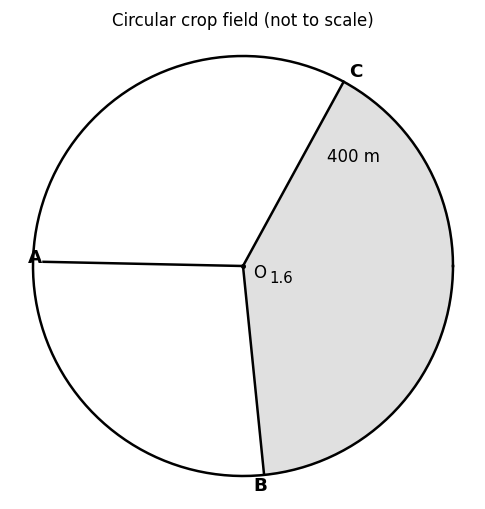
(a) Find the length of chord AB.
(b) Find the area of triangle AOB.
The angle BOC = 2.5 radians.
(c) Find the length of the minor arc AC.
(d) Find the area of the shaded region.
The shaded region is to be planted with corn. Corn seeds are sold in bags costing $140 each. One bag seeds 8960 m².
(e) Find the cost of the corn seeds.
(a) AB = 2 × 400 × sin(0.8) ≈ 573 m
(b) Area △AOB = ½ × 400² × sin(1.6) ≈ 77 550 m²
(c) Arc AC: angle AOC = 2π − 1.6 − 2.5 = 2.183 rad (minor arc) → l = 400 × 2.183 ≈ 873 m
(d) Area shaded = Area sector BOC − Area △BOC = ½(400²)(2.5) − ½(400²)sin(2.5) = 200 000 − ½(160 000)(0.5985) ≈ 200 000 − 47 880 ≈ 152 120 m²
(e) Number of bags = ⌈152120/8960⌉ = 17 bags; Cost = 17 × $140 = $2380
Let f(x) = sin x − √3 cos x, 0 ≤ x ≤ 2π.
The following diagram shows the graph of f(x). The curve crosses the x-axis at A and C and has a maximum at point B.
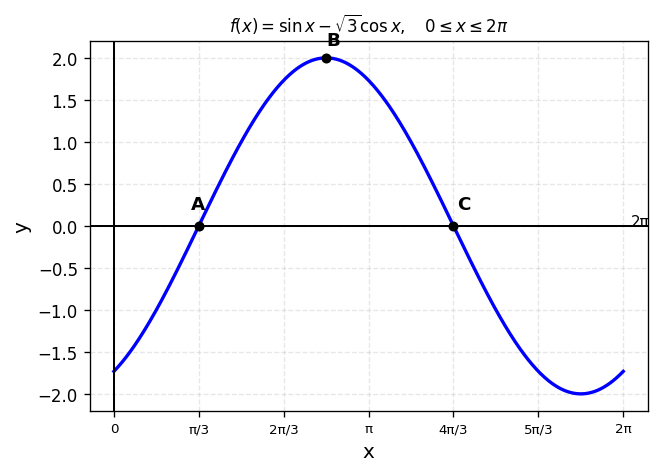
(a) Find the exact coordinates of A and of C.
(b) Find f'(x).
(c) Find the exact coordinates of B.
(a) sin x = √3 cos x → tan x = √3 → x = π/3 or x = 4π/3
A = (π/3, 0), C = (4π/3, 0)
(b) f'(x) = cos x + √3 sin x
(c) f'(x)=0: cos x + √3 sin x = 0 → tan x = −1/√3 → x = 5π/6
f(5π/6) = sin(5π/6) − √3 cos(5π/6) = ½ + 3/2 = 2 → B = (5π/6, 2)
Consider the functions f and g defined on the domain 0 < x < 2π by f(x) = 4 cos 2x and g(x) = 2 − 8 cos x.
The following diagram shows the graphs of y = f(x) and y = g(x).
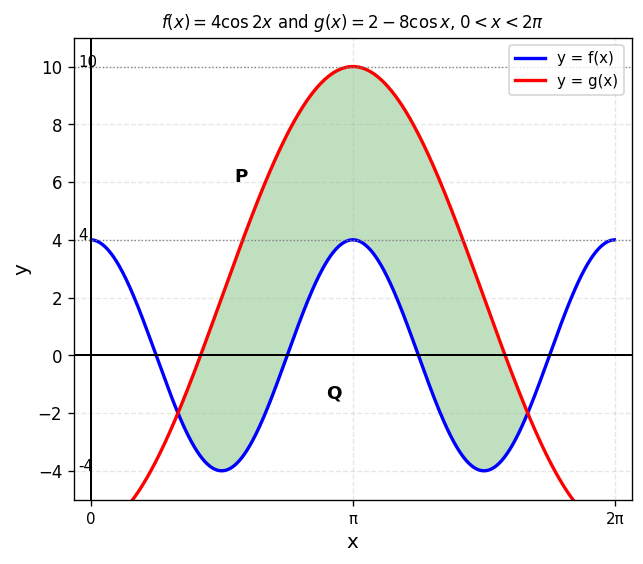
(a) Find the x-coordinates of the points of intersection of the two graphs.
(b) Find the exact area of the shaded region, giving your answer in the form aπ + b√3, where a, b ∈ ℚ.
At points P and Q, the gradients of the two graphs are equal.
(c) Determine the y-coordinate of P on the graph of g.
(a) 4cos2x = 2−8cosx → 8cos²x−4 = 2−8cosx → 8cos²x+8cosx−6=0 → 4cos²x+4cosx−3=0 → (2cosx+3)(2cosx−1)=0 → cosx=1/2
Intersections at x = π/3, 2π/3, 4π/3, 5π/3
(b) Area = 2π + 6√3 (exact)
(c) f'(x)=−8sin2x, g'(x)=8sinx; −8sin2x = 8sinx → −16sinxcosx = 8sinx → cosx = −1/2 (sinx≠0) → x = 2π/3 or 4π/3
P on upper part: g(2π/3) = 2 − 8(−1/2) = 6 → y-coordinate of P = 6
In a triangle ABC, BÂC = 60°, AB = (1 − x) cm, AC = (x + 3)² cm, where −3 < x < 1.
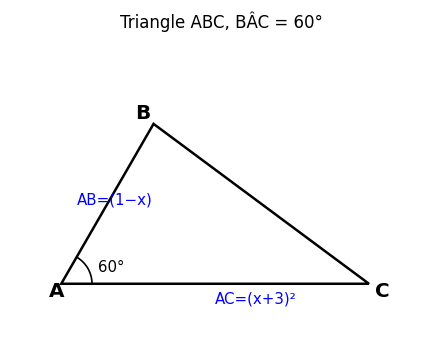
(a) Show that the area A cm² of the triangle is A = (√3/4)(9 − 3x − 5x² − x³).
(b)(i) Calculate dA/dx. (ii) Verify that dA/dx = 0 when x = −1/3.
(c)(i) Find d²A/dx² and hence verify that x = −1/3 gives the maximum area. (ii) Calculate the maximum area. (iii) Find the length of [BC] when the area is a maximum.
(a) A = ½·AB·AC·sin60° = ½(1−x)(x+3)²·(√3/2) = (√3/4)(1−x)(x+3)²
(1−x)(x+3)² = (1−x)(x²+6x+9) = 9−3x−5x²−x³ ✓
(b)(i) dA/dx = (√3/4)(−3−10x−3x²)
(b)(ii) At x=−1/3: −3+10/3−3/9 = −3+10/3−1/3 = 0 ✓
(c)(i) d²A/dx² = (√3/4)(−10−6x); at x=−1/3: (√3/4)(−8) < 0 → maximum
(c)(ii) A_max = (√3/4)(9+1−5/9+1/27) = (√3/4)(280/27) = 70√3/27 ≈ 4.49 cm²
(c)(iii) BC ≈ 6.08 cm
A sector OAB has radius r cm and the angle AOB = θ radians. A chord AB is drawn.
(a) Show that the area of the minor segment is ½r²(θ − sin θ).
(b) The perimeter of the sector is 30 cm. Express r in terms of θ and show that the area of the sector A = 450θ/(θ + 2)².
(c) Find the value of θ that maximizes the area of the sector.
(d) Hence find the maximum area of the sector.
(a) Segment = Sector − Triangle = ½r²θ − ½r²sinθ = ½r²(θ−sinθ) ✓
(b) Perimeter = 2r + rθ = r(θ+2) = 30 → r = 30/(θ+2)
A = ½r²θ = ½·(900/(θ+2)²)·θ = 450θ/(θ+2)² ✓
(c) dA/dθ = 450[(θ+2)²−2θ(θ+2)]/(θ+2)⁴ = 450(2−θ)/(θ+2)³ = 0 → θ = 2
(d) A_max = 450(2)/(4)² = 900/16 = 56.25 cm²
Let a = (2, −1, 3) and b = (1, 4, −2).
(a) Find the scalar product a · b.
(b) Find the angle between a and b. Give your answer in degrees to 1 decimal place.
(c) Find the vector product a × b.
(d) Find the equation of the plane containing the origin and perpendicular to a × b.
(a) a·b = 2 − 4 − 6 = −8
(b) |a| = √14, |b| = √21; cosθ = −8/√294 ≈ −0.467; θ ≈ 117.8°
(c) a×b = (−10, 7, 9)
(d) −10x + 7y + 9z = 0
Line L₁ passes through A(1,2,0) with direction d₁ = (1,1,2). Line L₂ passes through B(3,0,1) with direction d₂ = (2,−1,1).
(a) Write parametric equations for L₁ and L₂.
(b) Determine whether L₁ and L₂ intersect, are parallel, or are skew.
(c) Find the shortest distance between them.
(a) L₁: (1+t, 2+t, 2t); L₂: (3+2s, −s, 1+s)
(b) Setting equal leads to contradiction → Lines are skew
(c) d₁×d₂ = (3,3,−3); AB = (2,−2,1)
Distance = |AB·(d₁×d₂)|/|d₁×d₂| = |6−6−3|/√27 = 3/(3√3) = 1/√3 = √3/3
A Ferris wheel has diameter 40 m. The centre is 25 m above ground. It completes one full rotation every 50 seconds.
(a) Write h(t), the height above ground in metres, as a function of time t seconds. The passenger starts at the bottom.
(b) Find all times in the first 2 minutes when the passenger is exactly 40 m above the ground.
(c) Find the rate of change of h at t = 10 seconds.
(a) h(t) = 25 − 20cos(πt/25)
(b) 25−20cos(πt/25)=40 → cos(πt/25)=−3/4 → t ≈ 19.3, 30.7, 69.3, 80.7 seconds
(c) h'(t) = (4π/5)sin(πt/25); h'(10) = (4π/5)sin(2π/5) ≈ 2.37 m/s
Prove the identity: cos 2θ = 1 − 2sin²θ. Hence prove:
(a) sin²(π/12) = (2 − √3)/4.
(b) Solve 4sin²x − 2cos 2x = 3 for 0 ≤ x ≤ 2π. Give exact answers.
Identity: cos2θ = cos²θ−sin²θ = 1−2sin²θ ✓
(a) cos(π/6)=1−2sin²(π/12); √3/2=1−2sin²(π/12); sin²(π/12) = (2−√3)/4 ✓
(b) 4sin²x − 2cos2x = 4sin²x − 2(1−2sin²x) = 8sin²x − 2 = 3 → sin²x = 5/8 → sinx = ±√(5/8)
x = arcsin(√(5/8)), π−arcsin(√(5/8)), π+arcsin(√(5/8)), 2π−arcsin(√(5/8)) ≈ 0.675, 2.467, 3.817, 5.609 rad
Two buildings stand on flat ground. Building A is 50 m tall. From the top of A, the angle of depression to the base of B is 30°, and the angle of elevation to the top of B is 20°.
(a) Find the horizontal distance d between the buildings.
(b) Find the height of Building B.
(c) From the top of B, find the angle of depression to the base of A.
(d) Find the straight-line distance between the tops of the two buildings.
(a) tan30° = 50/d → d = 50/tan30° = 50√3 ≈ 86.6 m
(b) Height of B = 50 + d·tan20° = 50 + 86.6·tan20° ≈ 50 + 31.5 = 81.5 m
(c) Angle = arctan(81.5/86.6) ≈ 43.3°
(d) Horizontal = 86.6, Vertical diff = 31.5; Distance = √(86.6²+31.5²) ≈ 92.1 m