

On this page:
Q1. Area of Rectangle under Parabola Q2. Exponential Population Model Q3. Completing the Square Q4. Graph Transformations Q5. Vieta's Formulas Q6. Inverse Functions Q7. Rational Function Asymptotes Q8. Discriminant Analysis Q9. Factor & Remainder Theorem Q10. Multiple Transformations Q11. Cubic Stationary Points Q12. Polynomial Roots (HL) Q13. Cubic with α+β=0 (HL) Q14. Composite Functions Q15. Cubic from First Principles (HL) Q16. Logistic Growth Model Q17. Absolute Value Piecewise Q18. Rational Function Hole (HL) Q19. Quadratic Optimization Q20. Exponential/Logarithmic Model Q21. GDC Analysis Q22. Quadratic Transformations Q23. Exponential Decay Q24. Cubic with Remainder Q25. Transformation Mapping Q26. Inverse Exponential Q27. Logistic Model Time Q28. Projectile MotionPractice questions covering quadratic functions, completing the square, discriminants, Vieta's formulas, graph transformations, inverse functions, asymptotes, polynomial division, logistic models, optimization, and more.
Let f(x) = 16 − x², for x ∈ ℝ.
(a) Find the x-intercepts of the graph of f(x).
The following diagram shows part of the graph of f. Rectangle ABCD is drawn with A and B on the x-axis and C and D on the graph of f. Let OA = a.
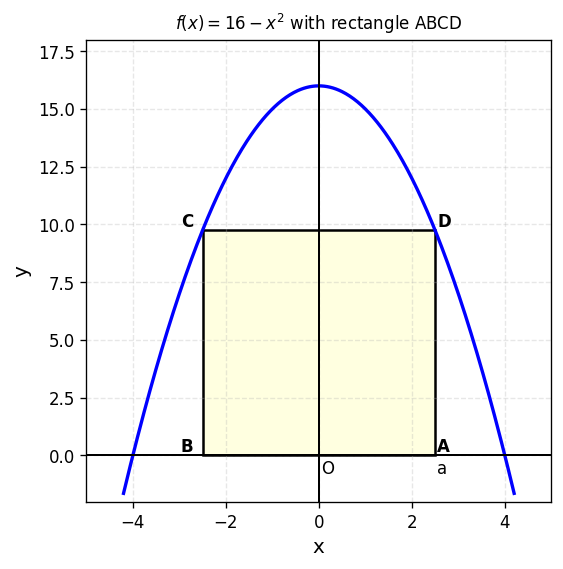
(b) Show that the area of ABCD is 32a − 2a³.
(c) Hence find the value of a > 0 such that the area of ABCD is a maximum.
Let g(x) = (x − 4)² + k, for x ∈ ℝ, where k is a constant.
(d) Show that when the graphs of f and g intersect, 2x² − 8x + k = 0.
(e) Given that the graphs of f and g intersect only once, find the value of k.
(a) x = ±4
(b) Width = 2a, height = f(a) = 16−a². Area = 2a(16−a²) = 32a−2a³ ✓
(c) dA/da = 32−6a² = 0 ⇒ a = √(16/3) = 4/√3 ≈ 2.31
(d) 16−x² = (x−4)²+k ⇒ 16−x² = x²−8x+16+k ⇒ 2x²−8x+k = 0 ✓
(e) Discriminant = 0: 64−8k = 0 ⇒ k = 8
The population of a town t years after 1 January 2014 can be modelled by the function P(t) = 15000e^(kt), where k < 0 and t ≥ 0. It is known that between 1 January 2014 and 1 January 2022 the population decreased by 11%. Use this model to estimate the population of this town on 1 January 2041.
ANSWER: P (January 2041) ≈ 10 100
P(8) = 15000e^(8k) = 15000 × 0.89 ⇒ k = ln(0.89)/8 ≈ −0.01459; t=27: P(27) ≈ 15000e^(−0.01459×27) ≈ 10,080 ≈ 10,100
Complete the square for f(x) = x² − 6x + 11. State the vertex form and identify the vertex. Find the discriminant and comment on the nature of roots.
ANSWER: f(x) = (x − 3)² + 2; Vertex: (3, 2)
Discriminant: b²−4ac = 36 − 44 = −8 < 0 → No real roots; parabola lies entirely above x-axis.
The graph of y = f(x) passes through (0, 2) and has a maximum at (3, 5).
(a) Write down the coordinates of the maximum of y = f(x − 2) + 1.
(b) Describe fully the transformation that maps f(x) to f(−x).
(c) The graph of g(x) = af(b(x−c)) + d passes through (5, 6) and has maximum at (5, 6). Find a possible set of values for a, b, c, d.
(a) Shift right 2, up 1: maximum at (5, 6)
(b) Reflection in the y-axis (x replaced by −x)
(c) Many valid answers; e.g. translate right 2, up 1: a=1, b=1, c=2, d=1
The quadratic function f(x) = x² + bx + c has roots α and β.
(a) By Vieta's formulas, write expressions for α+β and αβ in terms of b and c.
(b) If α+β = 7 and αβ = 10, find b and c, then find the function.
(c) Find α² + β².
(a) α + β = −b, αβ = c
(b) b = −7, c = 10. f(x) = x² − 7x + 10
(c) α² + β² = (α+β)² − 2αβ = 49 − 20 = 29
The function f(x) = eˣ − 3 is defined for x ∈ ℝ.
(a) Find the inverse function f⁻¹(x).
(b) State the domain and range of f⁻¹.
(c) Solve f(x) = f⁻¹(x). Use a GDC or exact methods.
(a) f⁻¹(x) = ln(x+3)
(b) Domain: x > −3, Range: ℝ
(c) eˣ − 3 = ln(x+3). Solving numerically: x ≈ 1.512
Sketch the function f(x) = (x² − x − 6)/(x − 1) showing all asymptotes, intercepts and any holes. State the equations of all asymptotes.
ANSWER: Factorise numerator: (x−3)(x+2). No common factor with (x−1).
Vertical asymptote: x = 1
Polynomial division: (x²−x−6)/(x−1) = x + 0 − 6/(x−1) → oblique: y = x
x-intercepts: x = 3 and x = −2. y-intercept: f(0) = 6.
The discriminant of kx² − 2kx + 1 = 0 is investigated.
(a) Find the discriminant in terms of k.
(b) Find the values of k for which the equation has two distinct real roots.
(c) Find the value of k for equal roots and solve the equation in this case.
(a) Δ = 4k² − 4k = 4k(k−1)
(b) Two distinct real roots when Δ > 0: k < 0 or k > 1
(c) Equal roots when Δ = 0: k = 1; x² − 2x + 1 = 0 → x = 1
The function f(x) = 3x³ − ax² + bx − 5 has a root at x = 1 and leaves a remainder of 7 when divided by (x + 1).
(a) Use the factor and remainder theorems to form two equations in a and b.
(b) Solve for a and b.
(c) Fully factorise f(x).
(d) Sketch f(x), labelling all intercepts and turning points (use GDC).
(a) f(1)=0 → −a + b = 2; f(−1)=7 → −a − b = 15
(b) a = −8.5, b = −6.5
(c) f(x) = (x−1)(3x² + 11.5x + 5)
A function is transformed as follows: g(x) = −2f(3x − 6) + 1.
(a) Describe in words all four transformations applied to f(x).
(b) The point (2, 5) is on y = f(x). Find the corresponding point on y = g(x).
(c) If f(x) = x², write g(x) in expanded form and sketch g(x).
(a) Write g(x) = −2f(3(x−2))+1: 1. Horizontal compression by factor 1/3; 2. Horizontal shift right by 2; 3. Vertical stretch by factor 2; 4. Reflection in x-axis and shift up 1
(b) Point: (8/3, −9)
(c) g(x) = −2(3x−6)² + 1 = −18x²+72x−71; Vertex: (2, 1)
f(x) = x³ − 3x² + 4. Use calculus (differentiation) to:
(a) Find all stationary points and classify them.
(b) Find intervals of increase and decrease.
(c) Sketch the curve labelling key features.
(a) f'(x)=3x²−6x=3x(x−2)=0 → x=0 (local max), x=2 (local min)
(b) Increasing: x < 0 and x > 2; Decreasing: 0 < x < 2
(c) Cubic shape, local max (0,4), local min (2,0), y-intercept (0,4)
The polynomial P(x) = x⁴ − 2x³ + ax² + bx + 10 has roots α, β, γ, δ.
(a) Write expressions for: α+β+γ+δ, Σαβ, Σαβγ, αβγδ.
(b) Given that two of the roots are 1+i and 1−i, find a and b.
(a) α+β+γ+δ = 2; Σαβ = a; Σαβγ = −b; αβγδ = 10
(b) a = 7, b = −10
The equation 2x³ + px² − 5x + q = 0 has roots α, β, γ such that α + β = 0.
(a) Show that γ = −p/2 using Vieta's formulae.
(b) Given γ = 1, find the values of p and q.
(c) Find all three roots of the equation.
(a) α+β+γ = −p/2. Since α+β=0 ⇒ γ = −p/2 ✓
(b) γ=1 ⇒ p=−2; αβ+(α+β)γ = −5/2 ⇒ αβ=−5/2; αβγ = −q/2 ⇒ q=5
(c) α = √(10)/2, β = −√(10)/2, γ=1
The functions f and g are defined as: f(x) = e^(2x) − 4 and g(x) = ln(x + 2).
(a) Find the composite function f(g(x)) and simplify.
(b) Find the composite function g(f(x)).
(c) Show that f and g are NOT inverses of each other.
(d) Find the actual inverse of f.
(a) f(g(x)) = e^(2ln(x+2)) − 4 = (x+2)² − 4 = x² + 4x
(b) g(f(x)) = ln(e^(2x)−2)
(c) f(g(x)) = x²+4x ≠ x ⇒ not inverses ✓
(d) f⁻¹(x) = ln(x+4)/2, domain x > −4
The function f(x) = x³ − 6x² + 11x − 6 is given.
(a) Show that x = 1 is a root. Hence fully factorise f(x).
(b) Find all roots (real and complex) if the factorisation includes irreducible quadratics.
(c) Using the quotient rule, find f'(x) from first principles (no shortcuts).
(a) f(1) = 0 ✓; f(x) = (x−1)(x²−5x+6) = (x−1)(x−2)(x−3)
(b) All three roots are real: x = 1, 2, 3
(c) f'(x) = lim_{h→0} [f(x+h)−f(x)]/h = 3x² − 12x + 11
An exponential model: N(t) = N₀/(1 + ke^(−rt)) is used to model population growth (logistic model).
(a) Find lim_{t→∞} N(t). Interpret this value.
(b) Find lim_{t→0} N(t). Hence find k in terms of N₀ and initial population N(0).
(c) Sketch the graph of N(t) for t ≥ 0, assuming N₀ = 1000, k = 9, r = 0.5.
(a) N → N₀ (carrying capacity)
(b) N(0) = N₀/(1+k) ⇒ k = N₀/N(0) − 1
(c) N(0) = 1000/10 = 100. S-shaped (logistic) curve starting at 100, asymptote N=1000.
The function h(x) = |2x − 4| + |x + 1|.
(a) Identify the critical points where the expression changes form.
(b) Write h(x) as a piecewise function.
(c) Sketch the graph and find the minimum value.
(a) Critical points: x = 2 and x = −1
(b) For x < −1: h = 3 − 3x; For −1 ≤ x < 2: h = 5 − x; For x ≥ 2: h = 3x − 3
(c) Minimum at x = 2: h(2) = 3
f(x) = (x³ − 8)/(x² − 4). Find the partial fraction decomposition and sketch the graph.
(a) Factorise numerator and denominator.
(b) Simplify, identifying any holes.
(c) Find the oblique asymptote using polynomial division.
(a) Numerator: (x−2)(x²+2x+4); Denominator: (x−2)(x+2)
(b) f(x) = (x²+2x+4)/(x+2) for x ≠ 2; hole at (2, 3)
(c) (x²+2x+4)/(x+2) = x + 0 + 4/(x+2); Oblique asymptote: y = x; Vertical asymptote: x = −2
A ball is thrown upward from a cliff. Its height above the ground is: h(t) = −5t² + 20t + 60, where t is in seconds and h is in metres.
(a) Find the maximum height reached.
(b) Find the time when the ball hits the ground.
(c) Sketch h(t), labelling all key features.
(a) h(2) = 80 metres (maximum height)
(b) t = 6 seconds
(c) Downward parabola, h-intercept (0,60), vertex (2,80), t-intercept (6,0)
Let f(x) = 16 − x², for x ∈ ℝ.
(a) Find the x-intercepts of the graph of f.
(b) Show that the area of ABCD is 32a − 2a³.
(c) Hence find the value of a > 0 such that the area of ABCD is a maximum.
(d) Show that when the graphs of f and g intersect, 2x² − 8x + k = 0.
(e) Given that the graphs of f and g intersect only once, find the value of k.
(a) x = ±4
(b) Area = 2a(16−a²) = 32a−2a³ ✓
(c) a = 4/√3 ≈ 2.31
(d) 2x²−8x+k = 0 ✓
(e) k = 8
The function f is defined by f(x) = ln(xeˣ + 1) − x², for 0 ≤ x ≤ 2. The graph of f has a local maximum at point A and crosses the x-axis again at point B.
(a) Find the coordinates of A.
(b) Find the x-coordinate of B.
(c) Find the total area enclosed by the graph of f, the x-axis, and the line x = 2.
(d) Find the equation of the normal to the graph of f at the point where x = 1.
(a) A = (0.710, 0.390) (by GDC)
(b) x ≈ 1.35
(c) Total area ≈ 0.703
(d) f(1) ≈ 0.313; f'(1) ≈ −0.817; Normal gradient ≈ 1.224; Equation: y − 0.313 = 1.224(x − 1)
The quadratic function f(x) = x² + bx + c has roots α and β.
(a) By Vieta's formulae, write expressions for α + β and αβ in terms of b and c.
(b) If α + β = 7 and αβ = 10, find b and c. Hence write down f(x).
(c) Find α² + β².
(d) A new function g(x) = f(x − 3) + 2. Describe the transformations that map f to g and state the new roots.
(a) α+β = −b, αβ = c
(b) b = −7, c = 10; f(x) = x² − 7x + 10
(c) α²+β² = 29
(d) shift right 3, shift up 2; roots: x = 5, x = 8
The population of a town t years after 1 January 2014 is modelled by P(t) = 15000 e^(kt), where k < 0. Between 1 January 2014 and 1 January 2022, the population decreased by 11%.
(a) Find k, giving your answer to 4 significant figures.
(b) Estimate the population on 1 January 2041.
(c) Find the year in which the population first falls below 10 000.
(d) State one limitation of this model.
(a) k = ln(0.89)/8 ≈ −0.01459
(b) P(27) ≈ 10 080
(c) t > 27.9 → Year 2042
(d) Model assumes continuous exponential decline; in reality migration, birth rate changes etc.
The function f(x) = 3x³ − ax² + bx − 5 has a root at x = 1 and leaves remainder 7 when divided by (x + 1).
(a) Use the factor and remainder theorems to form two equations in a and b.
(b) Solve for a and b.
(c) Fully factorise f(x).
(a) −a + b = 2; −a − b = 15
(b) a = −8.5, b = −6.5
(c) f(x) = (x−1)(3x² + 11.5x + 5)
A transformation g(x) = −2f(3x − 6) + 1 is applied to f(x).
(a) Describe, in order, all four transformations applied to f(x) to obtain g(x).
(b) The point (2, 5) lies on y = f(x). Find the corresponding point on y = g(x).
(c) If f(x) = x², write g(x) in fully expanded form and identify the vertex.
(a) 1. Horizontal compression by factor 1/3; 2. Horizontal translation right 2; 3. Vertical stretch by factor 2; 4. Reflection in x-axis, then translation up 1
(b) (8/3, −9)
(c) g(x) = −18x²+72x−71; Vertex: (2, 1)
Let f(x) = eˣ − 3.
(a) Find the inverse function f⁻¹(x).
(b) State the domain and range of f⁻¹.
(c) On the same set of axes, sketch f and f⁻¹, labelling all intercepts and asymptotes.
(d) Solve f(x) = f⁻¹(x). Comment on the geometric significance.
(a) f⁻¹(x) = ln(x + 3)
(b) Domain: x > −3; Range: ℝ
(c) f: y-intercept (0,−2), x-intercept (ln3,0), asymptote y=−3; f⁻¹: reflection in y=x
(d) x ≈ 1.512; Intersection lies on y = x (symmetric functions)
Consider the logistic model N(t) = N₀/(1 + ke^(−rt)) for population growth.
(a) Find lim_{t→∞} N(t). Interpret this value.
(b) Find lim_{t→0} N(t). Hence express k in terms of N₀ and N(0).
(c) Given N₀ = 1000, k = 9, r = 0.3, find the time when N(t) = 500. Give your answer to 3 significant figures.
(a) N → N₀ (carrying capacity)
(b) N(0) = N₀/(1+k) ⇒ k = N₀/N(0) − 1
(c) t = ln9/0.3 ≈ 7.32
A ball is thrown from a cliff. Its height h(t) = −5t² + 20t + 60 metres, where t ≥ 0.
(a) Find the maximum height reached.
(b) Find the time when the ball hits the ground.
(c) Sketch h(t), labelling vertex, t-intercept, and h-intercept.
(d) Find the average rate of change of h from t = 0 to t = 3.
(a) Vertex at t = 2: h(2) = 80 m
(b) t = 6 s
(c) h-intercept (0,60), vertex (2,80), t-intercept (6,0)
(d) [h(3)−h(0)]/3 = [75−60]/3 = 5 m/s