

On this page:
Q1. Differentiation Basic Rules Q2. Tangent Line Q3. Basic Integration Q4. Particle Motion Q5. Definite Integral Q6. Integration by Parts Q7. Area Between Curves Q8. Optimization - Box Q9. Integration by Substitution Q10. Particle Distance Q11. Rational Function Analysis Q12. Volumes of Revolution Q13. Implicit Differentiation (HL) Q14. Related Rates (HL) Q15. Differential Equations (HL) Q16. Maclaurin Series (HL) Q17. L'Hôpital's Rule (HL) Q18. Newton's Law of Cooling Q19. Area Between sin x and cos x Q20. Profit Optimization Q21. Integration by Parts Twice (HL) Q22. Volume of Revolution Q23. Second Order ODE (HL) Q24. Logarithmic Function Analysis Q25. Ladder Related Rates Q26. f(x)=4cos2x & g(x)=2-8cosx Q27. f(x)=ln(8x³)/(kx) Q28. Particle s(t)=t³-9t²+24t-10 Q29. ∫eˣ cos x dx Q30. dy/dx=2xy, y(0)=3 Q31. Box Surface Area Q32. Area y=x², y=4-x² Q33. Newton's Law of Cooling Q34. Maclaurin Series Q35. Ladder Related RatesPractice questions covering differentiation rules, tangent lines, integration (definite and indefinite), area between curves, volumes of revolution, optimization, related rates, differential equations, Maclaurin series, and L'Hôpital's rule.
Differentiate with respect to x:
(a) f(x) = 4x³ − 3x² + 2x − 5
(b) g(x) = √x + 1/x
(c) h(x) = e2x·sin(x)
(a) f'(x) = 12x² − 6x + 2
(b) g(x) = x^(1/2) + x^(−1). g'(x) = ½x^(−1/2) − x^(−2) = 1/(2√x) − 1/x²
(c) Product rule: h'(x) = 2e^(2x)sin(x) + e^(2x)cos(x) = e^(2x)(2sinx + cosx)
Find the equation of the tangent to y = x² − 3x + 2 at the point where x = 3.
y(3) = 9−9+2 = 2. Point: (3, 2).
y' = 2x−3. Slope at x=3: m = 3.
Tangent: y−2 = 3(x−3) → y = 3x − 7
Integrate:
(a) ∫(3x² + 2x − 1)dx
(b) ∫(ex + cos x)dx
(a) x³ + x² − x + C
(b) eˣ + sinx + C
A particle moves with velocity v(t) = 3t² − 6t + 2.
(a) Find the acceleration at t = 2.
(b) Find the displacement from t = 0 to t = 3.
(a) a(t) = 6t−6. a(2) = 12−6 = 6 m/s²
(b) s = ∫₀³ (3t²−6t+2)dt = [t³−3t²+2t]₀³ = 27−27+6 = 6 m
Evaluate ∫₁³ (2x + 1)dx using the fundamental theorem of calculus.
∫(2x+1)dx = x²+x+C
[x²+x]₁³ = (9+3)−(1+1) = 12−2 = 10
Find ∫ x·sin(x) dx using integration by parts. Hence evaluate ∫0π x·sin(x) dx
Let u=x, dv=sinx dx → du=dx, v=−cosx
∫xsinx dx = −xcosx + ∫cosx dx = −xcosx + sinx + C
[−xcosx + sinx]₀^π = (−π·(−1)+0)−(0+0) = π
Find the area enclosed between y = x² and y = 4 − x².
Intersection: x² = 4−x² → 2x²=4 → x=±√2
Area = ∫_{−√2}^{√2} [(4−x²)−x²]dx = ∫_{−√2}^{√2} (4−2x²)dx
= [4x − 2x³/3]_{−√2}^{√2} = 2[4√2 − 2(2√2)/3] = 2[4√2 − 4√2/3] = 2·8√2/3 = 16√2/3
A box (no lid) has square base with side x and height h. Volume = 500 cm³.
(a) Express total surface area S in terms of x only.
(b) Find x that minimises S.
(a) Volume: x²h=500 → h=500/x². S = x² + 4xh = x² + 4x(500/x²) = x² + 2000/x
(b) S'= 2x − 2000/x² = 0 → x³ = 1000 → x = 10 cm; S''= 2+4000/x³ > 0 at x=10 → minimum ✓
Use integration by substitution to find:
(a) ∫ 2x(x² + 1)⁴ dx
(b) ∫ cos(3x) dx
(c) x x2 + 1 dx
(a) Let u=x²+1, du=2x dx. ∫u⁴du = u⁵/5+C = (x²+1)⁵/5+C
(b) Let u=3x, du=3dx. ∫cos(u)du/3 = sin(3x)/3+C
(c) Let u=x²+1, du=2x dx. (1/2)∫du/u = (1/2)ln|x²+1|+C
A particle has displacement s(t) = t³ − 9t² + 24t − 10.
(a) Find when the particle is at rest.
(b) Find the total distance travelled between t=0 and t=5.
(a) v(t) = 3t²−18t+24 = 3(t−2)(t−4) = 0 → At rest: t=2 and t=4.
(b) s(0)=−10, s(2)=10, s(4)=6, s(5)=10. Distance = |10−(−10)| + |6−10| + |10−6| = 20+4+4 = 28 m
f(x) = 3x + 1 x2 − x − 2 Find:
(a) Asymptotes and domain.
(b) f'(x) using the quotient rule.
(c) Any stationary points. Classify using second derivative.
(a) x²−x−2=(x−2)(x+1). Vertical: x=2, x=−1. Horizontal: y=0. Domain: ℝ\{2,−1}
(b) f'(x) = [3(x²−x−2)−(3x+1)(2x−1)]/(x²−x−2)²
Numerator: 3x²−3x−6−(6x²−3x+2x−1) = 3x²−3x−6−6x²−x+1 = −3x²−4x−5... = −3x²−2x−5
f'(x) = (−3x²−2x−5)/(x²−x−2)²
(c) Discriminant of −3x²−2x−5: 4−60 = −56 < 0. No real roots. No stationary points.
Diagram: Region R is bounded by y=ex, y=1, and x=2. Shade region R.
(a) Find the area of R.
(b) Find the volume when R is rotated 360° about the x-axis.
(c) Find the volume when R is rotated 360° about the y-axis. (use HL if applicable)
(a) Boundaries: eˣ=1 at x=0. Area = ∫₀² (eˣ−1)dx = [eˣ−x]₀² = (e²−2)−1 = e²−3
(b) V = π∫₀² (eˣ)²dx − π∫₀²1²dx = π∫₀²e^(2x)dx − 2π = π[e^(2x)/2]₀² − 2π = π(e⁴/2−1/2)−2π = π(e⁴−5)/2
(c) V = 2π∫₀² x·eˣ dx = 2π[xeˣ−eˣ]₀² = 2π[(2e²−e²)−(0−1)] = 2π(e²+1)
Find y' using implicit differentiation for:
(a) x² + y² = 25
(b) x²y + y³ = 5
(c) e(xy) = x + y. Find the gradient at (0, 1).
(a) 2x + 2y·y' = 0 → y' = −x/y
(b) 2xy + x²y' + 3y²y' = 0 → y'(x²+3y²) = −2xy → y' = −2xy/(x²+3y²)
(c) e^(xy)·(y + xy') = 1 + y'
At (0,1): e⁰(1 + 0·y') = 1+y' → 1 = 1+y' → y' = 0
Related rates: A spherical balloon is inflated so its volume increases at 100 cm³/s.
(a) Find the rate of increase of radius when r = 5 cm.
(b) Find the rate of increase of surface area at the same instant.
(c) A conical paper cup (height = 2×radius) is filled with water at 20 cm³/s. Find dh/dt when h = 6 cm.
(a) V = 4πr³/3 → dV/dt = 4πr²·dr/dt → 100 = 4π(25)·dr/dt → dr/dt = 100/(100π) = 1/π cm/s
(b) S = 4πr² → dS/dt = 8πr·dr/dt = 8π(5)(1/π) = 40 cm²/s
(c) r = h/2. V = (1/3)πr²h = (1/3)π(h/2)²h = πh³/12 → dV/dt = πh²/4·dh/dt → 20 = π(36)/4·dh/dt → dh/dt = 80/(36π) = 20/(9π) cm/s
Solve the differential equation dy/dx = 2xy, given y(0) = 3.
Verify your solution. Sketch the solution curve.
Separate variables: dy/y = 2x dx
Integrate: ln|y| = x² + C → y = Ae^(x²)
Initial condition: y(0)=3 → A=3. y = 3e^(x²)
Verify: dy/dx = 3·2x·e^(x²) = 6x·e^(x²) = 2x·(3e^(x²)) = 2xy ✓
Sketch: bell-curve shape, y(0)=3, increasing for x>0, symmetric.
(a) Find the Maclaurin series for sin(x) up to x⁵.
(b) Use it to find limx→0 sin(x)/x.
(c) Find the Maclaurin series for sin(x²) up to x¹⁰.
(d) Use part (c) to approximate ∫₀(0.5) sin(x²)dx.
(a) sin(x) = x − x³/6 + x⁵/120 − ...
(b) sin(x)/x = 1 − x²/6 + x⁴/120 − ... → limit as x→0 is 1.
(c) sin(x²) = x² − x⁶/6 + x¹⁰/120 − ...
(d) ∫₀^(0.5) (x²−x⁶/6+x¹⁰/120) dx = [x³/3−x⁷/42+x¹¹/1320]₀^(0.5) = (0.125/3−0.0078125/42+...) = 0.04167−0.000186+... ≈ 0.0415
Use L'Hôpital's rule to evaluate:
(a) lim_{x→0} (e^x − 1 − x)/x²
(b) lim_{x→∞} x·e^(−x)
(c) lim_{x→0⁺} x·ln(x)
(a) Form 0/0. Apply L'H: (eˣ−1)/2x. Still 0/0. Apply again: eˣ/2 → 1/2.
(b) x/eˣ. As x→∞, form ∞/∞. Apply L'H: 1/eˣ → 0.
(c) x·lnx = lnx/(1/x). Form −∞/∞. Apply L'H: (1/x)/(−1/x²) = −x → 0.
The rate of cooling of coffee follows Newton's Law: dT dt = −k(T−20), where T°C is temperature, t is time in minutes, and k is a positive constant.
(a) Solve the differential equation.
(b) Initially T=90°C. After 5 minutes T=60°C. Find k.
(c) Find the temperature after 15 minutes.
(a) Separate: dT/(T−20) = −k dt → ln|T−20| = −kt + C → T = 20 + Ae(−kt)
(b) T(0)=90: A=70. T(5)=60: 60=20+70e(−5k) → e(−5k)=40/70=4/7 → k = −ln(4/7)/5 = ln(7/4)/5 ≈ 0.112
(c) T(15) = 20+70e(−3·ln(7/4)) = 20+70(4/7)³ = 20+70(64/343) = 20+13.1 = 33.1°C
Diagram: The region bounded by y = sin(x) and y = cos(x) for 0 ≤ x ≤ π 2 .
(a) Identify where sin(x) = cos(x) in this interval.
(b) Sketch the region, clearly shading it.
(c) Find the area of the shaded region.
(a) tan(x)=1 → x = π/4.
(b) For 0≤x≤π/4: cosx > sinx. For π/4≤x≤π/2: sinx > cosx.
(c) Area = ∫₀(π/4) (cosx−sinx)dx + ∫_(π/4)(π/2) (sinx−cosx)dx
= [sinx+cosx]₀(π/4) + [−cosx−sinx]_(π/4)(π/2) = (√2−1) + (−1 − (−√2)) = (√2−1) + (√2−1) = 2(√2−1)
A company's profit rate is dP/dt = 50e(0.1t) − 20t, where P is in $000s and t in years.
(a) Find the profit function P(t) given P(0) = 0.
(b) Find the time when profit is maximised.
(c) Find the maximum profit.
(a) P(t) = ∫(50e(0.1t)−20t)dt = 500e(0.1t) − 10t² + C
P(0)=0: 500+C=0 → C=−500. P(t) = 500e(0.1t) − 10t² − 500
(b) dP/dt = 0: 50e(0.1t) = 20t → solve numerically (GDC): t ≈ 14.3 years
(c) P(14.3) = 500e(1.43) − 10(204.5) − 500 ≈ 500(4.177)−2045−500 ≈ $543k
Use integration by parts twice to evaluate ∫ ex·cos(x) dx. Hence evaluate ∫₀π ex·cos(x) dx.
Let I = ∫eˣcosx dx.
IBP: u=cosx, dv=eˣdx → I = eˣcosx + ∫eˣsinx dx
IBP again: ∫eˣsinx dx = eˣsinx − ∫eˣcosx dx = eˣsinx − I
So: I = eˣcosx + eˣsinx − I → 2I = eˣ(cosx+sinx)
∫eˣcosx dx = eˣ(cosx+sinx)/2 + C
Definite: [eˣ(cosx+sinx)/2]₀π = eπ(cosπ+sinπ)/2 − e⁰(cos0+sin0)/2 = e^π(−1+0)/2 − (1+0)/2 = −e^π/2 − 1/2 = −(e^π+1)/2
Diagram: Volume of revolution. The region bounded by y=√x, y=0, and x=4 is rotated 360° about the x-axis.
(a) Set up the integral for the volume.
(b) Evaluate the integral.
(c) The same region is rotated about the y-axis. Set up and evaluate the new integral.
(a) V = π∫₀⁴ (√x)² dx = π∫₀⁴ x dx
(b) V = π[x²/2]₀⁴ = π·8 = 8π
(c) About y-axis (disc method): x=y², y from 0 to 2. V = π∫₀² (4)²dy − π∫₀² y⁴ dy = 16π(2)−π(32/5)=32π−32π/5=128π/5
The second order differential equation: y'' − 3y' + 2y = 0.
(a) Write the characteristic equation and find the roots.
(b) Write the general solution.
(c) Given y(0) = 3 and y'(0) = 5, find the particular solution.
(d) Find lim{x→∞} y(x) and interpret.
(a) r² − 3r + 2 = 0 → (r−1)(r−2)=0 → r=1, r=2
(b) y = Ae^x + Be^(2x)
(c) y(0)=3: A+B=3; y'=Ae^x+2Be^(2x), y'(0)=5: A+2B=5 → Solving: B=2, A=1 → y = eˣ + 2e^(2x)
(d) As x→∞, e^(2x) dominates → y→∞. Solution grows without bound.
f(x) = x²·ln(x) for x > 0.
(a) Find f'(x) and f''(x).
(b) Find all stationary points and classify them.
(c) Find the area under f(x) from x=1 to x=e. (use by parts)
(a) f'(x) = 2x·lnx + x²·(1/x) = 2xlnx + x = x(2lnx+1); f''(x) = (2lnx+1) + x·(2/x) = 2lnx+3
(b) f'(x)=0: x=0 (excluded) or 2lnx+1=0 → lnx=−1/2 → x=e^(−1/2)=1/√e; f''(1/√e) = 2(−1/2)+3 = 2 > 0 → local minimum. f(1/√e) = (1/e)·(−1/2) = −1/(2e)
(c) ∫₁^e x²lnx dx. IBP: u=lnx, dv=x²dx → v=x³/3 = [x³lnx/3]₁^e − ∫₁^e x²/3 dx = (e³/3−0) − [x³/9]₁^e = e³/3 − e³/9 + 1/9 = 2e³/9 + 1/9
A ladder of length 5m leans against a vertical wall. The bottom slides away from the wall at 0.3 m/s.
(a) Write a relationship between x (distance from wall) and y (height up wall).
(b) Find dy/dt when x = 3 m.
(c) Find the rate of change of the angle the ladder makes with the ground when x = 3 m.
(d) Find the rate at which the area of the triangle formed decreases when x = 3 m.
(a) x² + y² = 25
(b) 2x·dx/dt + 2y·dy/dt = 0. x=3: y=4. 2(3)(0.3) + 2(4)dy/dt = 0 → dy/dt = −0.225 m/s
(c) Let θ = angle with ground: sinθ = y/5 → cosθ·dθ/dt = (1/5)dy/dt; cosθ = 3/5 at x=3. (3/5)dθ/dt = (1/5)(−0.225) → dθ/dt = −0.225/3 = −0.075 rad/s
(d) Area = xy/2. dA/dt = (1/2)(y·dx/dt + x·dy/dt) = (1/2)(4·0.3 + 3·(−0.225)) = (1/2)(1.2−0.675) = 0.2625 m²/s (increasing)
Consider the functions f and g on the domain 0 < x < 2π:
f(x) = 4 cos 2x and g(x) = 2 − 8 cos x
The following diagram shows the graphs of y = f(x) and y = g(x).
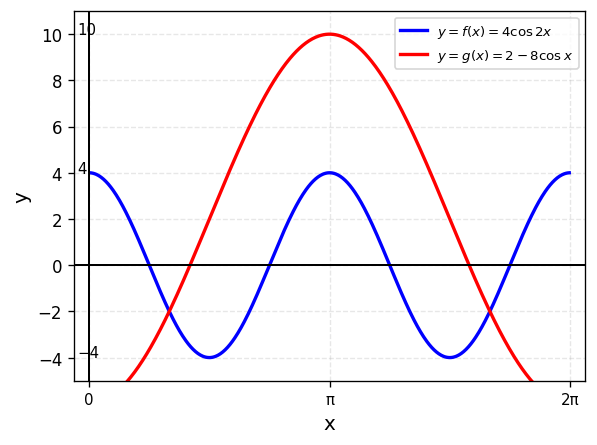
(a) Find the x-coordinates of all intersection points of the two graphs.
(b) Find the exact area of the shaded region, giving your answer in the form aπ + b√3 where a, b ∈ ℚ.
At points P and Q on the diagram, the gradients of the two graphs are equal.
(c) Determine the y-coordinate of P on the graph of g.
(a) Intersections at x = π/3, 2π/3, 4π/3, 5π/3
(b) Area = 2π + 6√3 (using ∫[π/3 to 2π/3](g−f)dx and symmetry)
(c) Equal gradients: cos x = −1/2 → x = 2π/3; g(2π/3) = 2+4 = 6
Let f(x) = ln(8x³)/(kx), where x > 0, k ∈ ℝ⁺
The graph of f has exactly one maximum point A. The second derivative is f''(x) = [2ln(8x³) − 9]/(kx³). The graph has exactly one point of inflection B. The region R is enclosed by the graph of f, the x-axis, and the vertical lines through A and B.
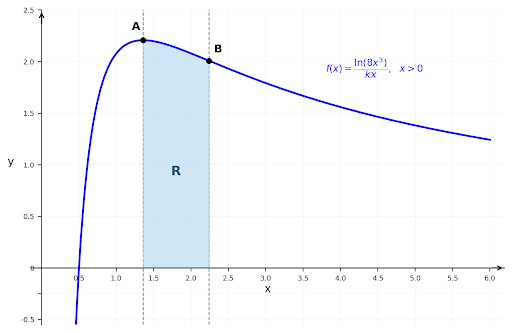
(a) Show that f'(x) = [3 − ln(8x³)]/(kx²).
(b) Find the x-coordinate of A.
(c) Show that the x-coordinate of B is e^(3/2)/2.
(d) Given that the area of R is 5, find the value of k.
(a) f'(x) = [kx·(3/x) − k·ln(8x³)]/(kx)² = [3 − ln(8x³)]/(kx²) ✓
(b) f'(x) = 0: ln(8x³) = 3 → 8x³ = e³ → x = e/2
(c) f''(x) = 0: 2ln(8x³) = 9 → ln(8x³) = 9/2 → 8x³ = e^(9/2) → x³ = e^(9/2)/8 → x = e^(3/2)/2 ✓
(d) ∫[e/2 to e^(3/2)/2] ln(8x³)/(kx) dx = 5 → Evaluate integral and solve for k → k ≈ 1.47 (by GDC or substitution)
A particle has displacement s(t) = t³ − 9t² + 24t − 10.
(a) Find the times when the particle is at rest.
(b) Find the total distance travelled between t = 0 and t = 5.
(c) Find the acceleration when t = 3. State whether the particle is speeding up or slowing down at this time.
(a) v(t) = 3t²−18t+24 = 3(t−2)(t−4) = 0 → t = 2 and t = 4
(b) s(0)=−10, s(2)=10, s(4)=6, s(5)=10; Distance = |10−(−10)| + |6−10| + |10−6| = 20+4+4 = 28 m
(c) a(t) = 6t−18; a(3) = 0 m/s² (momentarily constant velocity at t=3)
Use integration by parts twice to find ∫eˣ cos x dx. Hence evaluate ∫₀^π eˣ cos x dx.
(a) Let I = ∫eˣ cos x dx. Apply integration by parts with u = cos x, dv = eˣ dx.
(b) Apply integration by parts again to the resulting integral.
(c) Solve for I.
(d) Evaluate the definite integral.
(a) I = eˣcos x + ∫eˣ sin x dx
(b) ∫eˣsin x dx = eˣsin x − ∫eˣcos x dx = eˣsin x − I
(c) I = eˣcos x + eˣsin x − I → 2I = eˣ(cos x + sin x) → ∫eˣcos x dx = eˣ(cos x + sin x)/2 + C
(d) [eˣ(cosx+sinx)/2]₀^π = e^π(−1+0)/2 − e⁰(1+0)/2 = −e^π/2 − 1/2 = −(e^π+1)/2
Solve the differential equation dy/dx = 2xy, given y(0) = 3.
(a) Separate variables and integrate both sides.
(b) Apply the initial condition and find the particular solution.
(c) Verify your solution by substitution.
(d) Sketch the solution curve, labelling the y-intercept and describing the behaviour as x → ∞.
(a) dy/y = 2x dx → ln|y| = x² + C → y = Ae^(x²)
(b) y(0) = 3 → A = 3; ∴ y = 3e^(x²)
(c) dy/dx = 3·2x·e^(x²) = 6xe^(x²) = 2x·(3e^(x²)) = 2xy ✓
(d) y-intercept at (0,3); curve grows rapidly for x ≠ 0; y → ∞ as x → ±∞
A box (no lid) has a square base with side x cm and height h cm. Volume = 500 cm³.
(a) Express the total surface area S in terms of x only.
(b) Find the value of x that minimises S.
(c) Verify this is a minimum using the second derivative test.
(d) Find the minimum surface area.
(a) h = 500/x²; S = x² + 4x(500/x²) = x² + 2000/x
(b) S' = 2x − 2000/x² = 0 → x³ = 1000 → x = 10 cm
(c) S'' = 2 + 4000/x³ > 0 at x=10 → minimum ✓
(d) S_min = 100 + 200 = 300 cm²
Find the area enclosed between y = x² and y = 4 − x².
(a) Find the coordinates of the intersection points.
(b) Set up the integral for the enclosed area.
(c) Evaluate the integral.
(a) x² = 4−x² → 2x²=4 → x = ±√2; Points: (−√2, 2) and (√2, 2)
(b) Area = ∫_{−√2}^{√2} [(4−x²)−x²] dx = ∫_{−√2}^{√2} (4−2x²) dx
(c) = [4x − 2x³/3]_{−√2}^{√2} = 2(4√2 − 4√2/3) = 16√2/3
Newton's Law of Cooling: dT/dt = −k(T − 20), where T°C is temperature, t is time in minutes.
(a) Solve the differential equation, given T(0) = 90°C.
(b) Given T(5) = 60°C, find k to 3 significant figures.
(c) Find the temperature after 15 minutes.
(d) Find the time when T = 25°C.
(a) T = 20 + 70e^(−kt)
(b) 60 = 20+70e^(−5k) → e^(−5k) = 4/7 → k = ln(7/4)/5 ≈ 0.112
(c) T(15) = 20+70e^(−3ln(7/4)) = 20+70(4/7)³ = 20+70(64/343) ≈ 33.1°C
(d) 25 = 20+70e^(−kt) → e^(−kt) = 1/14 → t = ln14/k ≈ 23.6 min
Use the Maclaurin series to find lim_{x→0} [sin x − x + x³/6] / x⁵.
(a) Write down the Maclaurin series for sin x up to the x⁷ term.
(b) Evaluate the limit.
(c) Hence find an approximation for ∫₀^(0.5) sin(x²) dx, correct to 4 decimal places.
(a) sin x = x − x³/6 + x⁵/120 − x⁷/5040 + …
(b) sin x − x + x³/6 = x⁵/120 − …; divide by x⁵: → 1/120
(c) sin(x²) ≈ x² − x⁶/6 + x¹⁰/120; ∫₀^0.5 ≈ [x³/3 − x⁷/42 + x¹¹/1320]₀^0.5 ≈ 0.04167 − 0.000186 + 0.0000003 ≈ 0.0415
A ladder of length 5 m leans against a vertical wall. The bottom slides away at 0.3 m/s.
(a) Write the relationship between x (distance from wall) and y (height up wall).
(b) Find dy/dt when x = 3 m.
(c) Find the rate of change of the angle the ladder makes with the ground when x = 3 m.
(d) Find the rate at which the area of the triangle formed is changing when x = 3 m. State whether it is increasing or decreasing.
(a) x² + y² = 25
(b) 2x(dx/dt) + 2y(dy/dt) = 0; x=3,y=4: 2(3)(0.3)+2(4)(dy/dt)=0 → dy/dt = −0.225 m/s
(c) cosθ·(dθ/dt) = (1/5)(dy/dt); cosθ=3/5: dθ/dt = −0.075 rad/s
(d) Area = xy/2; dA/dt = (1/2)(y·dx/dt + x·dy/dt) = (1/2)(4×0.3+3×(−0.225)) = 0.2625 m²/s; Area is increasing at 0.2625 m²/s