

On this page:
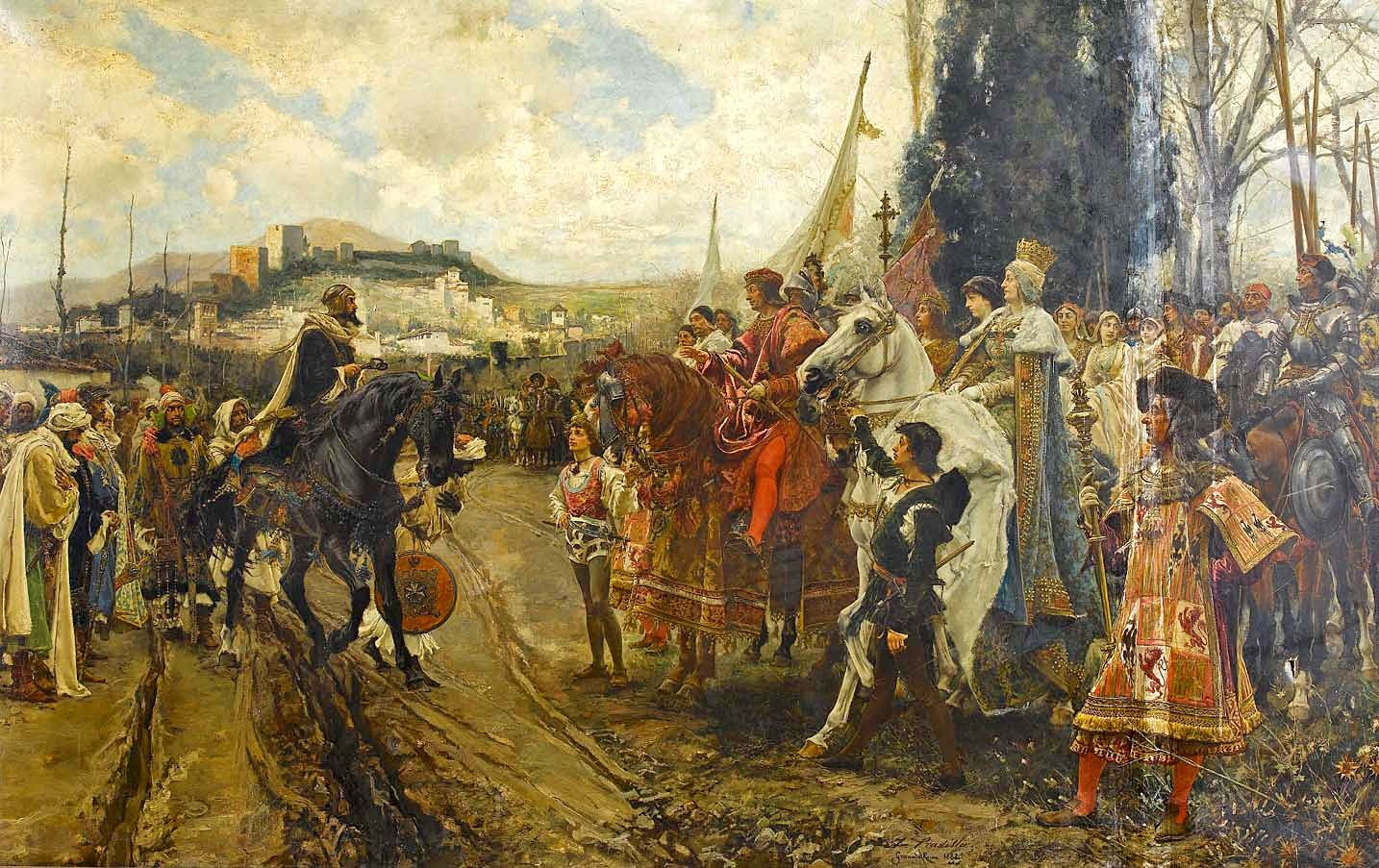
Introduction Background: Muslim Presence in Spain The Emirate of Granada (1238–1492) The Granada War (1482–1492) The Aftermath The Broader Impact ConclusionFew historical endings carry the weight of what happened on January 2, 1492, in Granada. On that day, Muhammad XII, known in the West as Boabdil, handed the keys of the Alhambra palace to the Catholic Monarchs Ferdinand and Isabella, ending nearly 780 years of Muslim political presence in the Iberian Peninsula. It was the conclusion of a centuries-long process known as the Reconquista — the Christian reconquest of Spain — and one of the most culturally significant events of the medieval world.
Muslim rule in Iberia began in 711 CE when Umayyad forces under Tariq ibn Ziyad crossed from North Africa and, within eight years, brought most of the peninsula under Islamic control. At its height, al-Andalus (the Muslim-ruled territory) was one of the most intellectually advanced societies in the medieval world. The city of Córdoba in the 10th century had a population of around 500,000 and was home to one of the largest libraries in the world, with an estimated 400,000 volumes. Muslim scholars preserved and built upon Greek, Roman, and Persian knowledge in mathematics, astronomy, medicine, and philosophy.
The first serious Christian resistance began almost immediately. Around 722 CE, a small force under the Visigothic nobleman Pelayo defeated a Muslim army at the Battle of Covadonga in the mountains of northern Spain, traditionally dated as the beginning of the Reconquista. From that foothold in the north, Christian kingdoms gradually expanded southward over the following centuries.
By the 11th century, the unified Umayyad Caliphate of Córdoba had fragmented into small rival city-states called taifas. Christian kingdoms in the north — Castile, León, Aragon, Portugal, and Navarre — exploited this division. Toledo fell to Castile in 1085. The great Battle of Las Navas de Tolosa in 1212 was a decisive turning point: a combined Christian army defeated the Almohad forces and broke their power in Spain permanently. By 1248, Ferdinand III of Castile had taken Seville and Córdoba. All that remained of Muslim Spain was the Emirate of Granada in the far south.
Granada survived for over two centuries as the last Muslim state in Iberia, and it did so largely through a combination of geography and political calculation. The emirate was protected on three sides by the Sierra Nevada mountain range and on the fourth by the sea, making direct military assault difficult. Its rulers also paid tribute to Castile, essentially buying continued existence through regular payments.
Under the Nasrid dynasty, Granada became a place of remarkable cultural achievement. The Alhambra palace, built primarily in the 13th and 14th centuries, stands today as one of the finest examples of Islamic architecture anywhere in the world — its intricately carved stucco, geometric tile work, and garden courtyards representing the height of Andalusian art. The city of Granada itself became a refuge for Muslim scholars and artists displaced from territories taken by Christian kingdoms, creating a final concentrated flowering of Andalusian culture.
But the emirate was also chronically unstable politically. The Nasrid sultans faced constant internal rivalry between factions and family members competing for the throne. This internal weakness would prove fatal when the Catholic Monarchs decided to push for final conquest.
The Alhambra — UNESCO World Heritage Site, finest example of Islamic architecture in Europe.
The Granada War began in 1482 when a Granadan force seized the Castilian town of Zahara. Ferdinand and Isabella, who had unified their kingdoms through their marriage in 1469, responded with a systematic military campaign unlike anything seen in the Reconquista before.
Rather than a single decisive battle, the ten-year war was fought as a series of careful seasonal campaigns, launched in spring, broken off in winter, in which the Catholic Monarchs methodically captured fortress towns one by one. They used artillery extensively and effectively — cannon fire allowed them to reduce fortifications that would otherwise have required months of traditional siege operations. Towns that might have held out for a year fell in days.
The Granadans were crippled by internal civil war. Boabdil, supported by Castile, fought against his own father Abu al-Hasan Ali and later his uncle Muhammad al-Zagal for control of the emirate. Ferdinand and Isabella exploited this division skillfully, supporting whichever claimant weakened the emirate most. By the late 1480s, al-Zagal had surrendered the eastern half of the emirate to Castile in 1489, leaving Boabdil with only the city of Granada itself.
In April 1491, the largest Christian army ever assembled in the Reconquista — estimates range up to 80,000 soldiers — began the final siege of Granada. Ferdinand and Isabella established a permanent camp outside the city walls, which they built into the town of Santa Fe. The message was clear: they were not leaving.
Granada could not be relieved. Boabdil sent appeals to Muslim rulers across North Africa and the Middle East. None responded with military assistance. After eight months, as food supplies ran low and internal disorder grew, Boabdil negotiated terms. The Treaty of Granada, signed November 25, 1491, promised the Muslim population freedom to practice their religion, keep their customs and language, and retain their property. On January 2, 1492, Boabdil formally surrendered the city.
As Boabdil rode out, he reportedly paused on a mountain pass to look back at the Alhambra one last time and wept. That spot became known as el último suspiro del Moro — the last sigh of the Moor.
The treaty's generous terms lasted approximately seven years. In 1499, Cardinal Cisneros, the queen's confessor, arrived in Granada and launched a program of forced mass conversions. When Muslims rebelled in 1500–1501, the Crown declared that the rebellion had released them from their treaty obligations. All Muslims in Granada were given a choice: convert to Christianity, leave, or face enslavement.
By 1502, Muslims in Castile had been formally expelled or forced to convert. Those who converted became known as Moriscos ("New Christians"), but they remained under constant suspicion of practicing Islam in secret. The Spanish Inquisition, established in 1478, scrutinized them relentlessly.
In 1609, King Philip III issued the final expulsion decree. Between 1609 and 1614, approximately 300,000 Moriscos were expelled from Spain. Some historians estimate the total number of Muslims who left or were driven from Spain between 1492 and 1614 at around three million.
After the fall of Granada, the Jewish community faced the same fate. On July 30, 1492, just six months after Boabdil's surrender, the Alhambra Decree expelled all Jews who refused to convert to Christianity. Approximately 200,000 Jews were expelled. Columbus, who received royal approval for his Atlantic voyage the same year, was reportedly an eyewitness to both events.
The fall of Granada in 1492 was not simply a military victory. It reshaped Spain's identity and launched its global empire. With the peninsula unified under Catholic rule, the monarchy could redirect resources outward. Columbus sailed in August 1492. Within decades, Spain had conquered the Aztec and Inca empires and become the dominant power in Europe.
The cultural loss was significant. Over a million volumes of Muslim learning were reportedly burned in the public square of Granada after the conquest. The libraries, schools, and intellectual institutions of al-Andalus — which had for centuries transmitted Greek philosophy, Arabic mathematics, and astronomical knowledge to Europe — were destroyed.
The architectural legacy survived. The Alhambra, the Great Mosque of Córdoba (converted into a cathedral), and the Giralda tower of Seville remain today as monuments to the civilization that was ended in 1492.
The fall of Granada closed a chapter in European history that had been opening since 711. For nearly eight centuries, Islamic civilization had been a part of Iberian life, at times coexisting with Christian and Jewish communities, at times at war with them. The end of Muslim rule in 1492 brought that period to a close through military force, political maneuvering, and ultimately cultural erasure. What remained was a Spain that would go on to build one of the largest empires in world history, shaped, in ways it rarely acknowledged, by the eight centuries of Andalusian influence that preceded it.