

On this page:
Introduction Why Spain Expanded to the Americas The Conquest of Mexico (1519–1521) The Conquest of Peru (1532–1551) How Were These Conquests Possible? The Impact ConclusionIn 1519, Hernán Cortés landed on the coast of Mexico with approximately 600 men, 16 horses, and a handful of cannon. Three years later, the Aztec Empire, one of the most powerful and organized states in the Americas, was gone. In 1532, Francisco Pizarro arrived in Peru with 180 men and 37 horses. Within two years, the Inca Empire, stretching over 4,000 kilometers along the Andes, had been decapitated. These two conquests were among the most rapid and consequential military operations in history, and understanding why they succeeded requires looking at more than Spanish military technology.
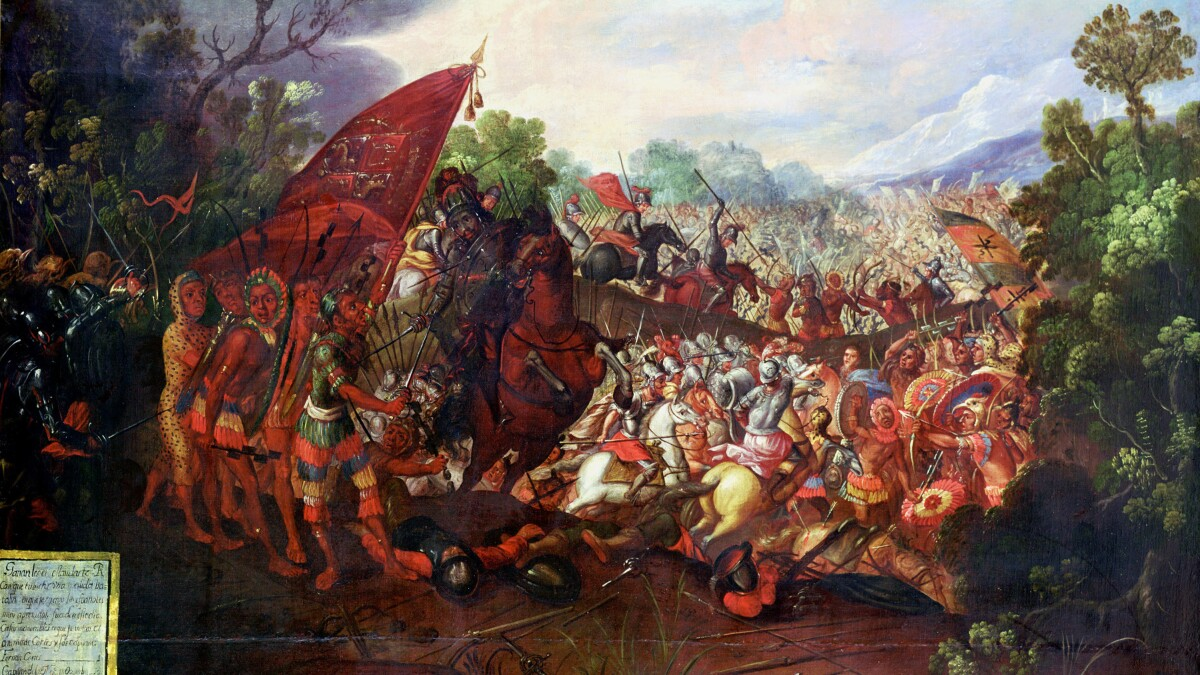
The Spanish conquest of the Americas was not accidental. After Columbus's voyages beginning in 1492, Spain established Caribbean island colonies — Hispaniola, Cuba, Puerto Rico — that became bases for further exploration. The conquest of Granada the same year had freed up both military resources and the crusading mentality that justified violent expansion in the name of Christianity. The reconquistadores, men who had fought in the final campaigns against Granada, brought that same combination of religious mission and personal ambition to the New World.
Three forces drove individual conquistadors:
Cortés set out from Cuba in February 1519, defying orders from the Cuban governor Diego Velázquez who tried to recall him. He established a base at Veracruz on the coast, deliberately burning his ships to prevent any retreat, and marched inland.
The Aztec Empire, ruled by Moctezuma II from the capital Tenochtitlán, was one of the most developed states in the Americas. Tenochtitlán, built on an island in Lake Texcoco at what is now Mexico City, had an estimated population of 200,000 to 300,000, larger than any city in Spain at the time. The empire extracted heavy tribute from dozens of subject peoples across central Mexico.
Those subject peoples were Cortés's most important strategic asset. He formed an alliance with the Tlaxcalans, a powerful independent people who resented Aztec domination, and with other groups who saw the Spanish as potential liberators. This gave Cortés not a force of 600 but an army that grew to thousands of indigenous warriors by the time he reached Tenochtitlán.
Cortés entered the Aztec capital in November 1519 and was initially received by Moctezuma. Within weeks, he had taken Moctezuma hostage. In June 1520, while Cortés was away dealing with a Spanish force sent to arrest him, his lieutenant Pedro de Alvarado massacred Aztec nobles during a religious festival. The Aztecs rose in revolt. Moctezuma died — accounts differ on whether killed by the Aztecs or the Spanish — and the Spanish were driven out of the city in the retreat known as the Noche Triste (Night of Sorrows) on June 30, 1520. An estimated 600 Spanish soldiers and thousands of their indigenous allies were killed.
Cortés regrouped, built a small fleet of ships on the lake, and launched a systematic siege of Tenochtitlán in May 1521. The 85-day siege cut off all food and fresh water. Smallpox, introduced by the Spanish, swept through the city, killing thousands including the new Aztec leader Cuitláhuac. By August 13, 1521, Tenochtitlán fell. The last Aztec emperor Cuauhtémoc was captured and later executed. The city was destroyed. Mexico became the Viceroyalty of New Spain in 1535.
Pizarro had heard rumors of a wealthy civilization to the south of Panama for years. After two failed expeditions, he received royal authorization in 1529 and arrived in northern Peru in late 1531 with 180 men and 37 horses. His timing, like Cortés's, was fortunate — the Inca Empire was in the middle of a devastating civil war.
The Inca Empire — Tawantinsuyu, or the "Four Quarters of the World" — was the largest state in pre-Columbian America, stretching from modern Ecuador to central Chile, with a population estimated at 6 to 14 million. It was governed through an efficient system of roads (over 40,000 kilometers of roads linking the empire), relay runners, and storehouses stocked with food and supplies.
The civil war had been triggered when Emperor Huayna Capac died, probably of smallpox introduced through the Caribbean, around 1527. His two sons, Atahualpa and Huáscar, went to war for succession. Atahualpa defeated and captured Huáscar just months before Pizarro arrived.
At Cajamarca in November 1532, Pizarro arranged a meeting with Atahualpa. The Inca emperor arrived with an estimated 5,000 to 6,000 attendants, largely unarmed, not anticipating violence. Pizarro had positioned his small force — cavalry and infantry — around the square, hidden. A Spanish friar presented Atahualpa with a Bible and demanded he accept Christianity and the authority of the Spanish Crown. Atahualpa, unable to read and unimpressed, dropped the Bible. The Spanish charged.
In less than two hours, the Inca escort was routed. Atahualpa, despite being surrounded by his entire court, was captured. An estimated 2,000 Inca were killed. Not a single Spaniard died.
Atahualpa offered a massive ransom: to fill a room 7 meters long and 5 meters wide with gold up to a height of 2.5 meters, and fill it twice more with silver. The ransom was paid: approximately 6,000 kg of gold and 12,000 kg of silver. Then Pizarro had Atahualpa strangled in July 1533. He marched on the Inca capital Cuzco, entering it in November 1533.
Inca resistance continued for decades. The last Inca stronghold, at Vilcabamba in the Amazon lowlands, held out until 1572, when the last ruler Túpac Amaru was captured and executed. Full Spanish control over Peru was not complete until approximately 1551 within the standard historical framing, though resistance continued beyond this date.
Three factors combined to make rapid Spanish conquest possible.
Human consequences: Indigenous populations that numbered in the tens of millions before 1492 had collapsed to a few million within a century. The encomienda system, which granted conquistadors the right to indigenous labor, replaced existing social structures with brutal exploitation.
Economic consequences: The silver mines of Potosí in Peru, discovered in 1545, produced enormous quantities of silver that funded Spanish military power across Europe for the next century. Between 1503 and 1660, Spain imported an estimated 181 tonnes of gold and 16,000 tonnes of silver from the Americas.
Cultural consequences: The conquests destroyed civilizations. Aztec and Inca temples were demolished and churches built on their foundations. Indigenous languages, religions, and knowledge systems were systematically suppressed. At the same time, the encounters produced new hybrid cultures — mestizo societies that blended Spanish, indigenous, and later African elements — which define Latin America today.
The Spanish conquest of Mexico and Peru between 1519 and 1551 was made possible by a combination of factors that went far beyond military superiority. Disease, political division, and timing created the conditions that small Spanish forces exploited. The results reshaped the Americas permanently, ending two of the most sophisticated civilizations of the pre-modern world and establishing a colonial system whose economic and cultural legacy endures today.