

On this page:
Introduction Early Life and the Road to the Throne Preparing for Crusade The Third Crusade (1189–1192) Captivity and Ransom Final Years and Death ConclusionRichard I is one of the most celebrated military figures in medieval European history. Known as Cœur de Lion, the Lionheart, he spent almost his entire ten-year reign as King of England (1189–1199) either on crusade, in captivity, or fighting wars in France. He spent less than six months of his reign actually in England. That fact alone tells you something important about who Richard was: not a king in the administrative sense, but a military commander who happened to wear a crown. His life was defined by war, and his reputation, both in his own time and in the centuries since, rests almost entirely on how he fought it.
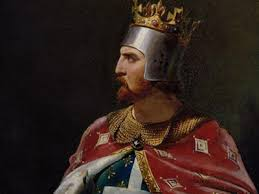
Richard was born on September 8, 1157, in Oxford, the third son of King Henry II of England and Eleanor of Aquitaine. As a younger son, he was not initially the heir to the English throne. Instead, from age 11, he was invested as Duke of Aquitaine, his mother's inheritance in southwestern France, and it was here that he learned the craft of warfare. Aquitaine was a rebellious duchy, and Richard spent his teens and twenties suppressing baronial revolts and learning how to control a fractious nobility through a combination of military force and political skill.
He was knighted at age 15 by Louis VII of France and first saw serious military action in his own duchy by age 16. By the time he was in his early twenties, his reputation as a soldier was already established.
Richard's path to the English throne was paved by the deaths of his older brothers — Henry the Young King died in 1183, Geoffrey of Brittany in 1186 — and by a series of rebellions against his father. In 1173–74, Richard joined his brothers and mother in a rebellion against Henry II, which failed. In 1188–89, he allied with Philip II of France against his father again. Henry II, facing military defeat and betrayal by his sons, died in July 1189, humiliated. Richard became King of England on September 3, 1189.
Richard's first act as king was to raise funds for a crusade. Jerusalem had fallen to Saladin, Sultan of Egypt and Syria, on October 2, 1187. The loss of Jerusalem had shocked Christian Europe, and Pope Gregory VIII called for a new crusade. Richard was determined to lead it.
He raised money aggressively, selling offices, titles, lands, and rights. He reportedly said he would sell London itself if he could find a buyer. By 1190 he had assembled a formidable fleet and army. He departed England in December 1189, met the French king Philip II at Vezelay in July 1190, and sailed for the Holy Land.
On the way, a storm drove some of his ships onto Cyprus, where the local ruler Isaac Komnenos seized the survivors, including Richard's fiancée Berengaria of Navarre and his sister Joan. Richard responded by conquering the entire island of Cyprus in under three weeks (May 1191). This proved to be the most strategically significant outcome of the entire Third Crusade. Cyprus became a permanent Western base in the eastern Mediterranean and would remain under Christian control for centuries.
When Richard arrived at Acre in June 1191, the crusading army had already been besieging the city for two years. His arrival, with his fleet, his resources, and his personal energy, transformed the situation. Acre fell on July 12, 1191.
What followed became one of the most controversial moments of Richard's career. After Saladin failed to meet the terms agreed for the ransom of the Acre garrison, Richard ordered the execution of approximately 2,700 Muslim prisoners on August 20, 1191. The act was brutal and calculated — he could not afford to leave a large prisoner population requiring food and guards as he marched south along the coast.
That march south toward Jerusalem was a masterpiece of military discipline. Richard kept his army in tight formation along the coast, with the fleet supplying them from the sea. Saladin's forces harassed them constantly, but Richard imposed strict orders: no soldier was to break formation to engage.
The test came at the Battle of Arsuf. Saladin launched a full assault with the aim of breaking the crusader column. Richard held his forces in formation until the precise moment, then launched a coordinated cavalry charge. The Ayyubid forces were routed. It was one of the clearest demonstrations of Richard's tactical ability.
The crusaders took Jaffa and pushed inland toward Jerusalem. Twice, Richard's army came within 12 miles of the city. Twice, Richard decided not to attack — a decision that modern historians largely agree was correct militarily. He concluded he could take Jerusalem but could not hold it with the forces he had, given that Philip II had already left for France and Richard's own support was unreliable.
In July 1192, Saladin recaptured Jaffa. Richard responded with one of his most celebrated personal feats, sailing to Jaffa with a small force and retaking the port almost single-handedly while his men were still disembarking. Contemporary accounts describe him fighting on the beach in only chain mail, without full armor, holding back Saladin's forces until his troops could organize.
On September 2, 1192, Richard and Saladin signed the Treaty of Jaffa. It recognized Muslim control over Jerusalem but guaranteed unarmed Christian pilgrims access to the city. The crusaders retained a coastal strip from Jaffa north to Tyre. It was not the victory Richard had sought, but it was a realistic settlement that preserved a Christian presence in the Holy Land.
Richard left Palestine on October 9, 1192. On his way home, he was shipwrecked near Venice and attempted to cross Europe in disguise. He was recognized and captured by Leopold V, Duke of Austria, whom he had publicly humiliated at Acre by throwing down his banner. Leopold handed him over to the Holy Roman Emperor Henry VI, who held him for ransom.
The ransom demanded was 150,000 marks of silver — roughly twice the annual income of the English crown. The English people paid it. Richard was released in February 1194. He returned to England briefly, his second visit in ten years, then spent the rest of his life fighting Philip II of France to recover the territories Philip had seized while Richard was imprisoned.
Between 1194 and 1199, Richard fought an effective campaign against Philip II and was genuinely regaining ground. He built the formidable Château Gaillard on the Seine in Normandy in 1196–98, a fortress so well designed it was considered virtually impregnable, and it held as long as Richard was alive.
Richard's death in 1199 came not in a great battle but in a minor siege. In March 1199, he was besieging the small castle of Châlus-Chabrol in the Limousin region of France. On March 26, he was hit in the shoulder by a crossbow bolt while walking outside the walls without full armor. The wound turned gangrenous. Richard died on April 6, 1199, at the age of 41, in his mother Eleanor's arms.
According to accounts, the crossbowman who shot him was a young man whose father and brothers Richard had killed. Richard, as a final gesture, pardoned him. The young man was executed by Richard's mercenary captain immediately after the king died.
Richard was, by the standards of military leadership, genuinely skilled. He understood terrain, logistics, troop discipline, and timing. His conduct of the march to Arsuf and his rapid recovery of Jaffa are studied as examples of medieval tactical excellence. He was personally brave to a degree that bordered on recklessness.
But in his own time and for centuries after, it was the warrior that people remembered. He is still represented in statue on horseback outside the Houses of Parliament in London, the enduring image of the medieval crusader king.