

Born around 1162 near Lake Baikal on the Mongolian steppe, Temujin, later known as Genghis Khan, started life with almost nothing. His father was poisoned by rival Tatars when Temujin was around nine years old. His family was abandoned by their clan and left to survive alone on the harsh steppe. He was captured and enslaved as a young man. These early experiences shaped a leader who understood survival, betrayal, and power in deeply personal terms. By the time he died in 1227, he had built the largest contiguous empire in history, stretching from the Pacific Ocean to the Caspian Sea, covering over 24 million square kilometers.
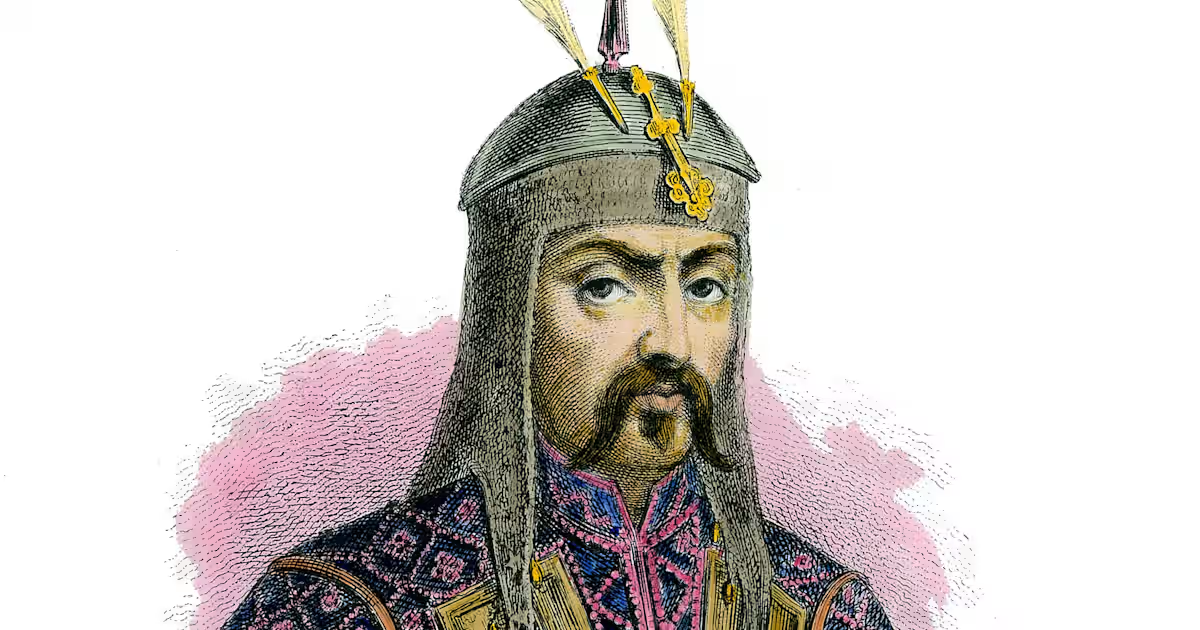
The Mongolian steppe in the late 12th century was a world of constant conflict between rival nomadic tribes — Mongols, Tatars, Merkits, Naimans, and Keraites — who raided each other, formed shifting alliances, and fought for dominance over grazing land and trade routes. Temujin spent his early years building alliances strategically, often through marriages and blood-brother bonds with key figures. His most important early alliance was with Toghrul Khan of the Keraites, who became a powerful patron.
Over two decades of fighting, Temujin defeated each rival tribe in turn, first the Merkits who had kidnapped his wife Börte, then the Tatars, then the Naimans and Keraites. He did not simply conquer these tribes — he reorganized them. Defeated peoples were absorbed into his forces, their old tribal identities dissolved, and their warriors reorganized into his military structure.
By 1206, Temujin had unified all the Mongol and Turkic tribes of Mongolia. At a great assembly called a khuriltai held on the banks of the Onon River, he was proclaimed Genghis Khan, meaning "Universal Ruler." He was approximately 44 years old.
What made the Mongol army under Genghis Khan so effective was not simply numbers but organization, discipline, and adaptability. He built his military on a decimal system:
Decimal System:
10 (arban) → 100 (zuun) → 1,000 (minghaan) → 10,000 (tumen)
Every man from the lowest soldier to the highest commander operated within this structure. Loyalty was to the unit and to Genghis personally, not to tribal or family identity — a radical break from traditional steppe warfare.
Before any campaign, the Mongols gathered intelligence systematically. They interviewed merchants, travelers, and diplomats to map out the political divisions, defensive weaknesses, and economic resources of their targets. They understood their enemies before they fought them.
Genghis began his external campaigns with the Western Xia dynasty, a Tangut kingdom to the southwest of Mongolia. He forced their submission in 1209, extracting tribute and forcing them to provide military support. He then turned to the much larger Jin Dynasty in northern China in 1211, beginning a 23-year war. The Jin had ruled northern China since the early 12th century and had long extracted tribute from the Mongol tribes. Genghis raided deep into Jin territory, but the full conquest was only completed by his son Ögedei in 1234.
The campaign against the Khwarazmian Empire, covering modern Iran, Central Asia, and Afghanistan, began in 1219 and was one of the most devastating of Genghis Khan's career. It was triggered by the execution of a Mongol trade mission. The Shah of Khwarezm had the approximately 450 merchants in the caravan killed and the Mongol ambassador beheaded. Genghis responded with an army of around 200,000 men.
The campaign was merciless. Samarkand, one of the great cities of the Islamic world and a major center of scholarship and trade, fell in 1220. Urgench was taken, and each Mongol soldier, in an army of approximately 20,000, was reportedly ordered to execute 24 people. The Khwarazmian state was destroyed so completely that some of its cities and agricultural systems never recovered.
Two of his best generals, Subutai and Jebe, were sent with 20,000 men to pursue the Shah westward. They swept through the Caucasus, into Georgia and Armenia, defeated a combined Russian-Cuman force at the Battle of the Kalka River in 1223, and returned to Mongolia having completed a reconnaissance of Europe that would prove useful to Genghis's successors.
Genghis Khan launched his final campaign against the Western Xia in 1226–27, angry at their refusal to provide troops for the Khwarazmian campaign. He was thrown from a horse during a hunting expedition in winter 1226 and suffered internal injuries. He pressed on despite worsening health. He died on August 18, 1227, before the Western Xia capital fell. His death was kept secret — the supply trains continued, the campaign continued, and the city was taken and its population destroyed after his death.
The exact cause of his death remains uncertain. Possible causes include the injuries from the fall, typhus, or bubonic plague.
By the time of his death, the Mongol Empire under Genghis Khan covered territory twice the size of the Roman Empire at its height. He had conquered more land than any person in history.
"He came from nothing and built the largest land empire the world has ever seen through a combination of organizational genius, tactical brilliance, and ruthless application of force."
Genghis Khan remains one of the most consequential military leaders in history. He came from nothing and built the largest land empire the world has ever seen through a combination of organizational genius, tactical brilliance, and ruthless application of force. He was not simply a conqueror — he was an institution builder who created systems that outlasted him.
His legacy is a complicated one: a man who connected civilizations and enabled centuries of trade and cultural exchange, and who also presided over some of the most destructive campaigns in recorded human history.