

On this page:
Introduction The System Being Challenged: Jim Crow Brown v. Board of Education (1954) Montgomery Bus Boycott (1955–1956) Sit-ins and the Freedom Rides (1960–1961) Birmingham and the March on Washington (1963) Civil Rights Act of 1964 and Voting Rights Act of 1965 The Methods That Made the Movement ConclusionBy 1954, the United States had been a democracy for nearly two centuries. It had fought a Civil War to end slavery, amended its Constitution to guarantee equal citizenship, and presented itself to the world as the leader of the free world against Soviet communism. And yet, millions of its own Black citizens lived under a system of racial segregation enforced by law and violence — barred from the same schools, buses, restaurants, courtrooms, and voting booths as white Americans. The Civil Rights Movement of 1954 to 1965 was the organized campaign to force the country to live up to its own founding promises.
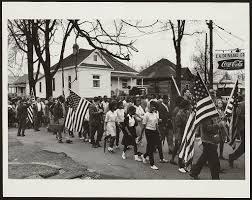
The legal framework the movement fought against was known as Jim Crow, a system of state and local laws across the American South that mandated racial segregation in virtually every area of public life. Schools, hospitals, buses, restaurants, drinking fountains, swimming pools, courtrooms, and cemeteries were all segregated. Black Americans were systematically denied the right to vote through poll taxes, literacy tests administered selectively, and outright violence and intimidation.
This system had legal backing from the Supreme Court's 1896 ruling in Plessy v. Ferguson, which declared "separate but equal" facilities constitutional. In practice, facilities for Black Americans were never equal — they were chronically underfunded, inferior, and deliberately demeaning.
Black Americans who challenged this system faced severe consequences. Emmett Till, a 14-year-old boy from Chicago, was kidnapped, tortured, and murdered in Mississippi in August 1955 after allegedly whistling at a white woman in a shop. His mother insisted on an open casket funeral so the world could see what had been done to her son. Tens of thousands attended or viewed photographs. His murderers were acquitted by an all-white jury in just over an hour.
The legal challenge to segregation began long before 1954, driven by the NAACP's Legal Defense Fund under chief attorney Thurgood Marshall. For decades, the NAACP had been building a strategic litigation campaign to dismantle Plessy v. Ferguson piece by piece.
On May 17, 1954, the Supreme Court ruled unanimously in Brown v. Board of Education of Topeka that racial segregation in public schools was unconstitutional. Chief Justice Earl Warren wrote that "separate educational facilities are inherently unequal." The ruling directly overturned Plessy and was one of the most significant judicial decisions in American history.
Southern states reacted with fierce resistance. In February 1956, 101 Southern members of Congress signed the "Southern Manifesto" pledging resistance to integration by all lawful means. When the Little Rock, Arkansas, school board attempted to integrate Central High School in September 1957, Arkansas Governor Orval Faubus ordered the National Guard to block nine Black students from entering. President Eisenhower was forced to send 1,200 US Army paratroopers to escort the Little Rock Nine into school and protect them for the rest of the year.
On December 1, 1955, Rosa Parks, secretary of the Montgomery, Alabama chapter of the NAACP, refused to give up her seat on a city bus to a white passenger and was arrested. The Montgomery Women's Political Council, led by Jo Ann Robinson, had been planning exactly this kind of action. That night, Robinson and others mimeographed 52,500 leaflets calling for a bus boycott.
The boycott began December 5, 1955. 90 percent of Montgomery's Black population, who made up the majority of bus riders, participated. A 26-year-old minister named Martin Luther King Jr. was elected president of the Montgomery Improvement Association to lead it. The boycott lasted 381 days, putting severe economic pressure on the bus system and downtown businesses.
On November 14, 1956, the Supreme Court ruled that segregated bus seating was unconstitutional. The boycott ended in victory on December 21, 1956, when Montgomery's buses were desegregated. More importantly, it demonstrated that mass nonviolent direct action could produce real results — and it made King a national figure.
The success of Montgomery led to the formation of the Southern Christian Leadership Conference (SCLC) in January 1957, with King as its first president. The SCLC became the primary organizational vehicle for nonviolent civil rights campaigns across the South.
On February 1, 1960, four Black college students — Ezell Blair Jr., Franklin McCain, Joseph McNeil, and David Richmond — sat down at a whites-only lunch counter at a Woolworth's store in Greensboro, North Carolina, and asked to be served. They were refused but stayed until closing. The following day, more students joined them. Within two weeks, sit-ins had spread to 54 cities across nine states.
The student-led movement organized into the Student Nonviolent Coordinating Committee (SNCC) in April 1960. SNCC became the frontline organization of the younger, more activist generation of the movement.
In May 1961, integrated groups of activists — Freedom Riders — boarded interstate buses to challenge segregation in bus terminals across the Deep South, testing a Supreme Court ruling that had banned segregation in interstate travel facilities. In Alabama, their buses were firebombed. Riders were beaten savagely by mobs while local police stood by. The violence received international television coverage, deeply embarrassing the Kennedy administration, which ultimately pressured the Interstate Commerce Commission to enforce desegregation of bus terminals by November 1961.
In April 1963, King and the SCLC launched a major campaign in Birmingham, Alabama, one of the most aggressively segregated cities in America. Bull Connor, the city's Commissioner of Public Safety, responded to peaceful marchers with fire hoses and police dogs. Television cameras captured the images and broadcast them nationally and internationally. President Kennedy, watching on television, reportedly said the footage made him sick.
On May 10, 1963, Birmingham's business leaders agreed to desegregate lunch counters and hire Black workers in stores — a direct victory for the campaign.
On August 28, 1963, the March on Washington brought approximately 250,000 people to the National Mall, the largest political demonstration in American history to that point. It was here that King delivered his "I Have a Dream" speech, one of the most celebrated addresses in American political history. The march applied direct public pressure on Congress to pass civil rights legislation.
The assassination of President Kennedy on November 22, 1963 brought Lyndon B. Johnson to the presidency. Johnson, a Southern politician with deep knowledge of Congress, used the national grief and his own legislative skill to push through the landmark Civil Rights Act of 1964, signed on July 2, 1964. It banned discrimination based on race, color, religion, sex, or national origin in public facilities and employment, and established the Equal Employment Opportunity Commission to enforce it.
But the Act had a gap: it did not fully address the methods used to deny Black Americans the right to vote. That brought the movement to Selma, Alabama.
On March 7, 1965, later called "Bloody Sunday," approximately 600 marchers led by 25-year-old John Lewis attempted to cross the Edmund Pettus Bridge in Selma on their way to Montgomery to demand voting rights. State troopers and local police attacked them with clubs and tear gas on national television. The images shocked the nation.
President Johnson addressed a joint session of Congress on March 15, invoking the movement's own words: "We shall overcome." The Voting Rights Act of 1965, signed on August 6, 1965, prohibited discriminatory voting practices and authorized federal oversight of elections in states with histories of discrimination. Rosa Parks stood beside President Johnson as he signed it.
The Civil Rights Movement between 1954 and 1965 forced the most powerful democracy in the world to confront the gap between its ideals and its reality. Through disciplined nonviolent protest, legal challenge, and economic pressure, ordinary people compelled extraordinary legislative change. The Civil Rights Act of 1964 and the Voting Rights Act of 1965 were genuine achievements — won at enormous personal cost by people who risked their jobs, their freedom, and their lives. The movement did not end racial inequality in America. But it ended the legal framework that had enforced it for nearly a century.